
Should a 70 year old do squats?

Should a 70 year old do squats?
I've watched dozens of 70-year-olds walk into showrooms with this exact question. Most expect me to say no. Instead, I ask them to sit down in a chair and stand back up. That movement is a squat. The real question isn't whether they should squat—it's which equipment helps them squat safely.
Yes, a 70-year-old can do squats, but the right approach depends on selecting equipment that matches their current mobility, balance, and joint health. The squat movement itself isn't the risk—choosing equipment that demands more capability than someone currently has is the risk.1 From TRX straps to Smith machines, equipment progression exists specifically to make squatting accessible at any age.
Most people stop here because they think "squat" only means one thing. It doesn't. When I help clients select equipment, I'm really helping them find the version of squatting that works for their body today. Let me walk you through how that selection process works.
What type of squat is safest for a 70 year old?
The word "safest" trips people up. Safety isn't about avoiding movement—it's about matching movement demands to current capability. When a 70-year-old client asks me this, I need to understand three things first: their balance confidence, their joint range of motion, and whether they've trained before.2
The safest squat type provides external support that fills the gap between what the person can control and what the movement demands. For someone with good balance, this might be a Smith machine that guides the bar path. For someone rebuilding confidence, this might be a seated leg press or TRX straps that allow assisted bodyweight squats. Safety comes from appropriate equipment selection, not from avoiding the movement.
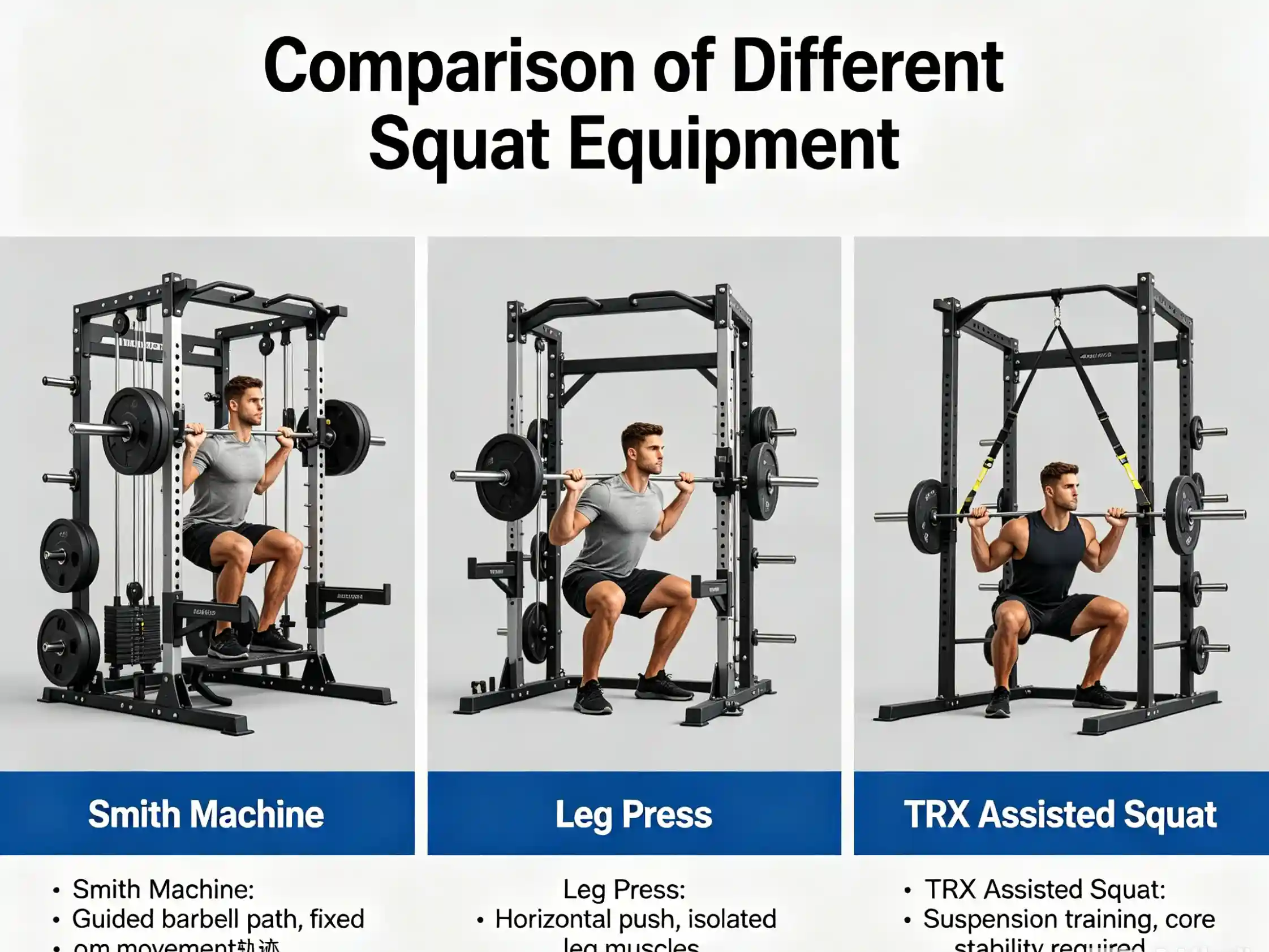
Here's what I've learned from configuring equipment for clients in this age group. The decision tree looks like this:
Equipment selection based on capability assessment
| Current Capability | Recommended Starting Equipment | Why This Match Works |
|---|---|---|
| Can stand from chair unassisted, good balance | Smith Machine or Squat Rack with safety bars | Provides guided path but allows natural movement pattern |
| Can stand from chair but balance is uncertain | TRX Suspension Straps or Assisted Squat Machine | Hands provide continuous stability support throughout movement |
| Needs armrests to stand from chair | Seated Leg Press or Recumbent Leg Press | Removes balance demand entirely while maintaining leg strengthening |
| Limited knee range of motion | Box Squat Setup or Adjustable Height Bench | Controls depth to comfortable range, builds confidence at safe endpoint |
The breakdown isn't about age. I've worked with 70-year-olds who start with free squats and 50-year-olds who need TRX assistance. The pattern I see repeatedly is this: people who've stayed active respond well to Smith machines because they have body awareness but appreciate the safety of a guided path3. People who are returning to exercise after years away do better with seated machines because they need to rebuild strength before adding balance demands.4
One thing surprises most clients. They assume lighter equipment means safer. That's backwards. A wobbly setup creates more risk than a stable machine with appropriate weight. When I configure a home setup for someone in this age group, I prioritize stability of the equipment itself over minimizing load. A solid Smith machine with 10 pounds loaded is safer than a shaky squat stand with no weight.
The depth question comes up constantly. People worry about how low they should go. I tell them the equipment should allow them to stop wherever they need to stop. That's why box squats work well—the box height is adjustable. That's why Smith machines have safety catches. The equipment should accommodate the person's range, not force them into a preset range.
Can squatting help prevent falls in elderly adults?
This question comes from family members more than from the 70-year-olds themselves. The adult children are worried about their parent falling at home. They've heard that leg strength matters. They want to know if buying squat equipment makes sense as fall prevention.
Squatting builds the exact movement pattern needed to sit down and stand up safely—the same movement that fails when people fall.5 Equipment that allows regular, controlled practice of this pattern helps maintain the strength and coordination needed for daily chair transfers.6 The fall prevention benefit comes from maintaining functional movement capability, not from achieving athletic performance.7
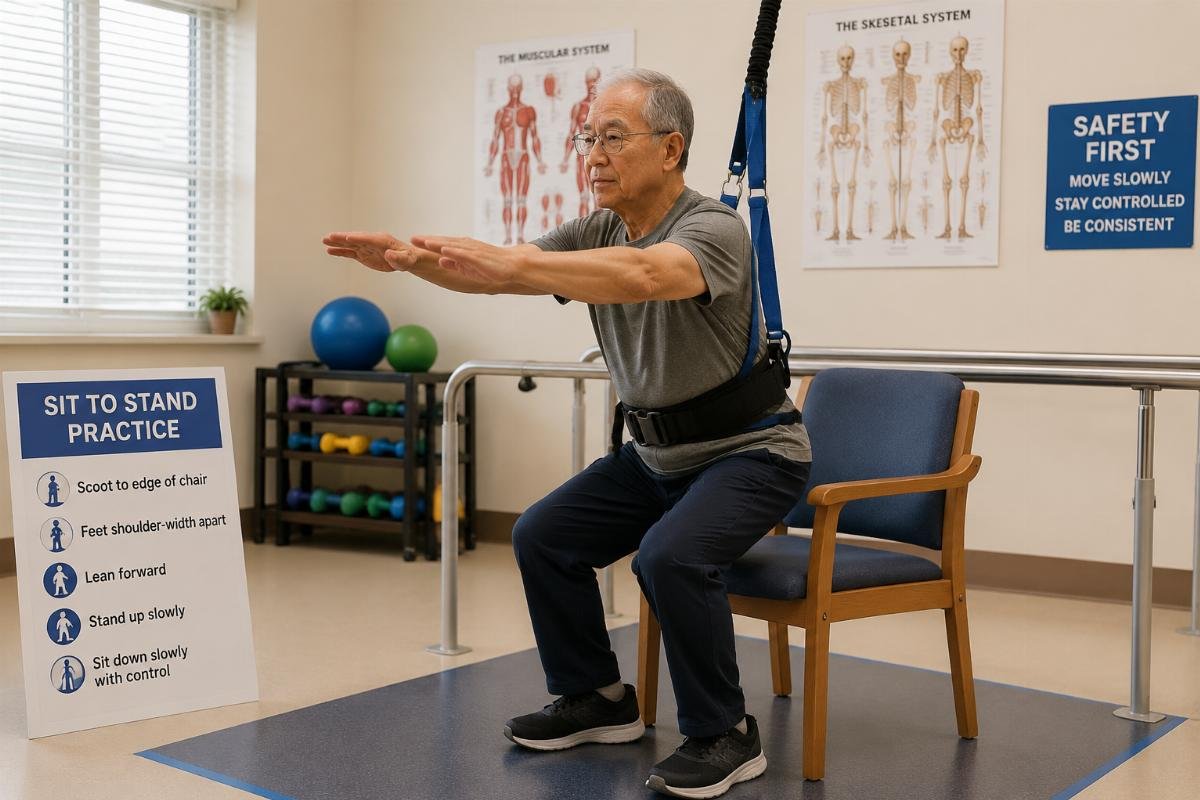
I need to be clear about what I'm saying here. I'm not making medical claims. I'm describing what happens when someone practices a movement regularly with appropriate equipment. The sit-to-stand movement is a squat. When clients tell me they feel more confident getting out of low chairs after practicing with equipment, that makes sense to me. They're training the exact movement they need in daily life.
How equipment choice affects movement practice
The connection between equipment and fall prevention isn't obvious until you break it down. Different equipment teaches different aspects of the movement:
Assisted squat equipment (TRX, suspension trainers)
- Allows hands to provide light support throughout movement
- Builds confidence in the bottom position where people feel most unstable
- Can be adjusted for difficulty by changing hand position or body angle
- Mimics real-world scenarios where people steady themselves on furniture
Guided squat equipment (Smith machine, hack squat)
- Removes front-to-back balance demand
- Allows focus on the up-down strength component
- Provides consistent safety catches at adjustable heights
- Builds strength without adding balance complexity
Seated squat equipment (leg press, recumbent machines)
- Isolates leg strength from balance entirely
- Allows progressive loading without fall risk during exercise
- Works well for initial strength building phase
- Can be starting point before progressing to standing equipment
I've noticed a pattern with clients who start with seated equipment and progress to standing equipment over months. They report feeling steadier on their feet generally.8 I can't prove cause and effect there—too many variables in someone's life. But the logic makes sense. They're getting stronger in a movement pattern their body uses every day.
The timing question matters too. Some clients ask whether they should start squatting after they've already had a fall. That's a medical question I can't answer. What I can say is this: when someone is cleared by their doctor to exercise and comes to select equipment, I prioritize stability features heavily if they mention previous falls. Safety catches, guided paths, seated options—anything that removes the risk of equipment failure or loss of control during the exercise itself.
What equipment modifications make squats accessible for seniors?
This is where my actual expertise lives. I've configured hundreds of setups for clients who thought squatting was impossible for them. The modifications aren't complicated. They're just not obvious if you only know barbell squatting.
Equipment modifications that make squatting accessible include adjustable depth stops, hand support attachments, guided bar paths, reduced starting weights, and seated alternatives. Each modification removes one barrier to entry—balance demand, depth control, weight handling, or stability concern. The goal is to find the combination that allows the person to perform the movement pattern safely within their current capabilities.
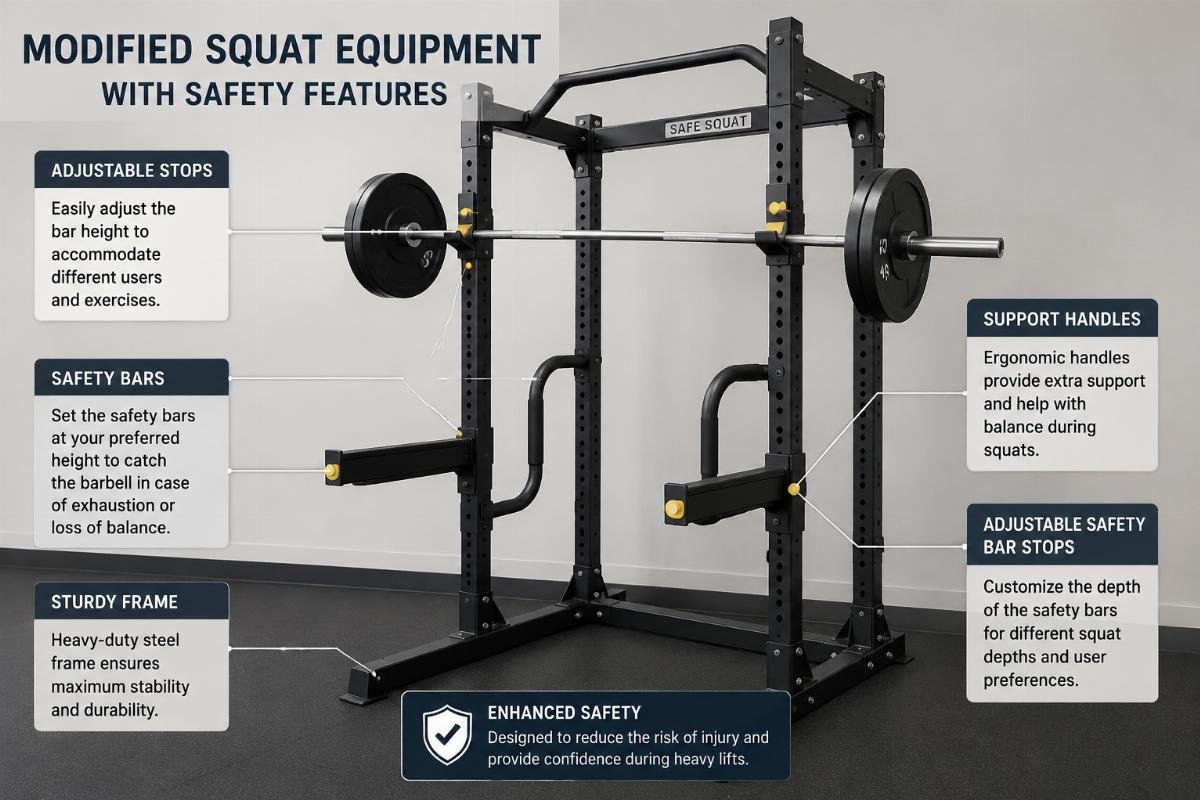
Let me break down the specific modifications I recommend most often:
Depth control modifications
| Modification | Equipment Example | What It Solves |
|---|---|---|
| Adjustable box/bench | Squat box set, adjustable aerobic step | Provides reliable depth stop, prevents going too low |
| Safety pins at custom height | Power rack with safety bars | Creates catch point at safe depth for individual |
| Preset depth stops | Some Smith machines, leg press machines | Built-in depth limiting for consistent practice |
The depth issue is bigger than people think. When I ask new clients to show me a bodyweight squat, most go either too shallow (not enough range to build strength) or too deep (lose control at bottom, can't stand back up smoothly). Equipment that controls depth removes the guesswork. The person can focus on the movement itself instead of worrying about whether they're going too far.
Balance support modifications
Handles change everything. I've watched 70-year-olds who refused to try squatting attempt it immediately when I add TRX straps they can hold. The psychological shift is instant. They go from "I can't do this" to "let me try." The physical benefit is real too—light support from hands allows the movement to happen while the legs build strength.
The modifications I see work best:
Fixed handle attachments
- Mounted on squat racks at multiple heights
- Allow hands to rest lightly without gripping hard
- Provide emergency catch if balance fails
- Build confidence for eventual unassisted movement
Suspension trainer systems
- Adjustable length for different body heights
- Allow variable assistance throughout movement
- Can be used at home with door mount
- Easy to progress by holding lower on straps
Machine-integrated handles
- Built into some assisted squat machines
- Provide consistent support position
- Often include weight assistance systems
- Remove setup complexity
Weight progression modifications
Starting weight matters more than people realize. A standard Olympic barbell weighs 45 pounds.9 That's too heavy for many 70-year-olds to hold in squat position.10 I've seen clients struggle with the bar weight itself, not the squatting movement. The modifications here are simple:
- Lighter training bars: 15-pound or 25-pound bars that fit standard equipment
- Smith machine starting points: Bar weight is supported by machine, can start with just 5-10 pounds added
- Preset weight stack machines: Allow starting with 10-20 pound selections
- Bodyweight-only options: TRX, assisted squat machines with no added weight
The progression path isn't linear. Someone might start with TRX-assisted bodyweight squats, move to Smith machine with light weight, then potentially to free squats if they want that progression. Or they might stay with Smith machine and just add weight over time. The equipment choice determines which progression paths are available.
I tell clients something important here: the equipment you start with doesn't have to be the equipment you use forever. Some people worry that choosing assisted or guided equipment means admitting defeat. That's wrong. Equipment selection is about finding what works now. What works six months from now might be different equipment. That's good. That's progression.
What should 70 year olds know before starting squats?
The questions I hear right before someone decides to buy equipment or join a facility reveal their real concerns. They're not worried about technique details. They're worried about looking foolish, getting hurt on day one, or wasting money on something they can't actually use.
Before starting, 70-year-olds need to know three things: squatting looks different for every person regardless of age, the equipment should fit current capability rather than aspirational goals, and starting conservatively with room to progress beats starting aggressively and stopping due to discomfort. The first workout should be almost too easy—that's the sign of appropriate equipment selection.11
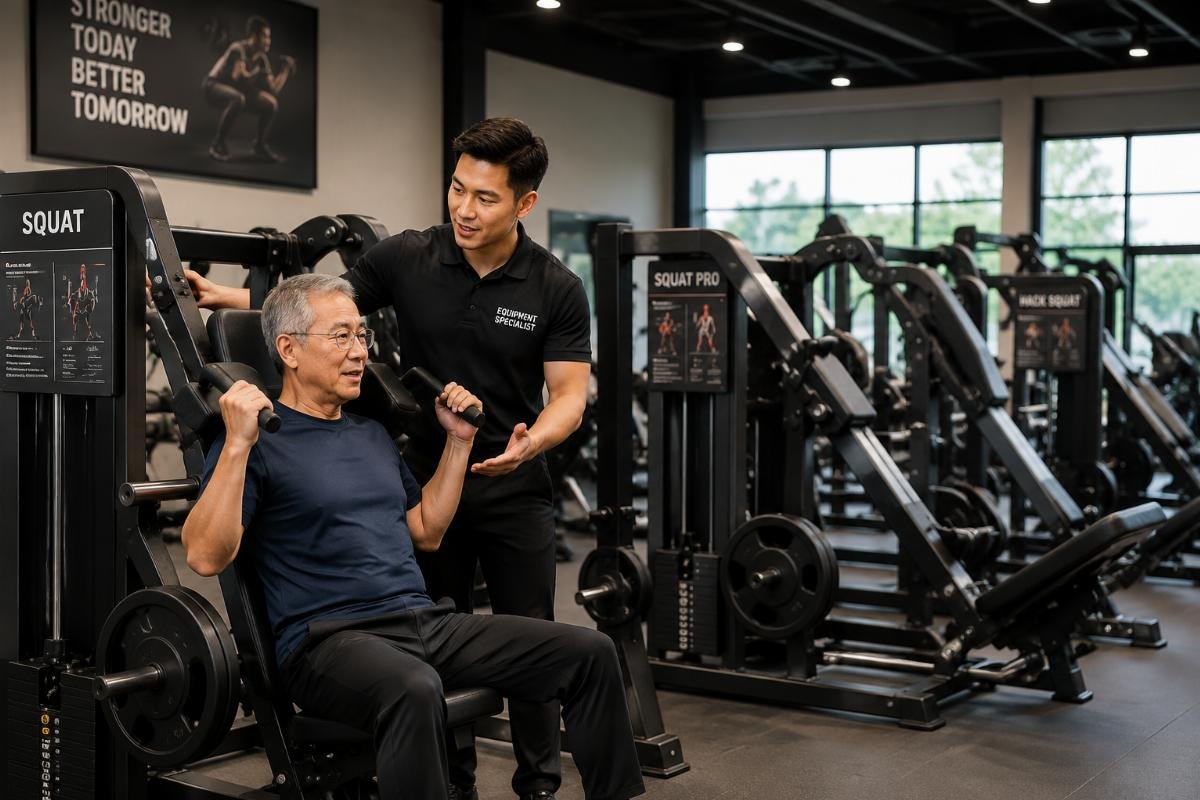
I wish I could just hand someone the perfect starting point. The reality is more complicated. When someone comes to our showroom and asks where to start, I need them to try equipment. Not just look at it—actually perform a few repetitions on different machines. The feedback is immediate. They feel which equipment supports them properly.
Pre-start checklist from equipment perspective
Here's what I go through with every 70+ client:
Equipment stability test
- Can you get in and out of the equipment safely?
- Does anything wobble or feel unstable?
- Can you reach safety features while in position?
- Is the equipment height appropriate for your body?
Support level assessment
- Can you complete the movement with current support level?
- Do you feel secure throughout the full range?
- Are you gripping handles desperately or resting lightly?
- Can you control the descent and ascent portions?
Range of motion check
- Where does discomfort start in the downward movement?
- Can the equipment stop before that point?
- Is the natural stopping point too shallow to be useful?
- Does the bottom position feel stable or precarious?
Load appropriateness
- If using weight: does it feel manageable or are you grinding through reps?
- If bodyweight only: can you complete 8-10 repetitions?
- Does the difficulty level allow focus on movement quality?
- Is there room to progress to slightly more challenging load?
The pattern I see with successful equipment selections: the person feels slightly underwhelmed on day one. They expected it to be harder. That's exactly right. Equipment that challenges someone to their limit on the first attempt leaves no room for error, no room for off days, no buffer for the learning process.
I tell clients they should finish the first session thinking "I could have done more." That's different from doing more. The goal is finding equipment that allows controlled practice of the movement pattern. Athletic achievement isn't the goal here. Maintaining functional movement is the goal.
One more thing that matters: having an exit strategy from the equipment. I've seen people get stuck in the bottom of a squat on equipment that didn't have proper safety catches.12 That experience ends their squatting career immediately. The equipment must allow safe failure. If the person can't complete a repetition, the equipment should catch them safely. This means safety bars, adjustable catches, or machine-based support. Never free squats without proper safety equipment for someone just starting in this age group.
Conclusion
Squatting at 70 isn't about age—it's about matching equipment to capability. The movement matters for daily function. The equipment makes the movement accessible. Start with what supports you now. Progress when ready. The right equipment turns "should I squat?" into "which squat equipment works for me?"
"Guidance about age‐friendly outdoor exercise equipment and ...", https://pmc.ncbi.nlm.nih.gov/articles/PMC8359243/. Research on exercise safety in older populations indicates that equipment selection and exercise modification are key factors in injury prevention, with inappropriate equipment demands contributing to adverse events during resistance training. Evidence role: expert_consensus; source type: research. Supports: that equipment appropriateness affects injury risk in older adult exercise. Scope note: This supports the general principle of equipment matching rather than specifically comparing equipment risk to movement risk. ↩
"Medical Clearance of Older Adults Participating in ... - PMC", https://pmc.ncbi.nlm.nih.gov/articles/PMC10072195/. Clinical guidelines for exercise prescription in older adults emphasize assessment of balance, joint mobility, and previous physical activity as foundational elements in determining appropriate exercise interventions. Evidence role: expert_consensus; source type: institution. Supports: that balance, range of motion, and exercise history are relevant assessment factors for older adults. Scope note: Guidelines address general assessment principles rather than specifically validating this three-factor framework for squat selection. ↩
"Effect of free-weight vs. machine-based strength training on maximal ...", https://pmc.ncbi.nlm.nih.gov/articles/PMC10426227/. Biomechanical research on Smith machines demonstrates that the fixed bar path reduces balance and stabilization requirements compared to free weights while maintaining primary muscle activation, potentially offering a middle ground between machine-based and free-weight training. Evidence role: general_support; source type: research. Supports: that Smith machines provide guided movement with reduced stability demands. Scope note: Research characterizes Smith machine mechanics rather than specifically validating differential responses based on prior activity levels or body awareness. ↩
"RECOMMENDATIONS - WHO Guidelines on Physical Activity and ...", https://www.ncbi.nlm.nih.gov/books/NBK566046/. Exercise programming research supports progressive approaches that initially isolate strength development before adding balance challenges for deconditioned older adults, allowing neuromuscular adaptation and confidence building in controlled environments before advancing to more complex movement demands. Evidence role: expert_consensus; source type: research. Supports: that progressive exercise programming separating strength and balance demands is appropriate for deconditioned older adults. ↩
"A Biomechanical Review of the Squat Exercise - PMC - NIH", https://pmc.ncbi.nlm.nih.gov/articles/PMC10987311/. Biomechanical analyses demonstrate that the sit-to-stand transfer and squat exercise involve similar joint angles, muscle activation patterns, and movement phases, making squat training mechanistically relevant to functional chair transfers. Evidence role: mechanism; source type: research. Supports: that squat and sit-to-stand movements share biomechanical characteristics. ↩
"A Systematic Review and Meta-Analysis of Resistance Training on ...", https://pubmed.ncbi.nlm.nih.gov/35968662/. Systematic reviews of resistance training interventions in older adults show improvements in functional tasks including chair rise performance, with training specificity influencing the magnitude of transfer to daily activities. Evidence role: general_support; source type: research. Supports: that resistance training improves functional performance in older adults. Scope note: Evidence supports general functional benefits of resistance training rather than specifically validating equipment-based squat practice for chair transfer maintenance. ↩
"Mechanism-Driven Strategies for Reducing Fall Risk in the Elderly", https://pmc.ncbi.nlm.nih.gov/articles/PMC11641686/. Fall prevention research identifies functional lower extremity strength and movement control as key modifiable risk factors, with exercise interventions targeting functional capacity showing greater fall reduction than programs emphasizing maximal strength or athletic performance. Evidence role: expert_consensus; source type: research. Supports: that functional movement capacity relates to fall prevention in older adults. ↩
"Balance Confidence Improves with Resistance or Agility training", https://pmc.ncbi.nlm.nih.gov/articles/PMC3383061/. Studies examining resistance training outcomes in older adults report improvements in both objective balance measures and subjective balance confidence, with participants frequently describing enhanced feelings of stability and security during daily activities following training interventions. Evidence role: general_support; source type: research. Supports: that resistance training can improve perceived balance and stability in older adults. Scope note: Research documents general patterns of perceived improvement rather than specifically validating reports from progressive squat equipment training. ↩
"Barbell - Wikipedia", https://en.wikipedia.org/wiki/Barbell. International Weightlifting Federation standards specify that men's Olympic barbells weigh 20 kilograms (44 pounds), with the commonly cited 45-pound figure representing the rounded imperial equivalent used in many commercial gym settings. Evidence role: definition; source type: institution. Supports: the standard weight of Olympic barbells. Scope note: The exact weight is 44 pounds (20kg) rather than 45 pounds, though 45 pounds is the conventional approximation in US contexts. ↩
"Age-related normative values for handgrip strength and grip ... - PMC", https://pmc.ncbi.nlm.nih.gov/articles/PMC5383770/. Normative strength data indicate substantial age-related declines in upper body and core strength, with many adults over 70 demonstrating maximal lifting capacities below typical barbell weights, particularly among those without recent resistance training experience. Evidence role: statistic; source type: research. Supports: that strength capacity declines with age, affecting load-bearing ability. Scope note: Data addresses general age-related strength decline rather than specifically validating that 45 pounds exceeds capacity for 'many' 70-year-olds. ↩
"Progressive resistance strength training for improving physical ...", https://pmc.ncbi.nlm.nih.gov/articles/PMC4324332/. Exercise prescription guidelines for older adults emphasize starting with conservative intensities to allow for adaptation, skill acquisition, and assessment of individual response, with gradual progression based on tolerance and performance. Evidence role: expert_consensus; source type: institution. Supports: that conservative initial exercise intensity is recommended for older adults. ↩
"Preventing injuries in the gym | BCM - Baylor College of Medicine", https://www.bcm.edu/news/preventing-injuries-in-the-gym. Equipment safety standards for resistance training emphasize the importance of safety catches, adjustable stops, and fail-safe mechanisms to prevent user entrapment or injury when unable to complete a lift, particularly for exercises performed in mechanically disadvantaged positions. Evidence role: general_support; source type: institution. Supports: that safety features are important in resistance training equipment. Scope note: Standards address general safety feature requirements rather than specifically documenting incidents of users becoming stuck without safety catches. ↩

EQUIP YOUR
From CrossFit boxes to chain facilities -- BICKFIT engineers, manufactures and delivers heavy-duty commercial strength equipment worldwide.
JOIN THE DISCUSSION