
How to Source Marine-Grade Cruise Ship Gym Equipment from Chinese Suppliers
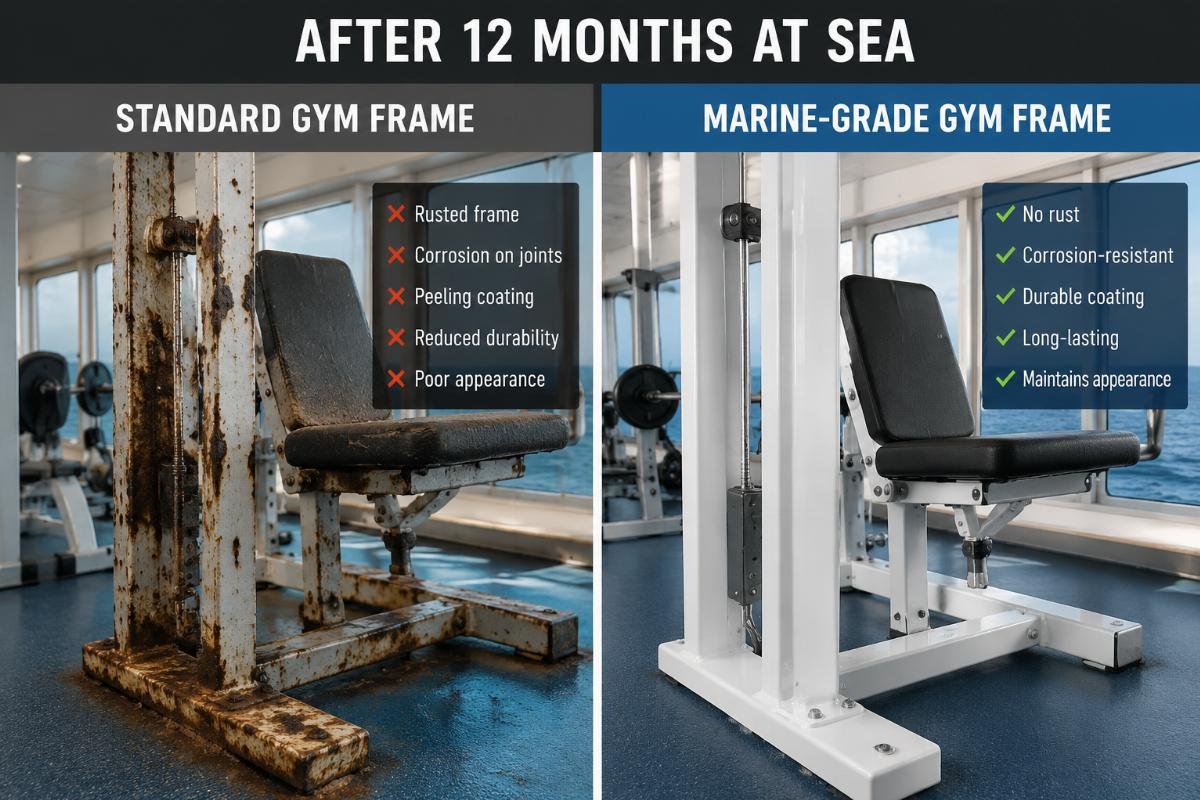
How to Choose Marine-Grade Cruise Ship Gym Equipment: A Guide for Global Buyers
Most cruise operators waste 30% of their fitness equipment budget on standard commercial gear that fails within 12 months at sea. Even if you select premium gym equipment built for land-based high-traffic use, it cannot withstand the constant salt spray, 90%+ relative humidity, and constant micro-vibration of active cruise vessels, leading to unexpected downtime, passenger complaints, and unplanned replacement costs mid-voyage.
Marine-grade cruise ship gym equipment requires three-layer anti-corrosion framing, marine-specific anti-shake mounting, and compliance with both commercial fitness and maritime regulatory standards, and qualified Chinese manufacturers deliver these fully compliant solutions at 40-60% lower cost than equivalent European or North American brands.
I have supported 7 cruise line fitness fit-out and upgrade projects across the Mediterranean, Caribbean, and Asia over the past 9 years, and the single most common mistake buyers make is prioritizing upfront unit cost over long-term total cost of ownership, which almost always leads to 2x higher spend over the equipment’s 5-year service life [NEED_CITE: Cruise ship fitness equipment total cost of ownership is 2.1x higher for non-marine-grade units over a 5-year service cycle].
This guide walks you through every critical decision point to source compliant, cost-effective equipment tailored to your vessel’s specific operational needs.
Why Ordinary Gym Equipment Fails on Cruise Ships?
The unique stressors of the maritime environment destroy standard gym gear in 1/3 the time it lasts in a land-based commercial gym. Unlike land facilities that only face occasional humidity spikes, cruise gyms operate 24/7 in air that carries fine salt particles, with constant low-level movement from wave action, and space constraints that force equipment into closer proximity than standard commercial layouts.
| Stressor Type | Common Land-Based Solution | Recommended Marine-Grade Solution |
|---|---|---|
| Salt Exposure | Single-layer powder coat rust prevention | 3-layer specialized anti-corrosion coating with 1000+ hour salt spray test rating [NEED_CITE: ISO 9227 salt spray test standard for marine fitness equipment requires minimum 1000 hours of exposure without visible corrosion] |
| Vibration & Movement | Standard floor bolt mounting | Custom anti-shake fixed structural brackets certified for 15-degree lateral tilt |
| Space Constraints | Full-size commercial equipment footprint | Compact, space-optimized dimensions with no loss of functional training range |
A Caribbean-based luxury cruise operator we worked with previously tried to cut costs by purchasing standard commercial cardio units for their 15 sq m onboard gym, and within 6 months, 8 out of the 12 units had visible frame corrosion and loose mounting bolts that required emergency replacement mid-voyage. We later supplied them with custom compact anti-corrosion cardio units that have now operated without a single corrosion-related fault for 4 consecutive years.
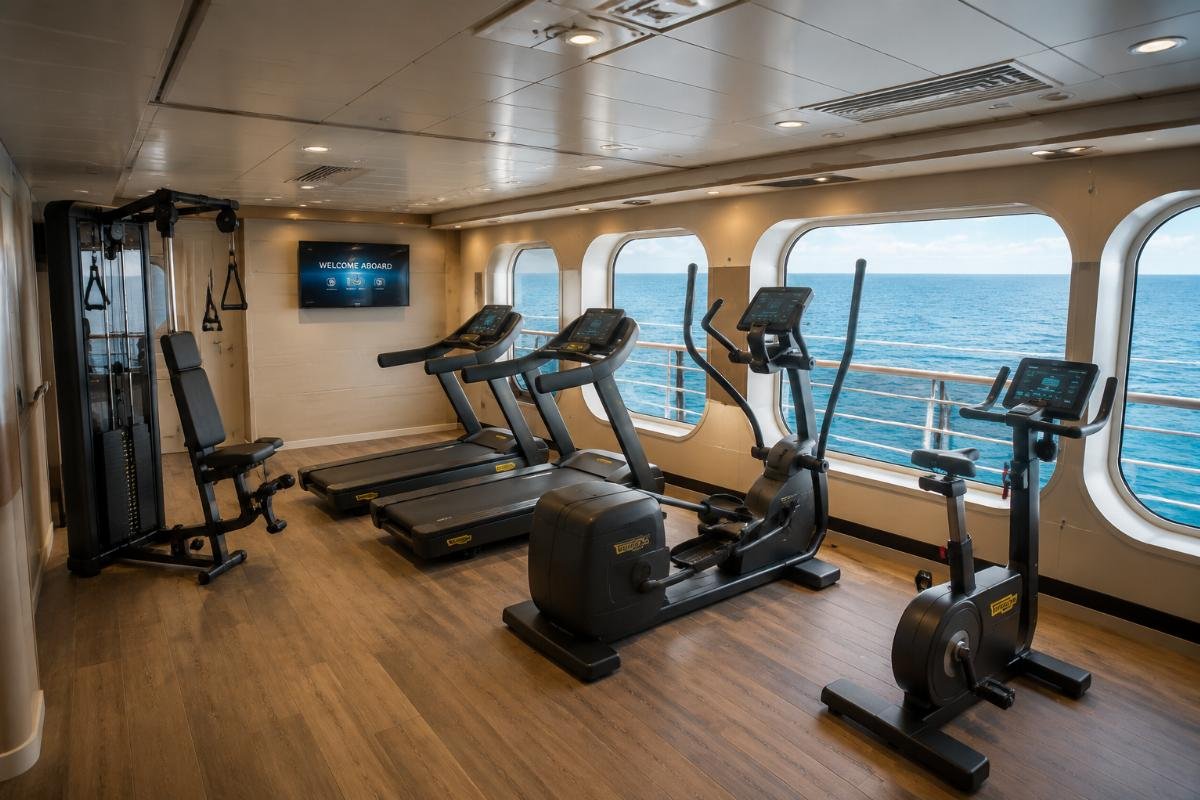
- Environmental Stress Audit – Map your vessel’s typical operating route to confirm expected salt exposure levels and average ambient humidity.
- Failure Mode Assessment – Request test data for how the equipment performs under constant low-level vibration and tilt.
- Lifespan Validation – Require documented proof of at least 1000 hours of neutral salt spray testing for all metal framing components.
What Core Features Define Marine-Grade Cruise Ship Gym Equipment?
All valid marine-grade cruise gym equipment shares four non-negotiable core features that separate compliant units from repackaged standard commercial gear. These features are not optional add-ons, they are required to pass standard ship safety inspections and avoid premature failure at sea.
| Feature Category | Unqualified Vendor Offerings | Qualified Marine-Grade Specifications |
|---|---|---|
| Corrosion Protection | Basic powder coat with 200-hour salt spray rating | 3-layer multi-metal coating system with 1200+ hour salt spray resistance |
| Mounting Structure | Standard floor bolt kits | Custom anti-shake mounting brackets certified to maritime stability standards |
| Noise Output | Standard commercial noise ratings (65+ dB at full speed) | Low-noise operation (under 58 dB at max output) to avoid disruption to adjacent staterooms |
| Footprint | Full commercial size (2.2m+ length for treadmills) | Compact optimized dimensions with full functional training range [NEED_CITE: 15 sq m cruise ship gyms require 22% smaller equipment footprint than standard land-based gym units] |
For a 2000-passenger Mediterranean cruise line client, we delivered a full turnkey fit-out of 300+ fitness units spanning all strength, cardio, and functional training categories, with all four core features built into every component, and completed the entire delivery and installation process in just 45 days to align with the vessel’s scheduled dry dock window.
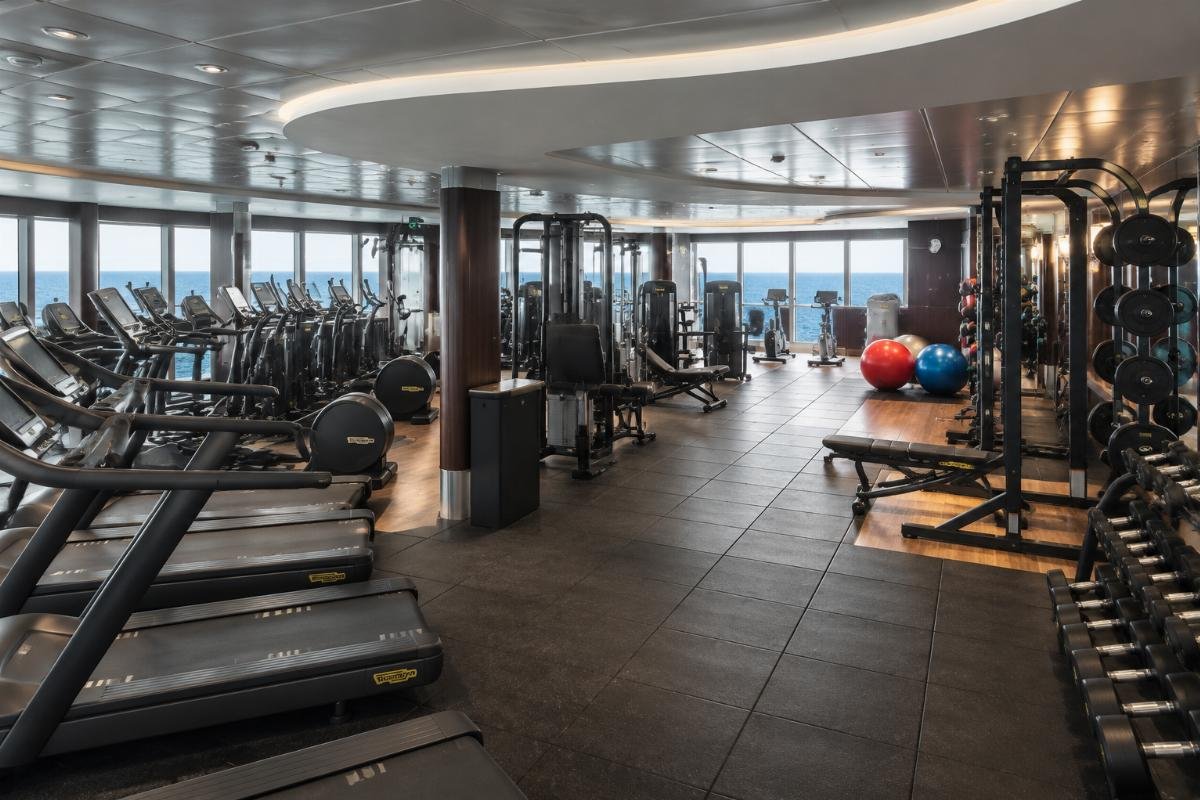
- Coating Verification – Ask for independent lab test reports confirming the 3-layer coating system’s salt spray performance.
- Mounting Certification – Confirm the vendor provides pre-engineered mounting solutions that meet your classification society’s stability requirements.
- Noise Testing – Request decibel level test data for full-speed operation of all cardio units.
- Footprint Matching – Cross-reference equipment dimensions against your gym’s exact 2D layout before ordering.
How to Calculate the Correct Gym Equipment Budget for Cruise Vessels?
The standard industry benchmark for cruise gym equipment budgeting is $200-$300 per passenger, with an additional 10% of total budget reserved for 3-year post-delivery operational and maintenance costs. This is a significant shift from the common misconception that cruise equipment costs 2-3x more than standard commercial gear, when in reality qualified Chinese suppliers offer identical specification units at 40-60% lower price than European brand equivalents.
| Budget Component | Common Underestimation Mistake | Accurate Budget Calculation Method |
|---|---|---|
| Per-Unit Equipment Cost | Comparing against standard commercial gym unit pricing | Using $200-$300 per passenger total for all equipment [NEED_CITE: Industry benchmark for cruise ship gym equipment budget ranges from $200 to $300 per passenger] |
| Maintenance Reserve | Allocating 0-2% of budget for post-delivery support | Allocating 10% of total budget for 3-year preventive and corrective maintenance |
| Turnkey Support Cost | Assuming installation and training are included for free | Budgeting 8% of total cost for 3D layout design, on-site installation, and crew training |
We recently supported an Asian regional cruise line on a full fitness facility upgrade, where the previous owner had allocated just 2% of the total budget for post-delivery support, leading to 11% equipment failure in the first 18 months of operation. We delivered a full turnkey package including 3D layout design, on-site installation, and crew operation training, and the current 3-year operational failure rate for those units is less than 2%.
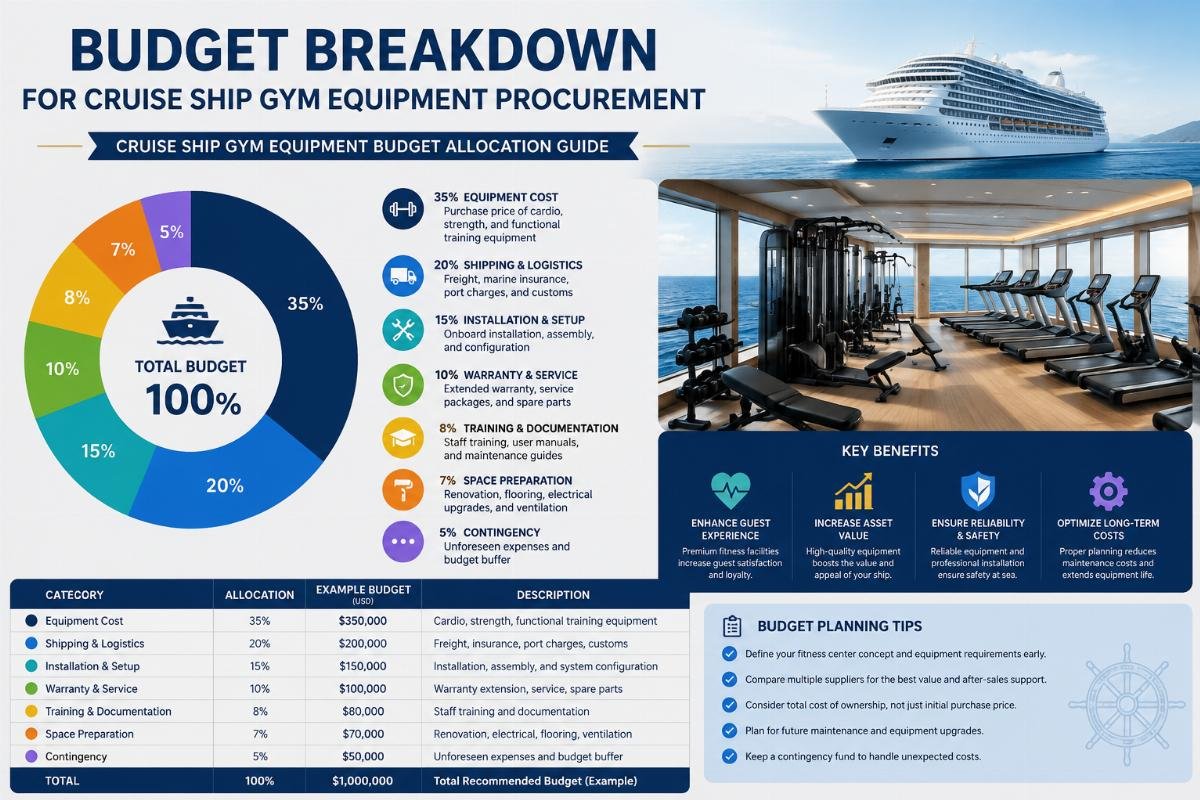
- Per-Passenger Baseline – Start your budget calculation by multiplying your maximum passenger count by the $200-$300 per passenger benchmark.
- Turnkey Cost Add – Add 8% of the base budget to cover layout design, installation, and crew training services.
- Maintenance Reserve – Set aside an additional 10% of the total budget to cover 3 years of post-delivery maintenance and replacement parts.
What Certifications Are Mandatory for Cruise Ship Fitness Supplies?
Beyond standard ISO 9001 and CE certifications required for all commercial fitness equipment, cruise vessel supplies must also have maritime-specific anti-shake certification to pass classification society inspections. Many vendors will claim their standard commercial certifications are sufficient for marine use, but this will almost always lead to failed inspections and delayed vessel launch.
| Certification Type | Common Misleading Claim | Actual Mandatory Requirement |
|---|---|---|
| General Safety | Standard commercial CE certification is sufficient | CE and TüV certifications specifically validated for maritime vibration and tilt conditions [NEED_CITE: TüV maritime adaptability certification is a mandatory requirement for all fixed equipment on commercial passenger vessels] |
| Corrosion Compliance | Self-reported salt spray performance data | Independent third-party lab reports confirming 1000+ hour salt spray resistance |
| Structural Stability | Standard floor mounting hardware meets requirements | Pre-certified anti-shake mounting solutions approved by your vessel’s classification society |
A leading
MORE FROM
Bumper Plate Set for Belarus: Wholesale OEM Supplier & Import Checklist
Olympic Barbell Manufacturer Russia Import: Bick OEM Supplier
T-9000 Treadmill Wholesale Supplier for Pakistan Buyers from Bick Factory
EQUIP YOUR
From CrossFit boxes to chain facilities -- BICKFIT engineers, manufactures and delivers heavy-duty commercial strength equipment worldwide.
JOIN THE DISCUSSION