
China rehabilitation equipment supplier professionalism ranking
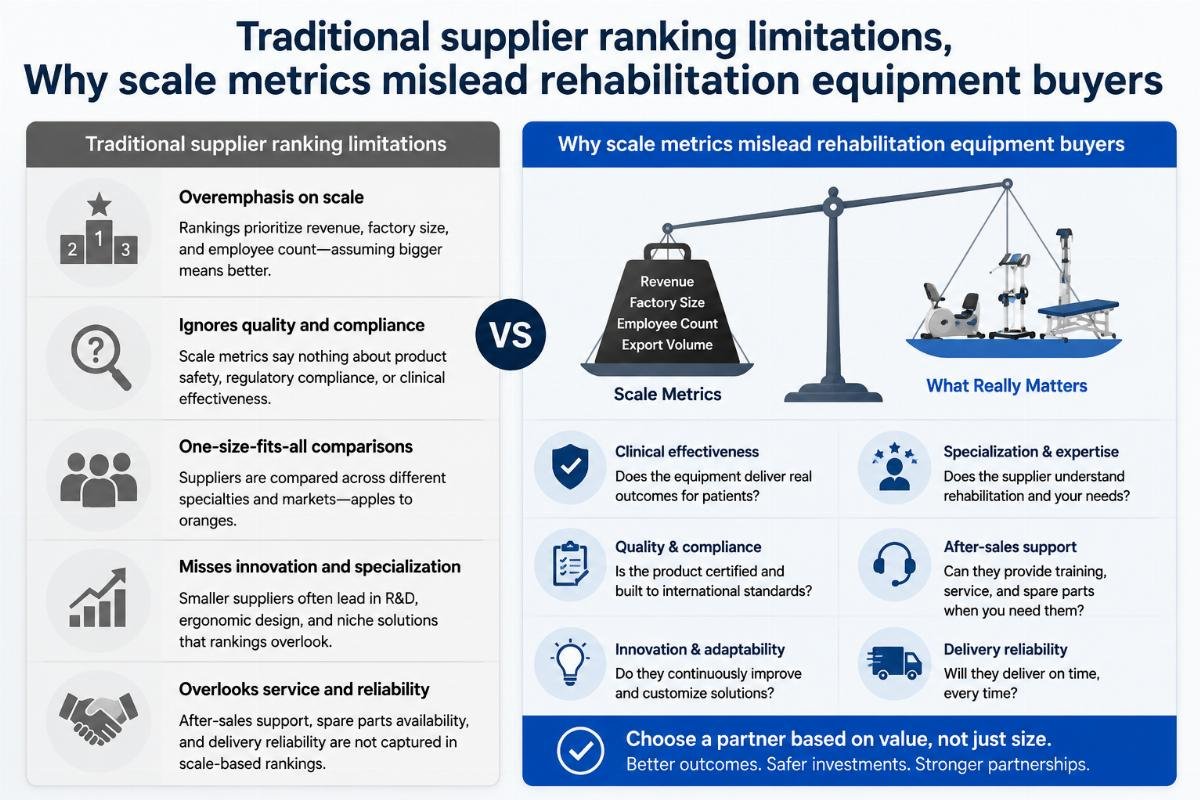
China rehabilitation equipment supplier professionalism ranking: Does this question reveal a procurement risk trap?
When buyers search for "China rehabilitation equipment supplier professionalism ranking," they assume such rankings exist and provide decision clarity. From years of handling procurement inquiries at our manufacturing company, I have seen this mindset create expensive mistakes. The real problem is not finding the right ranking list but understanding what "professionalism" actually means in rehabilitation equipment supply.
No credible third-party organization publishes professionalism rankings for China rehabilitation equipment suppliers1. The search for rankings distracts buyers from the actual task: verifying whether a supplier has genuine rehabilitation equipment expertise or just rebrands cross-industry products. Professional buyers need a capability assessment framework, not a non-existent ranking list that oversimplifies complex supplier differences.
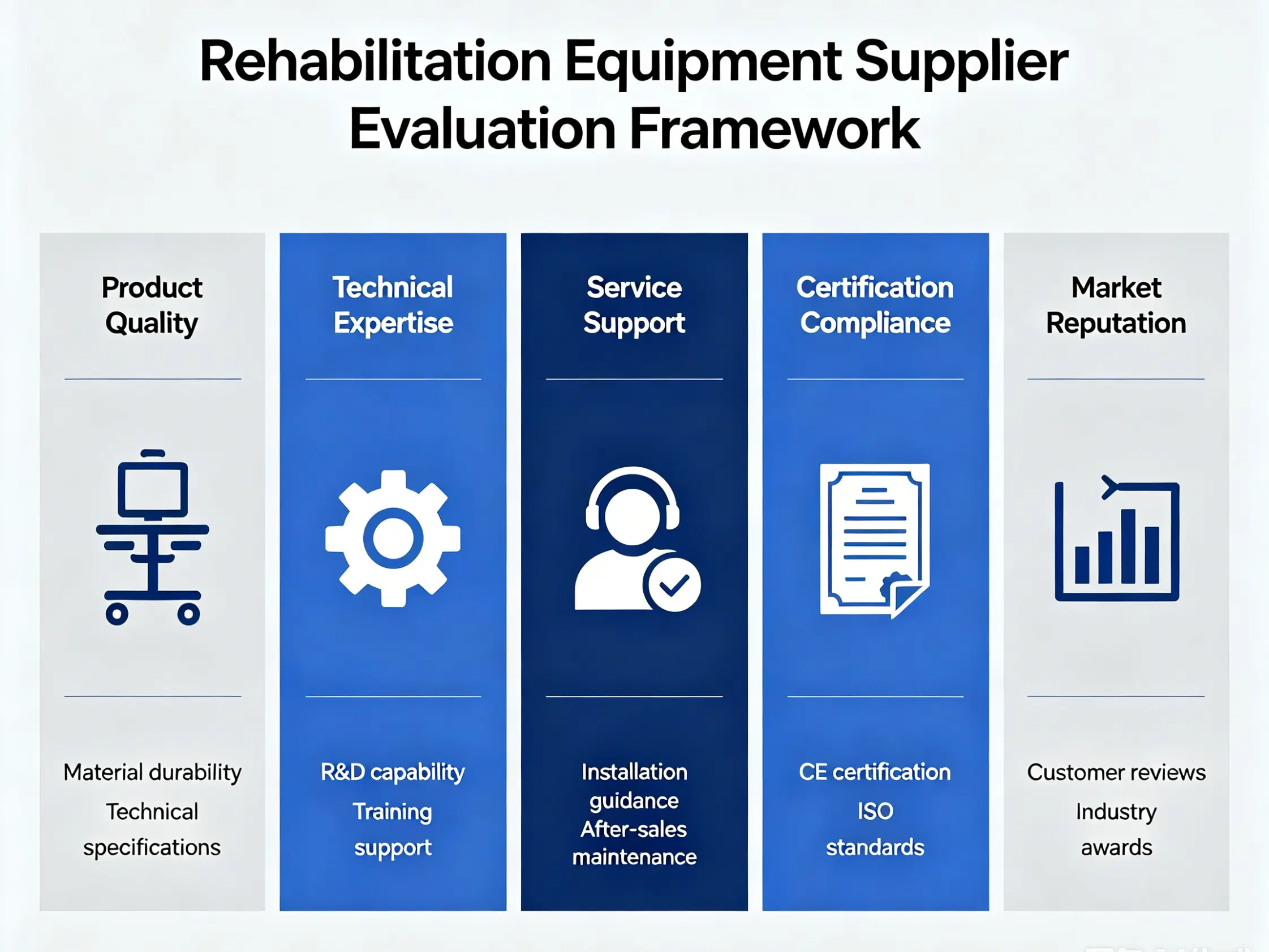
Most procurement managers I have spoken with make two dangerous assumptions. First, they believe a supplier with extensive product catalogs automatically demonstrates expertise. Second, they use factory size metrics like floor area or employee headcount as professionalism indicators. Both assumptions ignore the core difference between rehabilitation-focused manufacturers and general medical equipment distributors who simply add rehabilitation products to their catalogs. Understanding this gap changes how you evaluate suppliers.
Why do traditional ranking criteria fail for rehabilitation equipment suppliers?
Buyers naturally want simple ranking systems to compare suppliers. In procurement conversations I have handled, managers often ask for rankings based on production capacity, company age, or certification quantity. This approach works for commodity products but breaks down completely for specialized rehabilitation equipment.
Traditional rankings fail because they measure scale instead of specialization depth2. A supplier might rank high in factory size or product variety while lacking actual experience in rehabilitation therapy workflows, clinical safety protocols, or post-installation support for rehab centers. Rankings cannot capture whether engineering teams understand rehabilitation use cases versus just manufacturing generic medical devices.
What makes rehabilitation equipment supplier evaluation different from other medical devices?
Rehabilitation equipment operates at the intersection of medical devices, therapeutic protocols, and patient interaction design3. From buyer evaluation challenges I have seen, three factors make simple rankings inadequate:
| Evaluation factor | Why rankings fail | What buyers actually need to verify |
|---|---|---|
| Product application knowledge | Rankings count products, not application expertise | Does the supplier understand clinical rehabilitation workflows, not just device specifications? |
| Safety incident response | Rankings measure certifications, not problem-solving history | Can the supplier explain typical misuse scenarios specific to rehabilitation settings? |
| Post-sale support capability | Rankings focus on installation, not ongoing service | Does the supplier offer application training for therapists and maintenance for clinical environments? |
Traditional medical equipment might need installation and basic operation training. Rehabilitation equipment requires suppliers to understand how therapists use devices across different patient conditions, how equipment fits into treatment plans, and how to prevent safety issues unique to rehabilitation environments. A ranking based on production volume or ISO certifications completely misses these capability dimensions.
How do cross-industry suppliers disguise lack of rehabilitation specialization?
In procurement inquiries I have handled, I noticed a pattern. Some suppliers present impressive catalogs covering orthopedic equipment, physiotherapy devices, diagnostic tools, and rehabilitation products. Buyers see this variety as a strength. The reality often reveals a different story.
Cross-industry suppliers typically source rehabilitation products through OEM arrangements or purchase from specialized manufacturers for resale4. Their engineering teams understand manufacturing processes but lack experience with rehabilitation therapy applications. When buyers ask detailed questions about clinical use cases, post-installation support, or modification for specific patient populations, these suppliers deflect to generic answers about product specifications and quality certifications.
The disguise works because buyers focus on what suppliers show (product catalogs, factory tours, certification documents) instead of what suppliers know (rehabilitation therapy workflows, clinical safety protocols, application troubleshooting). Rankings based on visible company attributes cannot detect this expertise gap.
How should buyers verify actual rehabilitation equipment professionalism?
After seeing buyers struggle with supplier evaluation repeatedly, I developed a practical verification approach. This method shifts focus from comparing suppliers against each other to assessing whether each supplier demonstrates genuine rehabilitation equipment expertise.
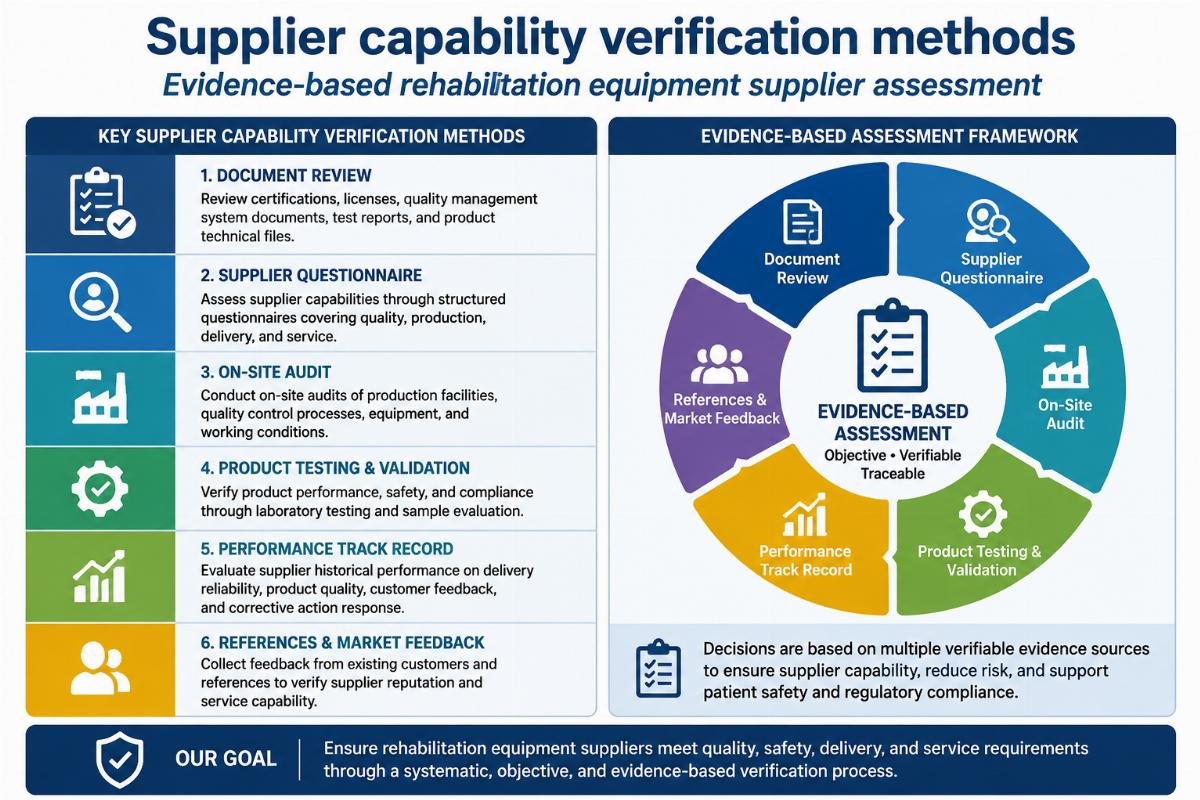
Buyers should verify professionalism through three evidence categories: project references from comparable institutions, technical support history showing rehabilitation-specific problem-solving, and R&D focus demonstrating understanding of rehabilitation use cases beyond generic medical device features. This verification reveals expertise boundaries that rankings cannot measure.
What specific questions expose supplier capability gaps?
From procurement conversations I have facilitated, I learned that certain questions quickly reveal whether suppliers have real rehabilitation expertise or just product catalogs. These questions force suppliers to demonstrate application knowledge instead of reciting specifications.
Project reference verification
Ask suppliers to provide case studies from institutions similar to yours—hospital rehabilitation departments for hospital buyers, independent rehab centers for clinic buyers, home care equipment providers for distributors. Request contact information for these references and actually call them. Ask the reference contacts about post-installation support quality, how the supplier handled equipment issues specific to rehabilitation use, and whether the supplier understood their clinical workflows.
Generic medical equipment distributors often provide references from unrelated sectors or refuse to share contact details. Specialized rehabilitation suppliers readily connect you with similar institutions because they have relevant experience to demonstrate.
Safety incident response capability
Request that suppliers explain typical misuse scenarios or safety incidents specific to their rehabilitation equipment in clinical settings. Ask what training they provide to prevent these incidents and how they support buyers when problems occur. This question reveals whether suppliers understand rehabilitation environment risks or just repeat generic medical device safety protocols.
Suppliers without rehabilitation experience struggle to provide specific examples. They might deflect to general quality control processes or regulatory compliance statements. Experienced rehabilitation suppliers describe detailed scenarios because they have encountered and solved these problems repeatedly across multiple installations.
Application training depth
Ask what training suppliers provide beyond installation and basic operation. Specifically request information about training for different patient conditions, integration with therapy protocols, and troubleshooting application issues versus equipment malfunctions. Check whether their training teams include people with clinical rehabilitation backgrounds or just technical installation staff.
Cross-industry suppliers typically offer standard installation training and operation manuals. Rehabilitation-focused suppliers provide ongoing application support, understand how therapists modify equipment use for different patients, and offer consultation on integrating equipment into treatment plans.
How do regulatory compliance records reveal specialization depth?
Buyers commonly verify supplier certifications during evaluation. However, from procurement processes I have observed, most buyers check only whether certifications exist, not whether certifications specifically address rehabilitation equipment requirements versus generic medical device standards.
| Certification type | What it actually indicates | What buyers should verify |
|---|---|---|
| ISO 13485 (medical devices)5 | Basic quality management for medical device manufacturing | Does the supplier have regulatory approvals specific to rehabilitation equipment categories in target markets? |
| CE marking (European markets) | Product meets EU safety requirements | Is the CE marking under Medical Device Directive (MDD)6 or specific rehabilitation equipment standards? |
| FDA registration (US markets)7 | Facility registered with FDA | Has the supplier actually obtained FDA clearance for rehabilitation equipment classifications, not just facility registration? |
| China NMPA approval8 | Product approved for China market | Is the NMPA approval for rehabilitation equipment classification or general medical devices? |
Generic medical equipment distributors accumulate broad certifications across product categories. Specialized rehabilitation suppliers demonstrate deeper compliance history in specific rehabilitation equipment classifications. Check approval dates, product categories covered, and whether regulatory records show ongoing compliance maintenance or one-time certifications.
The depth difference matters because rehabilitation equipment often faces stricter post-market surveillance requirements than general medical devices9. Suppliers experienced with these requirements understand compliance as an ongoing process, not just initial certification10. This mindset difference affects how they handle product modifications, safety updates, and documentation support for your institution's regulatory requirements.
What does R&D focus reveal about rehabilitation expertise?
Another verification method I recommend to buyers evaluates whether suppliers invest in rehabilitation-specific innovation or just manufacture products based on existing designs. Request information about the supplier's research and development activities, specifically looking for evidence of rehabilitation use case understanding.
Ask suppliers to describe recent product improvements they made based on feedback from rehabilitation professionals. Check whether improvements address clinical application challenges (patient comfort during extended therapy sessions, equipment adaptability for different patient mobility levels, safety features for cognitive impairment scenarios) versus generic manufacturing enhancements (production cost reduction, material substitution, aesthetic updates).
Suppliers who genuinely understand rehabilitation continuously refine products based on therapy workflow insights and patient outcome data11. Cross-industry suppliers improve products based on manufacturing efficiency or general medical device trends. The difference reveals whether their engineering teams interact with rehabilitation professionals or just respond to specification requests from sales teams.
What framework should replace professionalism ranking for supplier decisions?
Based on procurement challenges I have witnessed, buyers need a decision framework that assesses supplier capability dimensions instead of searching for non-existent rankings. This framework helps buyers distinguish genuine rehabilitation equipment expertise from marketing positioning.
Replace ranking searches with a four-dimension assessment: application knowledge depth (rehabilitation therapy workflow understanding), clinical environment experience (installation and support in comparable settings), regulatory specialization (compliance records specific to rehabilitation equipment), and problem-solving history (evidence of rehabilitation-specific troubleshooting). Score suppliers on evidence quality in each dimension, not on ranking list position.
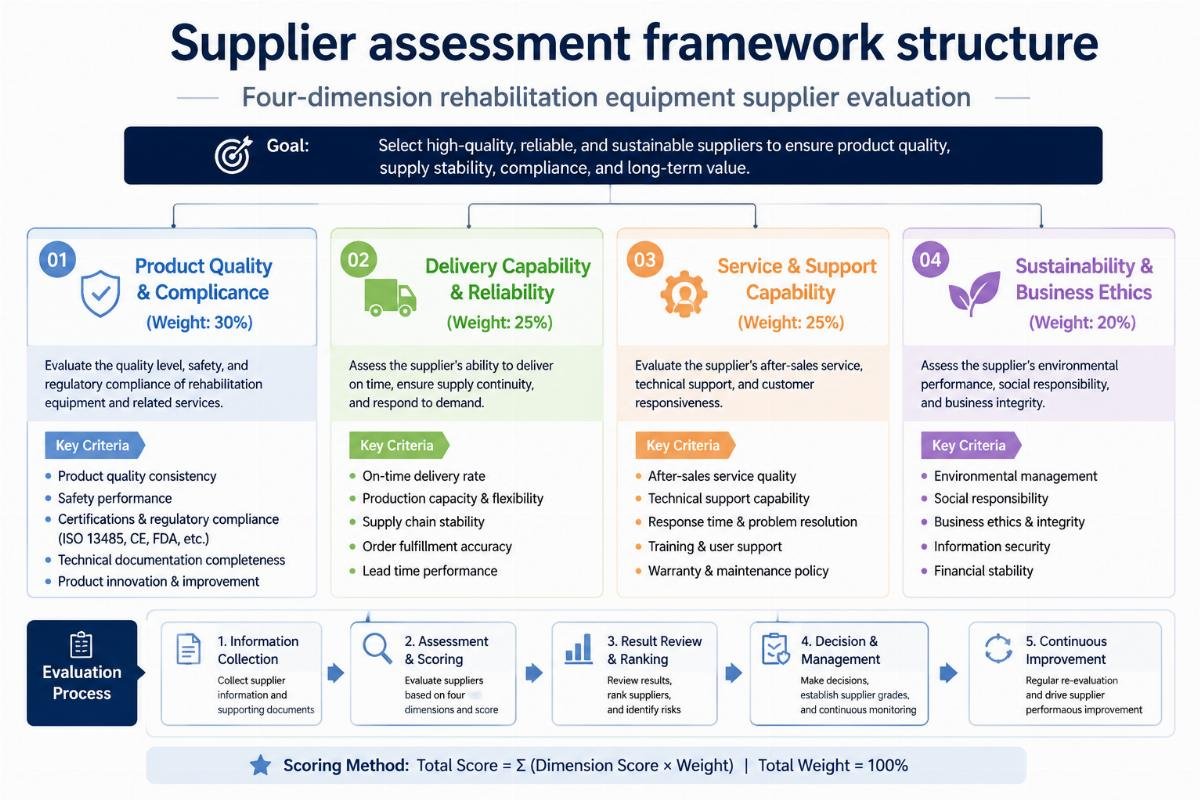
How do you implement this assessment framework practically?
From helping buyers develop supplier evaluation processes, I created a practical implementation approach. This method works for hospital rehabilitation department procurement and medical equipment distributor supplier selection.
Step one: Define your evidence requirements
Before contacting suppliers, specify what evidence would demonstrate capability in each assessment dimension. For application knowledge, you might require case studies from institutions treating similar patient populations. For clinical environment experience, you might need references from rehabilitation departments with comparable size and patient volume. For regulatory specialization, you might want approval records in specific rehabilitation equipment classifications. For problem-solving history, you might request documented examples of resolving rehabilitation-specific equipment issues.
This preparation prevents suppliers from overwhelming you with irrelevant information like general company profiles, broad product catalogs, or generic certifications. You can redirect conversations to evidence that actually indicates rehabilitation equipment professionalism.
Step two: Create supplier evidence profiles
As you evaluate each supplier, build an evidence profile organized by the four assessment dimensions. Record what evidence each supplier provides, what evidence they cannot provide, and what evidence they deflect from providing. This structure reveals capability patterns across suppliers.
A supplier with strong application knowledge but weak clinical environment experience might be a manufacturer with good product design but limited installation history in your type of institution. A supplier with strong regulatory specialization but weak problem-solving history might have compliance systems but limited post-sale support capability. These patterns help you assess fit for your specific procurement needs instead of searching for the "highest ranked" supplier.
Step three: Weight dimensions by your procurement priorities
Different buyers have different risk priorities. Hospital rehabilitation departments might prioritize clinical environment experience and problem-solving history because equipment downtime directly affects patient care12. Medical equipment distributors might prioritize regulatory specialization and application knowledge because they need to support diverse customer institutions.
Weight the four assessment dimensions based on your priorities, then calculate supplier scores using your weights. This personalized scoring system serves your specific needs better than any generic ranking list could.
What red flags indicate lack of genuine rehabilitation professionalism?
Through procurement conversations I have handled, I identified warning signs that appear consistently when suppliers lack genuine rehabilitation equipment expertise. These red flags should trigger deeper verification or disqualification from your evaluation process.
Suppliers who refuse to provide institution references for comparable rehabilitation settings often lack relevant experience. Suppliers who cannot explain specific rehabilitation safety scenarios beyond generic medical device safety statements likely have not worked extensively in clinical rehabilitation environments. Suppliers whose training programs only cover installation and operation but not application in therapy workflows probably do not understand how rehabilitation professionals actually use their equipment.
Another critical red flag appears when suppliers emphasize factory tours and production capacity over discussion of clinical application support. This emphasis suggests they view rehabilitation equipment as manufacturing output rather than therapeutic tools requiring application expertise. Manufacturers focused on rehabilitation professionalism lead with discussions of therapy workflow integration, patient outcome considerations, and clinical staff training—not factory floor area.
Conclusion
Stop searching for China rehabilitation equipment supplier professionalism rankings that do not exist. Build a capability verification framework that reveals genuine rehabilitation expertise instead of measuring generic company attributes. Professional procurement requires assessing evidence across application knowledge, clinical experience, regulatory specialization, and problem-solving history—dimensions that rankings cannot capture.
"Best 10 Medical Supply Companies to Know in China This Year", https://www.bkamed.com/medical-supply-companies-in-china/. Industry trade associations typically provide certification programs and member directories rather than comparative professionalism rankings, as supplier evaluation criteria vary significantly by procurement context and equipment specialization. Evidence role: general_support; source type: institution. Supports: the absence of standardized third-party professionalism rankings in the medical equipment supply industry. Scope note: This supports the general absence of standardized rankings but does not definitively prove no organization worldwide publishes such rankings ↩
"Assessing the Best Supplier Selection Criteria in Supply Chain ...", https://pmc.ncbi.nlm.nih.gov/articles/PMC9102987/. Supply chain management research indicates that traditional supplier evaluation models emphasizing production capacity and firm size may inadequately assess capability for specialized or technically complex products, where domain expertise and application knowledge become critical selection factors. Evidence role: expert_consensus; source type: research. Supports: limitations of scale-based supplier evaluation for specialized products. ↩
"Rehabilitation Engineering - Lampe Biomedical Engineering", https://bme.unc.edu/research-areas/rehabilitation-engineering/. Rehabilitation engineering integrates principles from biomedical engineering, physical therapy, and human factors design to create devices that support therapeutic interventions while accommodating diverse patient capabilities and clinical workflows. Evidence role: definition; source type: education. Supports: the multidisciplinary nature of rehabilitation equipment design and application. ↩
"Key Risks and Development Strategies for China's High-End ... - PMC", https://pmc.ncbi.nlm.nih.gov/articles/PMC8302230/. Medical equipment supply chains frequently involve OEM manufacturing and distribution arrangements, where companies with broad product portfolios source specialized equipment from focused manufacturers, a practice that can create expertise gaps in technical support and application knowledge. Evidence role: general_support; source type: research. Supports: the prevalence of OEM and resale arrangements in medical equipment supply chains. Scope note: This supports the general practice but does not provide specific data on rehabilitation equipment suppliers ↩
"ISO 13485 - Wikipedia", https://en.wikipedia.org/wiki/ISO_13485. ISO 13485 specifies requirements for a quality management system where an organization needs to demonstrate its ability to provide medical devices and related services that consistently meet customer and applicable regulatory requirements. Evidence role: definition; source type: institution. Supports: ISO 13485 as the international quality management standard for medical device manufacturers. ↩
"Medical Devices Directive - Wikipedia", https://en.wikipedia.org/wiki/Medical_Devices_Directive. The Medical Device Directive (MDD 93/42/EEC) was the primary European regulatory framework for medical device CE marking until being replaced by the Medical Device Regulation (EU 2017/745) in May 2021, with transitional provisions for devices certified under MDD. Evidence role: historical_context; source type: government. Supports: the Medical Device Directive as a former CE marking framework. Scope note: This provides historical context but indicates MDD has been superseded by current regulations ↩
"Device Registration and Listing - FDA", https://www.fda.gov/medical-devices/how-study-and-market-your-device/device-registration-and-listing. FDA requires medical device establishments engaged in the production and distribution of devices intended for US markets to register their facilities and list their devices, though registration alone does not constitute marketing authorization, which requires separate premarket notification or approval depending on device classification. Evidence role: mechanism; source type: government. Supports: FDA establishment registration requirements for medical device manufacturers. ↩
"Importance to understand medical device regulations for ... - PMC", https://pmc.ncbi.nlm.nih.gov/articles/PMC11978296/. The National Medical Products Administration (NMPA, formerly CFDA) regulates medical devices in China through a classification system requiring registration certificates for devices marketed domestically, with approval processes varying by device classification and risk level. Evidence role: mechanism; source type: government. Supports: NMPA approval requirements for medical devices in China. ↩
"Postmarket Requirements (Devices) - FDA", https://www.fda.gov/medical-devices/device-advice-comprehensive-regulatory-assistance/postmarket-requirements-devices. Medical device post-market surveillance intensity correlates with device classification and risk profile, with higher-risk devices requiring more extensive monitoring regardless of specific category, though devices involving patient interaction and therapeutic intervention typically receive enhanced scrutiny. Evidence role: general_support; source type: government. Supports: that post-market surveillance requirements vary by device classification and risk level. Scope note: This supports variable surveillance requirements but does not specifically confirm rehabilitation equipment faces universally stricter requirements than all general medical devices ↩
"Quality and Compliance (Medical Devices) - FDA", https://www.fda.gov/medical-devices/device-advice-comprehensive-regulatory-assistance/quality-and-compliance-medical-devices. Medical device quality management systems require continuous monitoring, periodic audits, and ongoing compliance maintenance to address evolving regulations, post-market surveillance findings, and corrective actions, distinguishing mature compliance programs from minimal certification approaches. Evidence role: expert_consensus; source type: education. Supports: regulatory compliance as a continuous process in medical device manufacturing. ↩
"Advanced Technology in a Real-World Rehabilitation Setting - PMC", https://pmc.ncbi.nlm.nih.gov/articles/PMC11729780/. Evidence-based rehabilitation engineering emphasizes incorporating clinical outcome data and user feedback into iterative device design, as patient functional improvements and therapy effectiveness provide critical validation of equipment performance beyond technical specifications. Evidence role: expert_consensus; source type: research. Supports: the importance of patient outcome data in rehabilitation equipment development. ↩
"Factors Affecting the Functioning of Critical Medical Equipment in a ...", https://pmc.ncbi.nlm.nih.gov/articles/PMC12963457/. Healthcare operations research demonstrates that medical equipment downtime can disrupt scheduled treatments, delay therapy interventions, and reduce service capacity, with impacts varying by equipment criticality and availability of backup resources. Evidence role: general_support; source type: research. Supports: the impact of medical equipment availability on care delivery. Scope note: This supports general equipment downtime impacts but does not specifically quantify effects in rehabilitation settings ↩
MORE FROM
Why do global spinning bike brand reputation lists contradict each other?
China Barbell Bar Bending Strength Ranking: Why This Question Leads Buyers Astray?
US Weightlifting Platform Shock Pad Durability Top Three?
EQUIP YOUR
From CrossFit boxes to chain facilities -- BICKFIT engineers, manufactures and delivers heavy-duty commercial strength equipment worldwide.
JOIN THE DISCUSSION