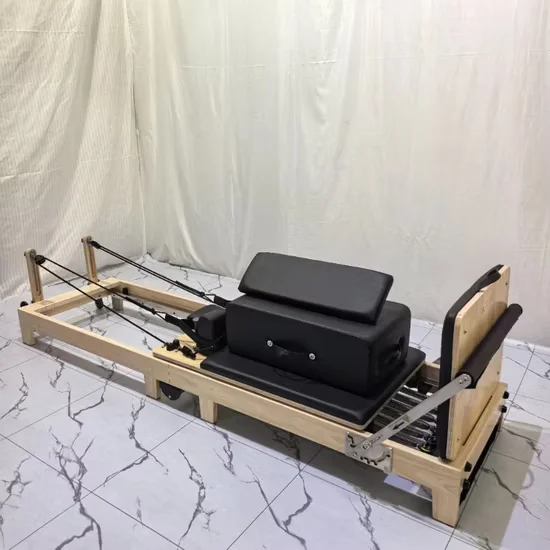
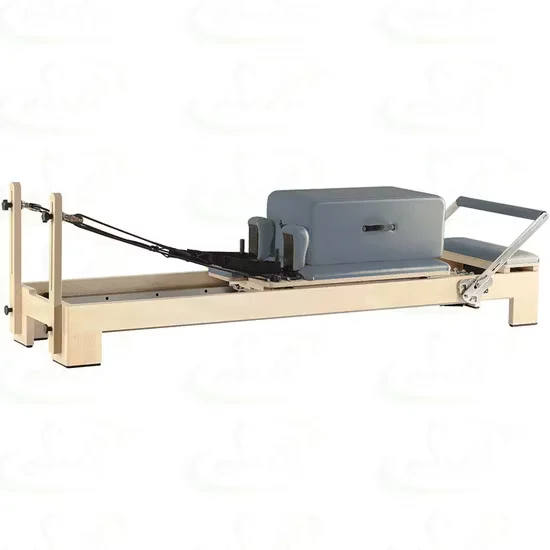
Wood Vibration Dampening — Solid timber rails naturally absorb micro-vibrations, keeping carriage glide quiet enough for shared residential floors and boutique studios.
Technical Specifications
| Parameter | Value |
|---|---|
| Designation | SRY-20B |
| Product Type | Pilates Reformer |
| Material | Wood |
| Color | Solid Color |
| Accessory | Long Box / Jump Board / Platform |
| Product Dimensions | 2400 × 600 × 350 mm |
| Net Weight | 100 kg |
| Foldable | Yes |
| Customization | Available (Logo, Color) |
| Production Capacity | 80 Pieces/Month |
| Warranty | 3 Years |
Application Suitability
| Deployment Scenario | Typical Use |
|---|---|
| Boutique Pilates studio | Group reformer classes with accessory swaps between sets |
| High-end residential home gym | Compact folding storage when the room serves multiple purposes |
| Yoga and movement studio | Low-impact flexibility and core sessions alongside mat work |
| Corporate wellness room | Employee recovery sessions during breaks |
| Personal training facility | One-on-one rehabilitation and functional movement programming |
Why a Wood Frame Silences the Noise Complaint Before It Reaches the Front Desk
Non-motorized, timber-based construction eliminates the hum and vibration that trigger noise complaints in multi-story facilities.
When a metal-frame reformer sits above occupied hotel rooms or residential units, every carriage roll transmits low-frequency vibration through the floor slab. Facility managers often discover the problem only after repeated guest calls [NEED_CITE: noise transmission through floor assemblies under dynamic equipment loads]. A solid wood frame absorbs that energy before it reaches the structure. The SRY-20B portable folding pilates reformer wood design relies on the natural damping properties of timber, so the carriage glides with minimal acoustic transfer to the floor below.
Where This Reformer Fits in a Mixed-Discipline Fitness Space
The SRY-20B covers controlled, low-velocity resistance work across the full spectrum of Pilates repertoire — footwork, long stretch, coordination, and advanced jump board sequences. In a studio layout, it pairs naturally with mat zones, Cadillac towers, and stability equipment, letting members rotate through stations without cardio-equipment congestion. Because the unit folds for storage, it suits rooms that double as yoga or functional-training spaces during off-peak hours. It accommodates users across a wide range of body proportions thanks to the adjustable spring-bar and rope-tower geometry. The portable folding pilates reformer wood frame handles repetitive daily carriage travel without the mechanical chatter that metal rails can introduce over time.
Continuous Daily Use and the Environment Around It
A busy studio may schedule back-to-back classes for eight or more hours, meaning the carriage rolls hundreds of times per day. The wood rails and sealed wheel bearings must stay aligned under that cycle count without generating friction noise that grows louder as sessions accumulate. Ventilation matters less than it does for motorized cardio, yet ambient humidity still affects timber — rooms with seasonal humidity swings need climate control to prevent rail warping [NEED_CITE: dimensional stability of hardwood under cyclic humidity]. A level subfloor is essential; even a slight slope causes uneven carriage drift and accelerates wheel wear. Because there is no motor or electronic console, power-outlet planning is unnecessary, simplifying deployment in heritage buildings where electrical upgrades are restricted.
Reading the Wood-and-Spring Specification Sheet
The SRY-20B’s timber frame provides inherent vibration damping that metal cannot match without added isolation pads. Spring-based resistance delivers a linear force curve — tension increases proportionally as the spring extends — which differs from the variable curve of elastic bands or pneumatic cylinders. The included Long Box extends the carriage surface for supine and seated work, while the Jump Board converts the foot bar into a rebound platform for plyometric sequences. The Platform attachment closes the carriage gap for standing exercises. Each accessory swaps in seconds without tools, keeping class transitions smooth. Rope and pulley routing through the tower determines the angle of resistance, so the tower height directly influences shoulder and hip loading during arm-and-leg work.
The Hidden Cost of Specifying Below What the Room Demands
Choosing a reformer rated only for light home use in a studio that runs six classes a day leads to premature wheel flattening and rail grooving, producing noise that grows impossible to ignore [NEED_CITE: wheel durometer degradation under high-frequency carriage travel]. Operators then face mid-cycle replacement of carriage assemblies and, in worst cases, complete rail resurfacing. A frame that lacks adequate cross-bracing may develop lateral play after several thousand cycles, creating a knocking sensation that clients attribute to poor build quality rather than spec mismatch. In multi-story deployments, insufficient vibration isolation results in complaints from tenants below, forcing the facility to relocate the entire reformer fleet to a ground-floor room at significant cost.
Why This Product Line Earns Its Place
Every unit undergoes load-bearing verification on folding joints and wood-to-wood connections before leaving the Shandong facility — a check rooted in 15 years of cardio-equipment engineering where structural fatigue was a recurring field issue. The 10,000-hour durability protocol originally developed for commercial motors and bearings has been adapted to validate the carriage-wheel and rail interface on this reformer. OEM customization covers logo engraving and frame color, letting boutique studios maintain brand consistency without third-party finishing. The folding mechanism allows a 3D layout plan to show both operational and stored configurations, so operators see exactly how much floor space opens up between classes. Technical support is reachable around the clock, with spare wheel sets and spring kits stocked for rapid dispatch.
Documentation & Test Records
- CE declaration of conformity for the SRY-20B reformer assembly
- EN 957 test report covering structural integrity and load-bearing
- ISO 9001 certificate for the manufacturing quality system
- Noise level test record for carriage glide on wood rails
- Durability test record documenting cyclic wheel-and-rail wear
- Assembly and spare parts list with accessory specifications
Installation, Commissioning & Maintenance
- Allow at least 600 mm clearance on each side of the 2400 × 600 mm footprint for safe movement
- Level the subfloor before positioning; use isolation pads under each foot to decouple vibration
- Inspect carriage wheel alignment and rail parallelism after the first week of daily use
- Wipe wood rails with a dry microfiber cloth after every session to prevent sweat residue buildup
- Verify spring hook engagement before each class to avoid unexpected tension release
- Lubricate pulley bearings per the maintenance schedule in the commissioning guide
Planning Your Studio Layout and Spec Confirmation
Share your room dimensions, ceiling height, and intended class size to receive a 3D layout that shows the SRY-20B in both deployed and folded positions with airflow paths marked. Specify average daily class count so the carriage-wheel duty cycle can be matched to the correct bearing grade. Identify the floor level and adjacent room usage so any supplemental isolation measures are included in the plan. Confirm target-market humidity ranges to determine whether a sealed-rail finish is recommended. State whether you need custom logo engraving or frame color, as these affect production lead time.
Frequently Asked Questions
Q: What are the advantages of a wood-frame Pilates Reformer over a metal-frame one in terms of noise and aesthetics?
A: Wood naturally absorbs micro-vibrations that metal transmits through the floor, keeping the carriage glide noticeably quieter — an important factor when the studio sits above guest rooms or apartments. Aesthetically, solid timber brings warmth that fits boutique and residential interiors without additional cladding. Over time, wood also resists the cosmetic surface scratches that show easily on painted or powder-coated metal frames.
Q: How does the folding mechanism affect overall stability and longevity of the reformer?
A: The folding joints on the SRY-20B are reinforced with steel brackets and tested under repeated open-close cycles to ensure they do not introduce lateral play. When fully deployed and locked, the frame behaves as a single rigid structure. Regular inspection of the locking pins and hinge bolts is recommended to maintain that rigidity, especially in high-frequency studio environments where the unit is folded and unfolded daily.
Q: What maintenance is recommended for the wood rails and carriage wheels to ensure a smooth glide?
A: Wipe the rails with a dry microfiber cloth after each session to remove sweat and dust that can embed into the grain. Periodically check wheel surfaces for flat spots and replace them when glide noise increases. Applying a light, manufacturer-approved wood conditioner to the rails helps prevent drying and micro-cracking, particularly in rooms with low humidity or aggressive air conditioning.
Q: Can the reformer’s accessories be easily swapped during a session?
A: Yes. The Long Box slides onto the carriage and locks with friction tabs, the Jump Board slots into the foot-bar mounts, and the Platform bridges the carriage gap — all without tools. Instructors can transition between exercises in seconds, keeping class flow uninterrupted and maximizing the variety of movement patterns within a single session.