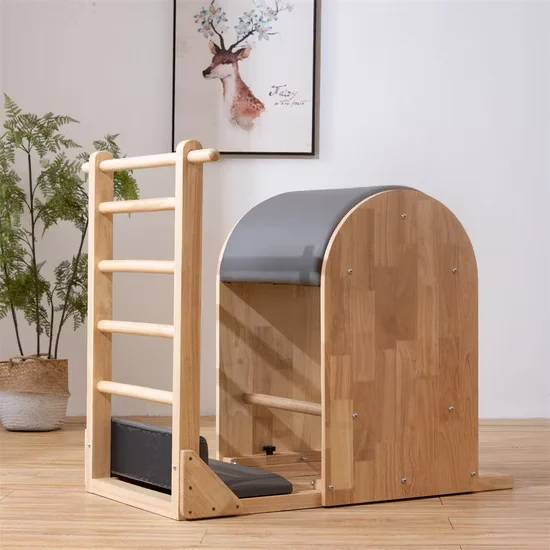
Reinforced Frame Durability — Steel construction tested for continuous studio use, supporting professional-grade Pilates training without frame flex or pedal degradation under high-repetition loads.
Technical Specifications
| Parameter | Value |
|---|---|
| Product Type | Pilates Wunda Chair |
| Dimensions | 800×620×1100mm |
| Net Weight | 45kg |
| Frame Construction | Reinforced Steel |
| Finish | Solid Color |
| Resistance System | Professional-Grade Spring Mechanism |
| Pedal Mechanism | High-Repetition Rated |
| Age Group | Adult |
| Gender | Unisex |
| Logo Customization | Available |
| Warranty | 3 Years |
| Transport Package | Standard Wood Case |
| HS Code | 9506911900 |
| Production Capacity | 80 Pieces/Month |
Application Suitability
| Deployment Scenario | Typical Use |
|---|---|
| Pilates and Yoga Studios | Daily group classes and one-on-one training sessions |
| High-End Residential Home Gyms | Personal practice and private instruction |
| Boutique Fitness Centers | Reformer and chair-based class programming |
| Personal Training Studios | Targeted strength and stability work |
Why Frame Rigidity Matters More Than Spring Count in Commercial Pilates Equipment
A commercial Pilates Wunda Chair trainer must resist lateral flex during single-leg work and maintain pedal alignment through thousands of compression cycles.
When Pilates studios equip their floors, the first failure point is rarely the springs — it is the frame joints and pedal hinges. Home-grade chairs flex during standing presses and uneven pedal work, creating wobble that compromises form and accelerates wear. Studio operators replacing units within eighteen months typically discover that light-gauge tubing and spot-welded joints cannot handle continuous daily sessions [NEED_CITE: frame fatigue testing standards for commercial Pilates apparatus]. The commercial Pilates Wunda Chair trainer addresses this with reinforced steel construction rated for the repetition density of back-to-back classes.
Positioning Within the Studio Equipment Mix
The commercial Pilates Wunda Chair trainer fills the gap between mat work and reformer training, targeting spinal stabilization, lower-limb strength, and balance challenges that reformers cannot replicate in a compact footprint. It pairs with reformer and Cadillac units in a full apparatus lineup, handling overflow during peak class hours and serving as the primary station for private sessions where space is limited. The compact footprint suits corner placements and partitioned training zones, accommodating users across a broad height and strength range without adjustment complexity. Spring tension adjustment allows instructors to scale resistance from rehabilitation-level support to advanced athletic loading, while the solid color finish integrates into any studio aesthetic.
Continuous Daily Use and Studio Environment Requirements
Studios running four to six chair-based classes daily subject every weld and hinge to sustained cyclic loading that far exceeds home-use patterns. The reinforced steel frame handles this density without the loosening and re-tightening cycles that lighter frames demand weekly [NEED_CITE: commercial fitness equipment duty cycle standards]. Floor placement requires a level, rigid surface — spring mechanism accuracy degrades on uneven flooring, causing asymmetric pedal travel. Adequate clearance on all sides allows instructors to cue movements safely, and the compact footprint leaves room for spotting without crowding adjacent reformer stations. The 45kg mass provides inherent stability during standing work, eliminating the need for floor anchoring in most deployment scenarios.
Spring Mechanism and Pedal Engineering
Professional-grade spring mechanisms deliver predictable resistance curves through the full pedal travel range, unlike elastic bands that lose tension consistency over months. The spring and pedal assembly on this commercial Pilates Wunda Chair trainer is designed for high-repetition training, maintaining calibration through the compression cycles typical of studio class volumes. Split-pedal configurations allow instructors to cue unilateral work and identify left-right strength imbalances — a diagnostic capability that mat-based classes cannot offer. The solid color finish accepts full OEM customization including logo placement, letting studio operators maintain brand consistency across their apparatus fleet without aftermarket refinishing.
The Hidden Cost of Specification Compromises
Choosing lighter frames for studio deployment saves upfront cost but generates a predictable failure sequence: wobble complaints within months, hinge replacements within a year, full unit replacement before the warranty period ends. Operators who standardize on home-grade equipment across multiple locations face compounding maintenance overhead and inconsistent client experiences [NEED_CITE: total cost of ownership for commercial Pilates equipment]. Spring mechanisms rated for light use lose their calibrated tension curve, making class programming unreliable and forcing instructors to compensate verbally for equipment inconsistency. A 45kg reinforced steel frame represents the threshold where commercial duty cycles become sustainable.
Why This Product Line Meets Studio Demands
The reinforced steel frame construction is validated through continuous studio-use testing, ensuring the frame and pedal mechanism withstand the repetition density of commercial class schedules. Full OEM customization — including logo and finish options — allows studio operators and equipment distributors to maintain brand identity across their apparatus range. The compact 800×620mm footprint fits standard studio floor plans, and our team provides 3D layout planning that accounts for instructor circulation, spotting clearance, and ventilation paths between stations. Three-year warranty coverage reflects confidence in long-term structural integrity, and 24/7 technical support ensures studio operators can resolve mechanism issues without scheduling downtime.
Documentation & Test Records
- Frame material certification and welding quality inspection report
- Spring tension calibration and pedal mechanism durability test record
- Product dimensions and weight verification documentation
- OEM customization scope and branding specification sheet
- Installation guide with floor preparation and clearance requirements
- Spare parts catalog covering springs, pedals, and frame hardware
Installation, Commissioning & Maintenance
- Position on level, rigid flooring with clearance on all sides for instructor spotting access
- Verify all frame bolts and pedal hinge pins are torqued to specification after transport
- Inspect spring attachment points and calibrate tension before first client session
- Clean upholstery and steel surfaces after each class to prevent sweat corrosion
- Schedule spring tension verification and pedal mechanism inspection at quarterly intervals
- Confirm warranty registration and spare parts availability with your distributor
Planning Your Studio Equipment Inquiry
Provide your studio floor area and planned class schedule to receive a 3D layout with equipment spacing and instructor circulation paths. Specify whether units will serve group classes, private sessions, or both, as this affects spring configuration and quantity planning. Indicate target market and branding requirements early to scope OEM customization lead times. Clarify warranty and spare parts support expectations to ensure long-term operational continuity.
Frequently Asked Questions
Q: What frame materials are used in commercial Pilates Wunda Chairs?
A: Commercial-grade Pilates Wunda Chairs use reinforced steel tubing with welded joints designed for continuous studio loads. The frame must resist lateral flex during single-leg and standing exercises without loosening over time. Material gauge and welding quality directly determine whether a chair survives eighteen months of daily classes, making frame inspection a critical procurement checkpoint before committing to bulk orders.
Q: How does spring tension affect training intensity and equipment longevity?
A: Spring tension determines resistance through the full pedal travel range, scaling from rehabilitation support to advanced athletic loading. Consistent tension curves require professional-grade springs calibrated for high-repetition use. Springs rated for light duty lose their curve over months, forcing instructors to verbally compensate. Specify spring durability ratings and verify tension retention during procurement testing.
Q: Can the Wunda Chair be customized with studio branding?
A: Yes, the solid color finish accepts full OEM customization including logo placement and brand-specific color options. Customization scope covers frame finish and upholstery, allowing studio operators to maintain visual consistency across their equipment fleet. Discuss logo specifications, color samples, and minimum order quantities with the manufacturer before finalizing purchase orders to ensure branding aligns with studio identity.
Q: What maintenance is required for pedal mechanisms and springs?
A: Pedal hinges and spring attachment points require periodic inspection for wear and loosening, particularly in studios running multiple daily classes. Quarterly tension verification ensures springs maintain their calibrated resistance curve. Sweat and moisture accelerate corrosion on moving parts, so post-class surface cleaning and periodic hardware lubrication extend service life and prevent mechanism noise during client sessions.
Q: How does the chair’s footprint compare to reformer equipment?
A: The 800×620mm footprint is significantly smaller than a standard reformer, making the Wunda Chair suitable for corner placements and compact training zones. This allows studios to add chair stations without displacing reformer inventory. The 45kg mass provides stability without floor anchoring, and the smaller footprint simplifies layout planning in multi-apparatus studios where floor space is at a premium.
![Senrui SRY-12A Commercial Foldable Aluminum Pilates Reformer for Studio [WARN] draft identifier mismatch](https://bicksport.com/wp-content/uploads/2026/08/senrui-sry-12a-commercial-foldable-aluminum-pilates-reformer-for-studio-warn-draft-identifier-mismatch-99853c.webp)