
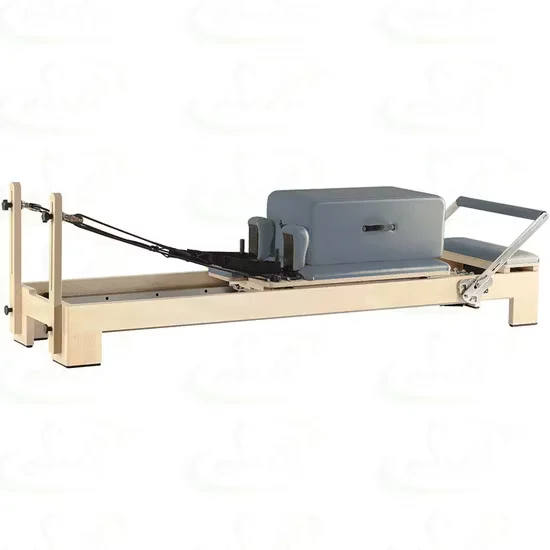
Whisper-Quiet Carriage Engineering — Sealed bearing wheels and progressive spring tension deliver smooth, low-noise travel suitable for shared-wall studio and hotel wellness deployments.
Technical Specifications
| Parameter | Value |
|---|---|
| Designation | SRY-02 |
| Product Type | Pilates Reformer |
| Resistance Type | Spring-resistance carriage system |
| Accessory Set | Long Box / Jump Board / Platform |
| Product Dimensions | 2460 × 730 × 680 mm |
| Net Weight | 100 kg |
| Carriage Travel | Full-length rail with cushioned end-stops |
| Color | Solid Color (customizable) |
| Logo | Customized Is Allowed |
| User Profile | Adult / Unisex |
| Warranty | 3 Years |
| Production Capacity | 80 Pieces/Month |
| HS Code | 9506911900 |
Application Suitability
| Deployment Scenario | Typical Use |
|---|---|
| Boutique Pilates studio outfitting full reformer rows | Group classes and semi-private core training sessions |
| Five-star hotel wellness floor | Private reformer sessions for guests on dedicated spa levels |
| High-end residential home gym | Daily personal core and flexibility training |
| Core training facility | Functional strength and rehabilitation-oriented programming |
Why Carriage Noise Reaches the Studio Owner Before the Maintenance Log Does
Spring-resistance travel with sealed bearings keeps rolling noise consistently low across every repetition.
Boutique studios sharing walls with occupied commercial or residential spaces face recurring complaints when reformer carriages produce clatter during footwork sequences or long-box transitions. Open-wheel designs tend to generate vibration noise that amplifies through hard floors, and accessory mounts that drift out of alignment over weeks of use compound the problem [NEED_CITE: EN 957 requirements for commercial studio equipment durability]. Facility operators who selected equipment without verified smooth-travel testing under load often end up replacing entire carriage assemblies — or the full commercial Pilates reformer core training bed — within the first year. A unit engineered with cushioned end-stops and a unified rail profile addresses these failures at the component level rather than relying on aftermarket retrofits.
Where This Reformer Fits in a Studio or Hotel Cardio-Strength Zone
The SRY-02 covers full-spectrum core conditioning, low-impact strength work, and jump-board cardio intervals from a single footprint. In a studio layout, it pairs naturally with mat zones and small apparatus stations, occupying the dedicated apparatus row where members cycle through timed circuits. For hotel wellness floors, it fits into private or semi-private session rooms where guests expect quiet operation beside occupied spa or guest areas. The 2460 mm length accommodates adult users across a broad height range, and the accessory ecosystem supports programming from rehabilitation through athletic conditioning without requiring equipment swaps. This commercial Pilates reformer core training bed handles high-frequency class rotation while maintaining consistent carriage feel.
Continuous Operation and Deployment Environment Considerations
Studio environments running back-to-back group sessions demand carriage systems that sustain smooth travel through six or more consecutive class blocks daily. Spring-resistance mechanisms do not rely on electrical power, eliminating motor heat buildup and duty-cycle limitations inherent in motorized equipment [NEED_CITE: motor duty cycle classification for continuous commercial operation]. The 100 kg net weight provides frame stability on hard studio floors, though level installation with vibration-dampening pads further reduces transmitted noise to rooms below. Operators deploying on upper floors of hotels or mixed-use buildings should verify floor loading capacity and specify cushioned underlayment. Ambient temperature and humidity affect spring tension over time, so climate-controlled rooms extend service intervals and maintain consistent resistance feel across seasonal changes.
Spring-Resistance Mechanics and Accessory Interface Engineering
Spring-resistance carriage systems produce a progressive tension curve: resistance increases proportionally as the carriage travels along the rail, matching natural muscle recruitment patterns during both concentric and eccentric phases. This contrasts with rope-and-pulley arrangements, where tension remains relatively constant and can create abrupt load changes at end-range. Sealed bearing carriage wheels isolate rolling friction from dust and humidity, maintaining smooth travel without the periodic lubrication open-wheel assemblies require. The cushioned end-stops absorb deceleration energy during high-rep footwork, preventing the metal-on-metal impact that generates structure-borne noise. Long box, jump board, and platform accessories mount to the same rail profile, ensuring alignment remains stable as fasteners experience repeated vibration cycles — a common failure point in modular systems where each attachment uses a separate mounting standard [NEED_CITE: EN 957 cyclic load testing for accessory mounting interfaces].
The Hidden Cost of Unverified Carriage Specifications
Studios that procured reformers without rolling noise test data under loaded conditions frequently discover acoustic problems only after installation in occupied buildings. Open-wheel carriages that function acceptably in showroom settings generate noticeable clatter once mounted on studio subfloors with adjacent occupied rooms. Accessory incompatibilities emerge gradually: jump boards that shift during plyometric sequences create safety concerns, and long boxes that wobble during prone exercises undermine member confidence. Operators face costly mid-contract replacements, member attrition from inconsistent class experiences, and reputational damage in markets where boutique fitness clients expect equipment precision [NEED_CITE: commercial fitness equipment replacement cycles due to component drift]. Specifying verified smooth-travel performance and unified accessory interfaces before procurement prevents these downstream costs.
Why This Product Line Addresses Facility-Level Procurement Risks
Sub-35dB whisper-quiet operation verified in hotel cardio deployments extends to the spring-resistance carriage platform, where sealed bearings and cushioned end-stops eliminate the structure-borne noise that plagues open-wheel designs. Components tested for 10,000+ hours of continuous high-frequency use ensure that spring anchors, carriage wheels, and rail surfaces maintain performance through years of class rotation. Full OEM customization — logo, solid-color upholstery, and finish — allows multi-location studio chains and hotel groups to maintain visual brand consistency across deployments. Free 3D layout planning accounts for reformer row spacing, member circulation paths, and accessory storage zones within the studio footprint. Round-the-clock technical support with documented spare parts availability means carriage wheel replacements and spring recalibrations are resolved without extended equipment downtime.
Documentation & Test Records
- CE declaration of conformity covering the SRY-02 platform and accessory set
- EN 957 test report validating structural load capacity and cyclic durability
- ISO 9001 certificate for manufacturing process control
- Noise level test report documenting carriage rolling sound under loaded operation
- Spring tension curve specification and replacement interval documentation
- Installation and commissioning guide with accessory mounting procedures
Installation, Commissioning & Maintenance
- Allocate 2460 × 730 mm footprint plus minimum clearance on all sides for safe carriage travel and accessory swaps
- Level the frame on vibration-dampening pads to minimize structure-borne noise transmission to floors below
- Verify carriage smooth-travel across full rail length before loading springs, then confirm cushioned end-stop engagement
- Inspect spring anchor points and carriage wheel bearings quarterly; replace springs showing tension drift
- Clean rail surfaces and accessory mounting interfaces weekly to prevent dust accumulation affecting carriage alignment
- Check long box and jump board fastener torque monthly to maintain accessory stability during dynamic exercises
Procurement and Configuration Inquiry
Provide studio square footage and planned reformer row count to receive a 3D layout covering spacing, member circulation, and accessory storage zones. Specify expected daily class volume to confirm spring-resistance durability alignment with your operational cadence. Identify deployment floor and adjacent occupied spaces to determine whether supplemental vibration isolation is recommended. Indicate target market color and logo customization requirements for multi-site brand consistency across your studio network or hotel group.
Frequently Asked Questions
Q: How does spring-resistance compare to rope-and-pulley reformer systems for noise and maintenance?
A: Spring-resistance carriages produce a progressive tension curve and, when paired with sealed bearing wheels, generate less mechanical noise than rope-and-pulley assemblies. Springs require periodic tension verification but avoid the cable fraying and pulley wear that necessitate more frequent part replacements in rope-based systems, reducing long-term maintenance labor for high-volume studios.
Q: What accessory types are included and can they be upgraded separately?
A: The SRY-02 ships with a long box, jump board, and platform, all mounting to the unified rail profile. Each accessory integrates without requiring separate alignment hardware. Facilities can request accessory upgrades or additional units separately, maintaining interface compatibility across the product line for future expansion.
Q: How to verify carriage smoothness before deployment in shared-wall environments?
A: Request a loaded carriage rolling noise test report documenting sound levels during simulated high-rep footwork. Verify that the specification includes sealed bearing confirmation and cushioned end-stop presence. On-site commissioning should include full-travel smoothness validation before the unit enters live class rotation.
Q: What OEM customization options are available for multi-site branding?
A: Logo placement, solid-color upholstery, and frame finish are customizable to match studio or hotel brand standards across locations. Console-free reformer platforms eliminate electronic interface variability, simplifying visual consistency requirements for operators deploying identical equipment across regional or international studio networks.
Q: What is the recommended maintenance cycle for carriage wheels and spring anchors?
A: Inspect sealed bearing carriage wheels for smooth rolling and lateral play quarterly. Check spring anchors for secure fastening and tension consistency at the same interval. Springs showing visible deformation or measurable tension drift should be replaced according to the manufacturer’s service documentation to maintain consistent resistance feel.

![Commercial Pilates Combo Wunda Chair with Wooden Base Aluminum Handles [WARN] draft identifier mismatch](https://bicksport.com/wp-content/uploads/2026/08/commercial-pilates-combo-wunda-chair-with-wooden-base-aluminum-handles-warn-draft-identifier-mismatch-66ffe4.webp)
