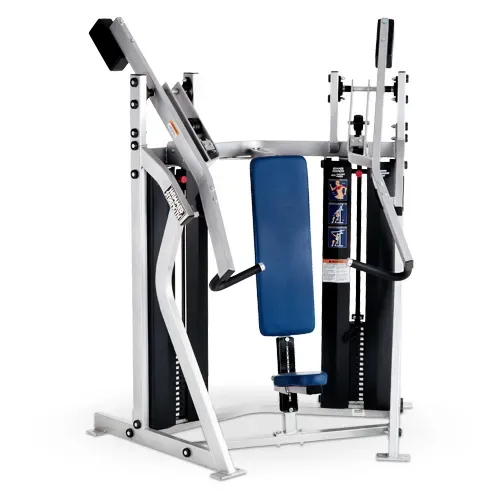
Whisper-Quiet Steel Frame — reinforced tube welding and high-density cushioning keep the bench stable and silent even under repetitive heavy loading in commercial weight rooms.
Technical Specifications
| Parameter | Value |
|---|---|
| Product Type | Adjustable Bench |
| Model NO. | 5069 |
| Frame Material | Steel |
| Max User Weight | 180 kg |
| Product Dimensions | 1215 × 680 × 1070 mm |
| Net Weight | 40 kg |
| Adjustable Backrest | Multiple angle positions |
| Frame Color | Available per customer requirements |
| Cushion Color | Available per customer requirements |
| Certification | ISO 9001, CE |
| OEM/ODM | Acceptable |
| Production Capacity | 500 PCS/Month |
Application Suitability
| Deployment Scenario | Typical Use |
|---|---|
| Chain gym strength zone | High-frequency bench press, dumbbell work, and accessory lifts across peak hours |
| Corporate wellness room | Moderate-use adjustable bench for employee strength circuits |
| Sports performance training center | Heavy plate-loaded compound movements requiring stable backrest angles |
| Community fitness center | Durable shared bench accommodating varied user sizes and daily rotation |
| Professional athletic facility | Biometric-consistent positioning for repeatable strength testing |
Why Weld Seams Crack Before Anyone Files a Work Order
Commercial benches fail at the weld, not the cushion — and the failure is always silent until it is not.
In a busy chain gym, a plate loaded hammer strength adjustable bench commercial gym unit sees hundreds of loading cycles daily. Members load plates, drop onto the pad, and shift their weight through compound movements. Over time, micro-fractures propagate at the tube junctions where the backrest pivot meets the main frame. [NEED_CITE: EN 957 structural fatigue requirements for commercial strength benches] The bench wobbles slightly, members adjust their form around the instability, and eventually someone reports it — usually after the weld has already separated. By then, the facility has been running compromised equipment for weeks.
Where This Bench Sits in a Commercial Strength Floor Layout
A plate loaded hammer strength adjustable bench commercial gym unit anchors the free-weight and plate-loaded machine zone. It pairs directly with plate-loaded chest press, shoulder press, and leverage-based rowing machines, giving members a stable platform for both machine-integrated and standalone dumbbell work. The bench accommodates users across a broad weight range up to 180 kg, and the adjustable backrest supports incline, flat, and decline positions for varied pressing angles. It handles high-density placement where benches are positioned roughly one meter apart in dedicated strength bays.
What Continuous High-Frequency Loading Demands from the Frame
A bench deployed in a chain gym or hotel fitness center may see use for most of the operating day, with members cycling on and off every few minutes. The 40 kg net weight of this unit reflects the steel mass needed to resist lateral shifting under asymmetric plate loads. Floor leveling is important: an uneven surface transfers shear forces into the pivot joints. [NEED_CITE: commercial gym floor load and leveling standards for plate-loaded equipment] Adequate spacing around the bench — particularly at the head and foot — allows spotters to move safely and prevents adjacent equipment vibration from compounding through shared flooring.
Reading the Steel Gauge and Weld Schedule Behind the Spec Sheet
The 1215 × 680 × 1070 mm footprint positions this bench within the standard commercial plate-loaded machine envelope. The steel frame must resist both static load — a loaded barbell plus user weight — and dynamic shock from eccentric lowering phases. Tube-wall thickness and the number of weld passes at the pivot bracket determine whether the backrest holds angle under load or drifts. High-density cushion filling resists compression set over thousands of cycles, maintaining pad firmness where softer foams would bottom out. The adjustable locking mechanism must engage positively at each angle notch; a spring-pin system with audible click confirmation prevents partial engagement that could collapse mid-set.
The Hidden Cost of Underspecifying a Bench in a Commercial Environment
When a facility installs a light-duty bench in a high-traffic strength zone, the cushion compresses and loses shape within months, prompting member complaints about uneven support. The frame may develop play at the pivot, causing the backrest to rock during incline presses. [NEED_CITE: commercial bench replacement frequency in high-traffic strength zones] Members compensate by avoiding the equipment or altering their movement patterns, which reduces training effectiveness and increases injury risk. Facilities then face the operational cost of pulling equipment offline for warranty claims while traffic continues to demand that station.
Why This Bench Line Holds Up Where Others Require Replacement
Sub-35 dB operation is verified across the cardio range, and the same engineering discipline applies to strength equipment: reinforced steel frames and sealed pivot bearings tested for 10,000+ hours of continuous high-frequency use. The adjustable bench accepts OEM customization on frame color and cushion color, allowing facilities to match brand identity across the entire strength zone. Full OEM/ODM extends to logo application and padding specifications. The six-series product family means a facility can source every cardio and strength discipline from one integrated production line. Free 3D strength-zone layout planning covers equipment spacing, member flow, and sightlines specific to this bench footprint and adjacent plate-loaded units.
Documentation & Test Records
- CE declaration of conformity for strength training equipment
- EN 957 test report covering structural and stability requirements
- ISO 9001 manufacturing quality certificate
- Noise level test record under loaded cyclic operation
- Durability test documentation for frame weld and pivot mechanism
- Cushion density specification and compression-set test data
Installation, Commissioning & Maintenance
- Allow minimum 600 mm clearance on all sides for safe plate loading and spotter access
- Level the 1215 × 680 mm footprint on reinforced flooring with anti-vibration pads
- Inspect backrest pivot pin engagement and locking mechanism before first member use
- Check weld joints at the pivot bracket quarterly for micro-fracture indicators
- Wipe cushion surfaces daily with pH-neutral cleaner to prevent sweat degradation
- Verify frame bolt torque at all junction points during scheduled maintenance cycles
How to Scope This Bench for Your Facility
Provide your strength-zone square footage and adjacent equipment list to receive a 3D layout covering bench placement, member circulation, and spotter clearance. Specify expected daily usage intensity so the frame and cushion specification matches your duty cycle. Confirm your deployment floor type and any adjacent noise-sensitive spaces. State target-market voltage requirements if integrating any electronic accessories. Indicate whether console or branding customization is needed for chain-wide consistency.
Frequently Asked Questions
Q: What separates a commercial adjustable bench from a residential model?
A: Commercial benches use heavier-gauge steel tubing, higher-density cushion filling rated for thousands of compression cycles, and reinforced pivot mechanisms tested for continuous loading. Residential benches prioritize cost and compact storage. In a high-traffic gym, a residential bench cushion compresses within months and the pivot develops play, creating instability under loaded pressing movements.
Q: How do you verify the frame welding quality on a strength bench?
A: Request the EN 957 structural test report, which documents cyclic loading applied to the frame and pivot joints. Visual inspection of weld beads should show consistent penetration without undercut or porosity. The manufacturer should provide weld procedure specifications and material certificates for the steel tubing used in the main frame and backrest support bracket.
Q: Does cushion density affect how long the bench stays usable?
A: Yes. High-density foam resists compression set — the permanent flattening that occurs after repeated loading. A bench used in a commercial gym may see hundreds of cycles daily, and low-density foam loses its shape within months, creating uneven support surfaces. The cushion specification should include density values and compression-set test results to confirm long-term durability under continuous use.
Q: Is the backrest locking mechanism safe under heavy plate loads?
A: The locking mechanism must engage positively at each angle notch with a spring-pin or equivalent system that prevents partial engagement. Under heavy incline press loads, any play in the lock translates to backrest movement during the eccentric phase. Request documentation showing the locking mechanism tested under maximum rated user weight plus external plate load at the steepest incline position.
Q: What OEM options are available for frame and cushion customization?
A: Frame color and cushion color are fully customizable to match facility branding. Logo application is available through powder-coat stenciling or embroidered cushion covers. Minimum order quantities apply and depend on the customization scope. Console or accessory integration can also be discussed for facilities requiring data connectivity alongside strength stations.