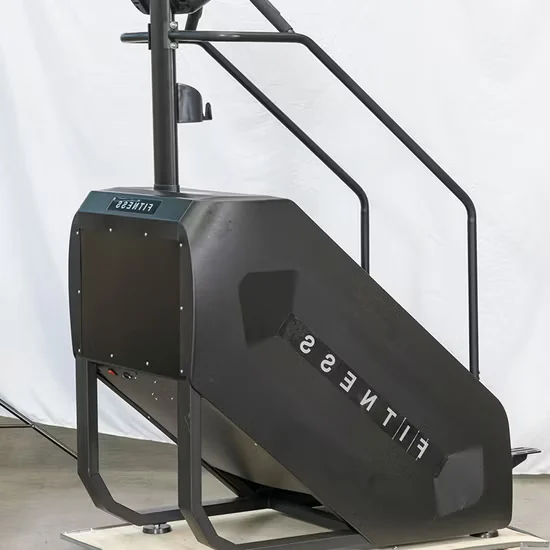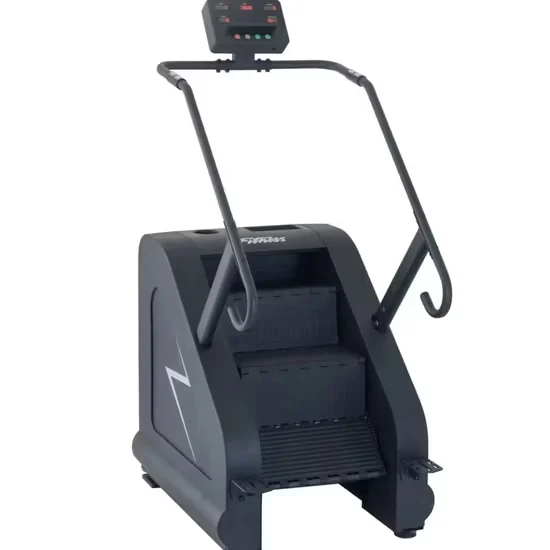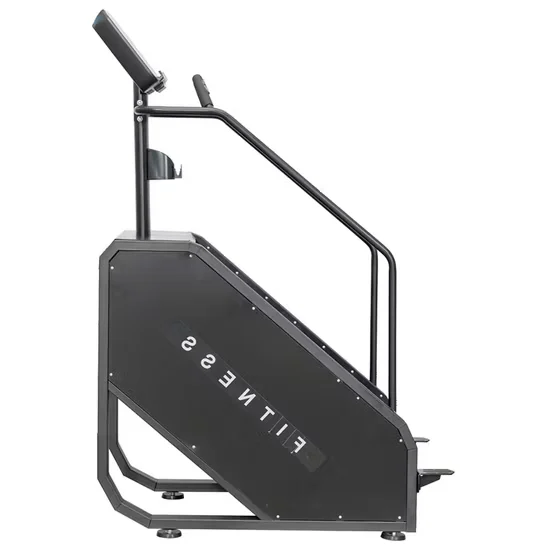
Continuous-Duty Drive Architecture — every SQ1017 motor undergoes 10,000-hour thermal stress validation before leaving our Shandong assembly line.
Technical Specifications
| Parameter | Value |
|---|---|
| Designation | SQ1017 |
| Product Type | Stair Climber |
| Type of Drive | Motor Drive |
| Mains Input | AC220V±10% / AC110V±10% |
| Running Velocity | 15–164 steps/min |
| Step Area | 560 × 235 × 220 mm |
| OSD Display | Time, Climb, Calories, Steps, Heart Rate |
| Product Dimensions | 1450 × 820 × 2080 mm |
| Net Weight | 148 kg |
| Material | Steel Pipe + PP Plastic |
| Folded | Unfolded |
| Certification | CE |
| Color | Black (customizable via OEM) |
| Condition | New |
Application Suitability
| Deployment Scenario | Typical Use |
|---|---|
| Chain gym cardio zone | High-frequency member rotation across all fitness levels |
| Corporate wellness room | Mid-day interval sessions with biometric tracking |
| Sports performance training center | Athlete conditioning with controlled step velocity progression |
| High-end residential home gym | Low-noise daily training in shared building environments |
| Hotel fitness center on guest room floors | 24-hour self-service access with minimal acoustic transfer |
Why Motor Burnout Reaches the Maintenance Log Before the Quarter Ends
A motor rated for light-commercial cycles cannot survive the thermal load of continuous public stair climbing.
I watched a batch of stair climbers get pulled from a Middle East five-star property because the drive units were specced for three hours of daily use, not the sixteen-hour reality of a resort gym. The commercial stair climber motor drive gymnasium operators actually need must sustain thermal equilibrium under back-to-back user loads without derating [NEED_CITE: motor duty cycle classification for continuous commercial operation]. When procurement teams focus on peak output numbers instead of continuous thermal capacity, the maintenance tickets arrive in waves — usually around month four, right when the warranty conversation gets uncomfortable.
Where This Stair Climber Sits in the Cardio Floor Mix
The SQ1017 fills the vertical-loading gap between treadmill intervals and elliptical steady-state work, targeting glute and quad activation through a controlled step velocity range of 15 to 164 steps per minute. In a commercial cardio layout, it pairs with treadmills for complementary lower-body stimulus without duplicating the same movement pattern. Its footprint at 1450 × 820 mm allows placement in high-traffic corridors or dedicated climbing zones, and the step area accommodates users across a wide anthropometric range. The console captures time, climb count, calories, steps, and heart rate — providing the commercial stair climber motor drive gymnasium managers need for usage analytics without prescribing training protocols.
Continuous Run-Time and Floor-Level Deployment Constraints
Facilities running this unit for twelve or more hours daily should confirm dedicated circuit capacity at either AC220V or AC110V to prevent voltage sag during peak usage windows. The motor drive system generates thermal output that requires adequate clearance from walls and adjacent equipment — we typically specify minimum spacing in the commissioning guide based on ambient temperature [NEED_CITE: EN 957 requirements for commercial cardio equipment clearance]. Floor-mounted units on upper levels transfer low-frequency vibration through the structure, so deployment above occupied spaces benefits from anti-vibration pads and level subfloor preparation. Console data output should be verified against facility management software interfaces before bulk deployment, particularly in multi-property hotel groups standardizing their telemetry.
Reading Between the Lines on Drive and Console Specifications
Motor drive architecture in stair climbers determines both the smoothness of step resistance transitions and the unit’s ability to hold consistent velocity under varying user weights. A continuous-duty motor maintains stable torque output across the full 15 to 164 steps/min range without thermal throttling, unlike intermittent-rated alternatives that lose consistency as internal temperature climbs. The multi-parameter OSD console provides real-time biometric feedback through time, climb, calories, steps, and heart rate displays — data points that facility operators use to verify equipment utilization without requiring third-party platform connectivity. Dual voltage input at AC220V±10% and AC110V±10% eliminates the deployment failures we see when single-voltage units arrive at international sites with mismatched electrical infrastructure. Steel pipe frame construction at 148 kg net weight provides the mass needed to absorb dynamic loading without frame resonance during high-velocity stepping [NEED_CITE: structural mass requirements for commercial stair climber stability].
The Hidden Cost of Specifying Below the Duty-Cycle Requirement
Light-duty motors installed in high-traffic climbing zones typically fail between months three and six, generating warranty claims that cost more in shipping and labor than the original unit margin. Noise from underpowered drive systems escalates as bearings degrade under continuous load, eventually reaching levels that trigger member complaints in adjacent studio spaces. Console units lacking proper data documentation create blind spots in facility utilization reporting, leaving operators guessing which equipment justifies its floor space. Voltage mismatches discovered after container arrival force either costly transformer installations or complete equipment reorders — a problem the SQ1017’s dual-voltage architecture was specifically designed to eliminate [NEED_CITE: international voltage standard compliance for commercial fitness equipment].
Why This Product Line Holds Up Under Real Deployment Conditions
Every unit we ship carries documentation from 10,000-hour continuous operation testing on both motor and frame components — not sample-batch testing, but production-line validation. The SQ1017’s motor drive system is matched to the thermal profile of all-day gym operation, verified through accelerated life testing in our Shandong facility. We provide 3D cardio zone layouts that account for this unit’s 1450 × 820 mm footprint, member circulation paths, and HVAC airflow requirements around heat-generating equipment. OEM customization extends to console interface configuration, allowing gym chains to align the OSD presentation with their brand standards. Our technical support team operates around the clock across time zones, and spare parts logistics are structured around the specific wear components in each model rather than generic kits.
Documentation & Test Records
- CE declaration of conformity covering the SQ1017 motor drive system
- EN 957 test report validating structural and safety requirements
- ISO 9001 certificate for the manufacturing quality management system
- Noise level test record under continuous stepping operation
- 10,000-hour durability test documentation for motor and frame
- Console technical documentation with OSD parameter specifications
Installation, Commissioning & Maintenance
- Confirm 1450 × 820 mm footprint plus clearance margins per commissioning guide
- Level subfloor and install anti-vibration pads before anchoring the 148 kg unit
- Verify AC220V or AC110V dedicated circuit matches site electrical infrastructure
- Calibrate step velocity range from 15 to 164 steps/min during first startup
- Schedule motor drive inspection and bearing lubrication per maintenance intervals
- Configure OSD console parameters and verify heart rate sensor response
Equipment Selection and Configuration Inquiry
Provide your cardio zone dimensions and target unit count so we can generate a 3D layout showing SQ1017 placement relative to adjacent equipment and airflow patterns. Specify daily operating hours so we can confirm motor duty-cycle alignment with your facility’s usage profile. Identify deployment floor level and adjacent occupied spaces to determine whether supplemental vibration isolation is required. Confirm target market voltage standards and plug configuration to ensure correct factory settings before shipment. Indicate whether console data output needs to interface with existing facility management software.
Frequently Asked Questions
Q: How does motor drive compare to manual stair climbers for commercial use?
A: Motor-driven systems maintain consistent step velocity regardless of user weight or fatigue level, which matters in facilities where members expect predictable resistance. Manual systems rely on user momentum and can feel uneven during low-speed warm-ups. For high-frequency commercial environments, motor drive also enables precise velocity tracking through the console, supporting utilization reporting that manual units cannot provide.
Q: What does the step velocity range mean for different user fitness levels?
A: The 15 to 164 steps/min range accommodates rehabilitation-paced stepping at the lower end through high-intensity interval work at the upper end. Beginners typically operate between 40 and 70 steps per minute, while conditioned athletes push past 120 during interval blocks. This breadth means a single commercial stair climber motor drive gymnasium installation serves the full membership spectrum without requiring multiple dedicated units.
Q: Can the console sync with facility management software or member apps?
A: The OSD console outputs time, climb, calories, steps, and heart rate data. Integration capability with specific facility management platforms depends on the software’s data interface protocol. We provide console technical documentation detailing available output formats so your IT team can evaluate compatibility before bulk deployment, rather than discovering limitations after installation.
Q: How does dual voltage input simplify international deployment?
A: The AC220V±10% and AC110V±10% dual input means the same SQ1017 unit ships to 220V markets in Europe and Asia or 110V markets in North America without factory reconfiguration or on-site transformer installation. This eliminates a failure point we frequently see in international projects where single-voltage equipment arrives incompatible with local electrical infrastructure, causing deployment delays and additional procurement costs.
![Stair Climber Machine with Easy Assembly Guide for Beginners [WARN] draft identifier mismatch](https://bicksport.com/wp-content/uploads/2026/08/stair-climber-machine-with-easy-assembly-guide-for-beginners-warn-draft-identifier-mismatch-d78b7a.webp)