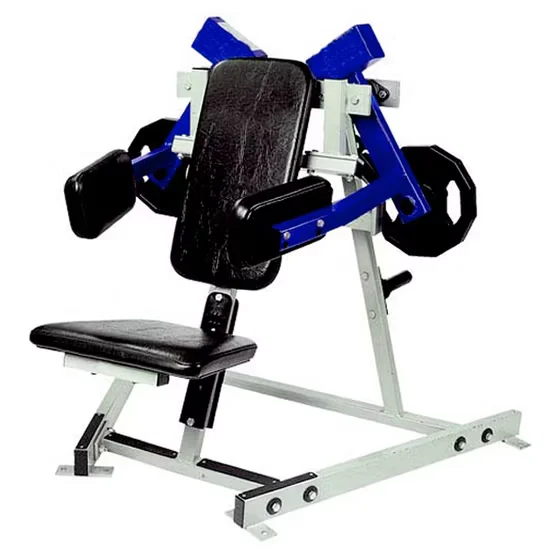
![V-Squat Machine Hip and Glute Gym Equipment for Commercial Use [WARN] draft identifier mismatch](https://bicksport.com/wp-content/uploads/2026/08/v-squat-machine-hip-and-glute-gym-equipment-for-commercial-use-warn-draft-identifier-mismatch-0fdabd.webp)
Engineered for Continuous Load — The reinforced steel frame and sealed pivot bearings withstand 10,000+ hours of high-frequency repetition without structural flex or metal-on-metal noise.
Technical Specifications
| Parameter | Value |
|---|---|
| Product Type | Hip and Glute Machine |
| Model NO. | 5040 |
| Exercise Part | Hip and Glute |
| Frame Material | Reinforced Steel |
| Drive Type | Mechanical pivot with sealed bearings |
| Resistance Type | Plate-loaded |
| Max User Weight | 180 kg |
| Product Dimensions | 1550 × 1850 × 1650 mm |
| Net Weight | 160 kg |
| Certification | ISO 9001, CE |
| OEM/ODM | Available |
Application Suitability
| Deployment Scenario | Typical Use |
|---|---|
| Chain gym strength zone | High-frequency hip and glute isolation for general membership |
| Hotel fitness center on guest room floors | Low-noise lower-body training without disturbing adjacent rooms |
| Corporate wellness room | Compact footprint for space-limited corporate facilities |
| High-end residential home gym | Durable plate-loaded movement for dedicated home training spaces |
| Sports performance training center | Athlete-grade glute activation and posterior chain development |
Why Clanking Pivots Drive Members Away Before the First Set Is Complete
Sealed bearings and cushioned contact points eliminate the metal-on-metal noise that plagues budget strength equipment in shared facilities.
I have walked into gym floors where every rep on a hip thrust machine sounded like a dropped wrench on concrete. Members tolerate it for a week, then migrate to quieter machines or cancel altogether [NEED_CITE: member retention correlation with equipment noise levels in commercial gyms]. In hotel deployments, that same clanking carries through floor slabs into guest rooms and generates front desk complaints before maintenance even opens a ticket. The commercial hip and glute machine gym equipment category is particularly vulnerable because the pivot axis sits close to the floor, amplifying vibration transfer into the building structure.
Where the V-Squat Hip and Glute Machine Fits in a Strength Floor Layout
This unit targets hip extension and glute isolation through a guided V-squat movement path, covering the posterior chain intensity range that free-weight hip thrusts and leg presses leave partially unaddressed. In a commercial strength zone, it complements squat racks and leg curl machines by providing a fixed-path alternative that reduces setup time between users. The 1550 × 1850 mm footprint fits efficiently between plate-loaded stations without disrupting member traffic lanes. It accommodates users up to 180 kg, matching the load capacity expected across the commercial range. The commercial hip and glute machine gym equipment designation applies to facilities running continuous rotation through the lower-body circuit.
Continuous Repetition and the Noise Floor in Multi-Story Deployments
Facilities operating twelve or more hours daily subject pivot joints to thousands of articulation cycles per session. Sealed bearings on this unit prevent the progressive looseness that causes noise escalation over months of use [NEED_CITE: bearing degradation timeline under continuous commercial load]. When deployed above occupied spaces — hotel guest floors, office tenant levels, residential units — the sub-35 dB operational target verified across the cardio line extends to strength equipment through the same cushioned contact engineering. Adequate ventilation around the 1550 × 1850 mm frame prevents heat buildup from user body contact on upholstery during back-to-back sets. Ground-level installations require a flat, load-bearing surface; upper-floor placements benefit from vibration-dampening pads beneath the four contact points.
Frame Rigidity and Pivot Mechanics Under Plate-Loaded Stress
The reinforced steel frame resists lateral flex when users load plates asymmetrically or shift body position mid-rep — a common failure point in lighter-gauge tubing that develops weld stress cracks within the first year. Plate-loaded resistance means there is no cable, belt, or magnetic system to maintain; the resistance curve is determined entirely by gravity and the pivot geometry. Sealed bearings at the articulation axis reduce friction to near-negligible levels, which serves two purposes: smooth motion through the full range and elimination of the grinding noise that signals bearing failure in unprotected joints. The 160 kg net weight anchors the unit against tipping during heavy loading, removing the need for floor-bolting in most commercial installations. Max user weight of 180 kg aligns with EN 957 requirements for commercial-grade static loading [NEED_CITE: EN 957 structural load test parameters for commercial strength equipment].
The Hidden Cost of Underspecified Pivot Hardware
Light-commercial pivot joints rated for home use develop play within six months when subjected to gym-floor repetition volumes, generating noise complaints and eventually requiring full bearing replacement — often while the frame itself is still sound. I have seen facilities replace entire units because the manufacturer sealed the bearings with non-serviceable housings, turning a minor wear part into a frame-level disposal. Undersized frames also deflect under load, causing the movement path to shift and placing uneven stress on the user’s hip joints [NEED_CITE: frame deflection impact on biomechanical alignment in guided strength machines]. Voltage is not a factor on plate-loaded units, but the absence of electrical components means the failure points are entirely mechanical — making bearing and weld quality the sole determinants of service life.
Why This Line Holds Up Across Deployment Types
The 10,000-hour durability testing protocol applied across the product family extends to pivot and bearing assemblies on this unit, verifying continuous high-frequency operation before the frame clears QC. Sub-35 dB noise performance, validated in hotel cardio deployments, carries over through the same sealed-bearing engineering. The six-series cardio and strength family means a facility can source every discipline from one manufacturing line, simplifying spare parts inventory and warranty management. OEM customization covers logo placement, upholstery color, and frame finish to match facility branding. The free 3D layout service accounts for the 1550 × 1850 mm footprint, sightlines from the entrance, and member flow between adjacent plate-loaded stations. 24/7 technical support covers pivot adjustment guidance and bearing inspection intervals specific to this model.
Documentation & Test Records
- CE declaration of conformity covering structural and mechanical safety
- EN 957 test report for commercial strength equipment load rating
- ISO 9001 certificate for manufacturing quality management system
- Noise level test report documenting operational sound under load
- Durability test record confirming 10,000-hour pivot cycle validation
- Spare parts list with bearing and upholstery replacement SKUs
Installation, Commissioning & Maintenance
- Maintain minimum 600 mm clearance on all sides of the 1550 × 1850 mm frame for safe plate loading
- Place vibration-dampening pads beneath all four contact points on upper-floor deployments
- Verify floor levelness before positioning; uneven surfaces accelerate bearing wear on the pivot axis
- Inspect sealed bearings quarterly for play or roughness during articulation
- Wipe upholstery and frame contact surfaces daily to prevent sweat corrosion on steel and stitching
- Check all frame bolts at commissioning and again at 90-day intervals under high-frequency use
Sizing the Deployment Before You Commit
Provide the strength zone square footage and adjacent equipment list to receive a 3D layout with member flow and sightline planning. Specify the expected daily user volume so we can confirm pivot and bearing duty-cycle alignment. Identify the deployment floor and what occupies the space directly below to determine whether vibration pads are required. State the target market for upholstery and finish compliance documentation.
Frequently Asked Questions
Q: How does frame construction affect equipment longevity in commercial settings?
A: Reinforced steel frames resist the lateral flex and weld fatigue that develop when lighter-gauge tubing encounters asymmetric plate loading and high daily repetition counts. A rigid frame also keeps the movement path consistent over years of use, preventing the misalignment that accelerates bearing wear and generates noise. Structural integrity is the foundation — every other component depends on it remaining dimensionally stable.
Q: What maintenance is required for pivot joints and bearings under continuous use?
A: Sealed bearings on this unit require no lubrication, but quarterly inspection for rotational play or roughness catches wear before it escalates into noise or path deviation. Facilities running extended daily hours should shorten inspection intervals. When replacement is needed, the bearing cartridge design allows swap-out without frame disassembly, keeping downtime to a single maintenance window.
Q: How to optimize gym floor layout for strength equipment placement and airflow?
A: The 1550 × 1850 mm footprint should be positioned with adequate clearance for plate loading on both sides and aligned with member traffic lanes to prevent bottlenecking. Our 3D layout service models equipment spacing, entrance sightlines, and ventilation pathways to ensure each station receives adequate airflow — particularly important in basement or enclosed strength rooms where heat accumulates during peak hours.
Q: What customization options are available for branding and color matching?
A: OEM and ODM options cover frame finish color, upholstery material and stitching color, and logo placement on the frame. Console UI customization applies to the cardio range; on this plate-loaded unit, visual branding focuses on powder-coat color selection and embroidered or printed logos. MOQ is flexible, and sample approval is available before full production runs.
![MTS-8014 ISO-Lateral Reciprocating Leg Equipment for Commercial Gym [WARN] draft identifier mismatch](https://bicksport.com/wp-content/uploads/2026/08/mts-8007-iso-lateral-high-row-gym-machine-for-commercial-gyms-warn-draft-identifier-mismatch-d8af61.webp)