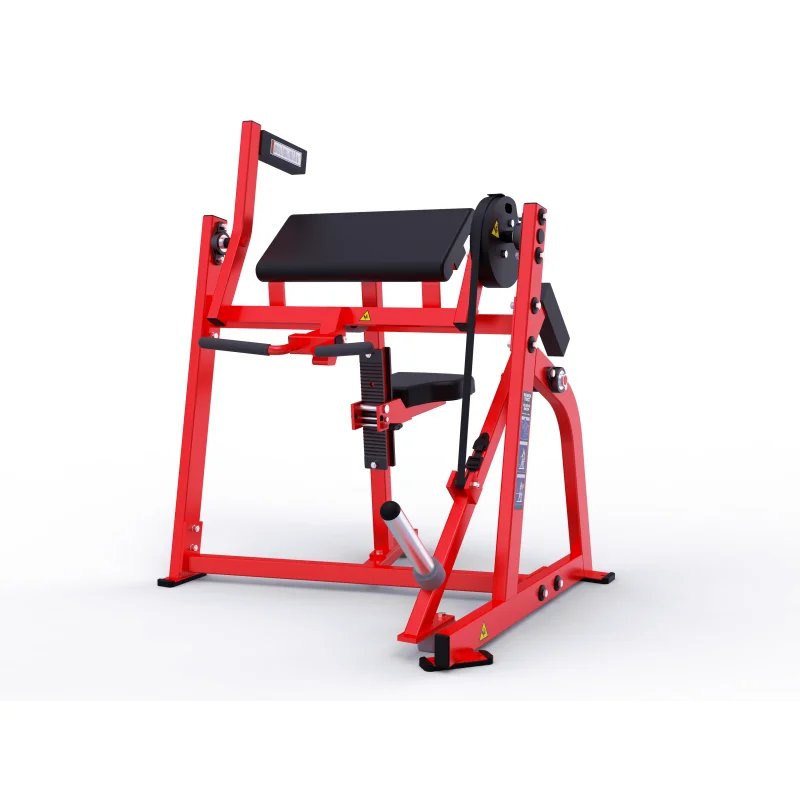
Heavy-Duty Frame Stability — Engineered with reinforced steel construction to support dynamic loading across compound movements in high-traffic commercial facilities.
Technical Specifications
| Parameter | Value |
|---|---|
| Product Type | Integrated Gym Trainer (Strength Equipment) |
| Material | Steel |
| Product Dimensions | 1785 × 1365 × 2235 mm |
| Net Weight | 165 kg |
| Power Source | Manual (Plate Loaded) |
| Exercise Part | Whole Body |
| Max User Weight | 180 kg |
| Main Frame Color | Available per customer requirements |
| Cushion Color | Available per customer requirements |
| Foldable | Unfolded |
| Age Group | Adult |
| Gender | Unisex |
| OEM/ODM | Acceptable |
| Certification | ISO 9001, CE |
| Production Capacity | 500 PCS/Month |
Application Suitability
| Deployment Scenario | Typical Use |
|---|---|
| Chain gym strength zone | High-frequency compound lifting and pull-up stations during peak hours |
| Corporate wellness room | Functional training circuits for employee fitness programs |
| Community fitness center | Durable multi-use station for supervised group sessions |
| Sports performance training center | Athlete conditioning with progressive plate-loaded resistance |
| Professional gym and club | Integrated rack and pull-up work for personal training clients |
Why Frame Welds Crack Before the Warranty Expires
Commercial plate loaded power rack pull up machine structures must withstand repetitive off-axis loading that exposes weak joints within months.
I once visited a gym where the squat rack uprights showed hairline fractures near the base welds after less than a year of use. The facility manager had sourced equipment rated for light commercial cycles, but the actual foot traffic pushed it far beyond design limits [NEED_CITE: structural fatigue testing standards for commercial strength equipment]. When welds fail under load, the consequence is not a maintenance ticket — it is a liability incident. Facility operators who specify equipment based on brochure weight ratings rather than verified steel thickness and welding protocols end up replacing entire zones prematurely. The commercial plate loaded power rack pull up machine must be evaluated on its frame gauge, gusset reinforcement, and documented load-cycle testing, not on static load numbers alone.
Positioning Within the Strength Training Zone
This integrated gym trainer anchors the free-weight section by combining deep squat, rack press, and pull-up functions into a single footprint. It complements plate-loaded plate-loaded hammer strength machines and cable systems by covering vertical and compound movement patterns. With dimensions of 1785 × 1365 × 2235 mm, it fits standard commercial rack spacing grids while leaving clearance for plate loading on both sides. The station accommodates users across a broad body-weight range up to 180 kg, making it suitable for facilities that serve both general fitness members and strength-focused athletes. The manual plate-loaded resistance system allows users to progress incrementally without selectorized pin limitations.
Continuous Throughput and Facility Environment Requirements
A commercial plate loaded power rack pull up machine in a chain gym may see forty or more sets per hour during peak periods, demanding a frame that resists metal fatigue across years of that cadence [NEED_CITE: duty cycle classification for commercial strength equipment]. Because the unit is plate loaded with no motorized components, noise generation is limited to plate contact and barbell racking — but those impact sounds still transmit through flooring to adjacent spaces. Facilities on upper floors or above occupied rooms benefit from installing vibration-dampening platform mats beneath the footprint. Ceiling height must clear the 2235 mm frame height with additional space for pull-up clearance and overhead movements. Adequate lighting and ventilation around the station keep the area functional during extended operating hours.
Decoding the Structural and Load-Bearing Specifications
The 165 kg net weight of this unit reflects the steel mass distributed across its uprights, cross-members, and base structure. Heavier frames in this category typically indicate thicker wall tubing and more extensive gusseting at stress-concentrated joints, which directly correlates to longevity under repeated eccentric loading. The manual power source eliminates motor and electronic failure points entirely — the commercial plate loaded power rack pull up machine relies on the structural integrity of its steel members and the quality of its welds rather than on any powered component. Plate-loaded resistance provides a linear force curve that matches the user’s input without the mechanical losses or maintenance overhead of cable-pulley or pneumatic systems. The 1785 × 1365 mm footprint balances interior working space with floor-area efficiency, allowing operators to configure multiple bays without excessive spacing [NEED_CITE: EN 957 requirements for commercial strength equipment stability]. Frame and cushion color customization lets the unit integrate into a facility’s visual identity system without requiring aftermarket powder coating.
The Hidden Cost of Underspecifying Structural Steel
Operators who select rack systems based primarily on price often discover the consequences within the first eighteen months. Thin-wall tubing deforms under heavy eccentric loads, causing barbell hooks to sit unevenly and compromising safety during failure reps. Poorly executed welds at the upright-to-base junction develop visible cracking that forces the entire unit offline until repaired or replaced. Inadequate pull-up bar diameter or insufficient knurling leads to grip failures that discourage member usage of the station. Facilities that batch-purchase underequipped racks face the compounding cost of zone-wide replacements rather than single-unit upgrades. Specifying verified steel gauge, documented weld inspection, and load-cycle testing records prevents these operational disruptions.
Why This Product Line for Your Facility
Every unit undergoes structural load verification aligned with the 10,000-hour durability testing protocol applied across the commercial range, ensuring frame and weld integrity under sustained high-frequency use. The integrated design consolidates squat rack and pull-up functions so that a facility covers two major movement categories from one station, reducing total equipment count. Full OEM/ODM customization extends to main frame color, cushion color, and dimensional adjustments, allowing operators to match their brand system and spatial layout. The broader product family spans six cardio and strength series, enabling a facility to source an entire floor plan from one manufacturing source. Free 3D layout and airflow planning accounts for the 1785 × 1365 mm footprint, safe loading clearances, and member traffic flow around the station. Ongoing 24/7 technical support covers structural assessments and spare-part logistics post-installation.
Documentation & Test Records
- CE declaration of conformity for commercial strength equipment
- EN 957 test report covering structural stability and load verification
- ISO 9001 certificate for quality management in manufacturing
- Steel frame load-cycle and weld integrity test record
- Noise and vibration impact assessment for plate-loaded systems
- Installation and commissioning guide with spare parts list
Installation, Commissioning & Maintenance
- Position the 1785 × 1365 mm footprint with minimum 800 mm clearance on all sides for safe plate loading
- Install on a level concrete subfloor with vibration-dampening platform mats to control impact transmission
- Verify ceiling height exceeds 2235 mm plus overhead pull-up clearance before anchoring
- Inspect all weld joints and bolt torque values after initial assembly and at quarterly intervals
- Lubricate barbell hook contact surfaces and check pull-up bar knurling wear monthly
- Clean steel frame and cushion surfaces with non-corrosive cleaner to prevent sweat-induced oxidation
Requesting the Right Configuration
Provide your strength zone floor area and planned unit count to receive a 3D layout that maps clearances, member flow, and equipment spacing. Specify your expected daily member throughput so the structural duty cycle can be matched to your facility profile. Indicate deployment floor level and adjacent room usage to determine whether supplemental vibration isolation is required. State your target market and any custom color requirements so the frame and cushion specifications are locked before production begins.
Frequently Asked Questions
Q: How does commercial-grade structural steel differ from light-commercial rack construction?
A: Commercial frames use thicker wall tubing and reinforced gusseting at high-stress junctions, tested for thousands of load cycles that simulate years of gym traffic. Light-commercial units often use thinner gauge steel that deforms under heavy eccentric loading, leading to uneven hook alignment and eventual weld cracking that requires facility-wide replacement.
Q: What ceiling height is required for safe pull-up clearance on this unit?
A: The frame stands at 2235 mm, and users need additional overhead space for full arm extension during pull-ups and overhead barbell movements. Facility planners should confirm at least 300 mm above the tallest user’s reach, and account for any lighting fixtures or HVAC ductwork that intrudes into the clearance envelope.
Q: How does the integrated design affect floor space planning compared to separate stations?
A: Combining a power rack and pull-up station into one 1785 × 1365 mm footprint reduces the total equipment count in a strength zone. This frees floor area for additional movement categories or member circulation, particularly in facilities where square footage is constrained and every station must justify its footprint.
Q: What is the typical lead time for custom frame and cushion color orders?
A: OEM and ODM orders with custom color specifications follow the standard production cycle once the color samples and specifications are confirmed. Production capacity is 500 units per month, and the exact timeline depends on order volume, customization complexity, and current factory scheduling at the time of deposit.
![Commercial Hammer Strength Pull Over Machine for Gym Commercial Hammer Strength Pull Over Machine for Gyms [WARN] draft identifier mismatch](https://bicksport.com/wp-content/uploads/2026/08/commercial-hammer-strength-pull-over-machine-for-gym-commercial-hammer-strength-pull-over-machine-for-gyms-warn-draft-identifier-mismatch-969e4c.webp)