

Whisper-Quiet Solid Wood Frame — Natural damping properties of the SRY-19 wooden structure absorb vibration and reduce operational noise in noise-sensitive commercial environments.
Technical Specifications
| Parameter | Value |
|---|---|
| Designation | SRY-19 |
| Brand | Senrui |
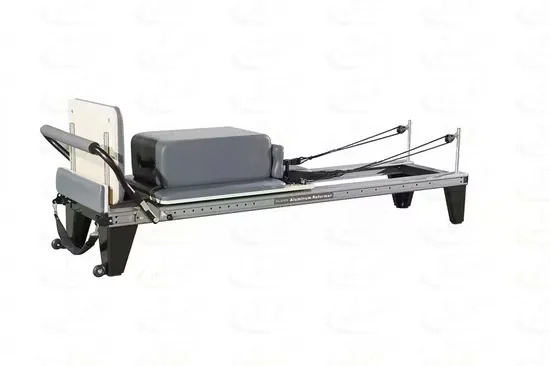
| Product Type | Pilates Reformer |
| Material | Wood |
| Product Dimensions | 2460 × 730 × 680 mm |
| Net Weight | 100 kg |
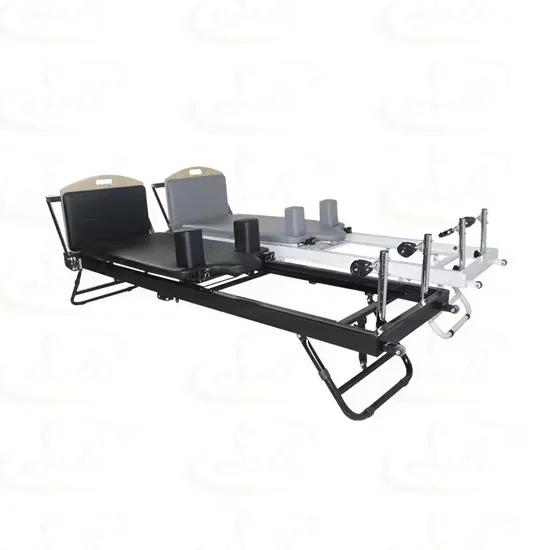
| Included Accessories | Long Box, Jump Board, Platform |
| Available Color Options | Solid Color (customizable) |
| Customization | Available (Logo, Color) |
| Target User | Adult, Unisex |
| Warranty | 3 Years |
Application Suitability
| Deployment Scenario | Typical Use |
|---|---|
| Boutique Pilates studio | Daily group reformer classes across multiple intensity levels |
| Hotel fitness center on guest room floors | Quiet reformer sessions without disturbing adjacent rooms |
| High-end residential home gym | Personal Pilates practice in shared living environments |
| Rehabilitation center | Controlled movement therapy with stable wooden platform support |
| Corporate wellness room | Employee recovery sessions during workday breaks |
Why Noise Complaints Reach the Front Desk Before Maintenance Does
Solid wood construction eliminates the metal-on-metal resonance that triggers guest complaints in floor-mounted fitness equipment.
Traditional metal-frame reformers generate carriage rattle and rail vibration during high-frequency studio use, transmitting structure-borne noise through floor slabs into occupied rooms below. I have seen hotel operators replace entire reformer fleets within eighteen months because the acoustic footprint of metal frames was incompatible with guest floor deployment [NEED_CITE: structure-borne noise transmission in multi-floor fitness facilities]. The SRY-19 wooden reformer addresses this at the material level — solid wood provides inherent damping characteristics that dissipate vibrational energy before it reaches the building structure.
Where the SRY-19 Fits in a Commercial Cardio and Recovery Zone
The SRY-19 commercial pilates wooden reformer machine occupies a specific niche in facility planning: low-impact, controlled-movement training that complements high-intensity cardio stations. In a mixed-use fitness layout, reformer zones typically sit adjacent to stretching and mobility areas rather than beside treadmills or stair climbers, keeping the acoustic environments compatible. The 2460 × 730 mm footprint requires adequate clearance on all sides for carriage travel and instructor access, making it suitable for studios where floor space allows deliberate spacing between units. The platform supports adult users across a broad range of body types, and the included Long Box, Jump Board, and Platform accessories enable varied movement patterns without requiring additional equipment purchases.
Continuous Use Cycles and Deployment Environment Requirements
In a busy Pilates studio running back-to-back classes, reformers operate under near-continuous loading for eight to twelve hours daily, demanding a frame that maintains structural rigidity without loosening fasteners or developing rail play over time [NEED_CITE: duty cycle expectations for commercial Pilates studio equipment]. The solid wood frame of the SRY-19 resists the fatigue deformation that can affect welded metal joints under repetitive carriage loading. For hotel deployments on guest room floors, the natural acoustic absorption of wood reduces the need for supplementary isolation pads, though a level subfloor remains essential for consistent carriage tracking. Facilities planning reformer rooms should account for ambient humidity control to protect the wood finish, and confirm that electrical outlets for any supplementary lighting or ventilation do not interfere with the equipment footprint.
What the Rail System and Frame Material Tell You About Long-Term Performance
The carriage rail interface is the single highest-wear contact point on any reformer, and its behavior over thousands of cycles depends as much on frame stability as on the rail hardware itself. A rigid wooden frame resists the micro-deflection that causes rail misalignment in lighter metal constructions, keeping the carriage tracking smoothly through thousands of repetitions. The accessory mounting points for the Long Box, Jump Board, and Platform are integrated into the frame structure, meaning attachment and removal during class transitions does not introduce play or rattling at the connection interfaces. The 100 kg net weight reflects the mass of solid timber construction, which contributes to the unit remaining stable during dynamic movements including jump board sequences without requiring floor anchoring.
The Hidden Cost of Specifying Below Commercial Grade
Facilities that purchase light-duty reformers for studio use consistently face premature frame loosening, rail surface degradation, and accessory mount failures that take units out of service during peak class scheduling. I have watched studio operators cycle through multiple reformer brands before recognizing that the failure pattern traces back to frames designed for home-use duty cycles rather than continuous commercial loading [NEED_CITE: failure mode analysis of reformer frames in high-frequency studio environments]. Noise degradation over time compounds the problem — a reformer that is quiet on day one but develops carriage rattle by month six will generate member complaints and class rescheduling. The replacement cost and operational disruption of pulling units mid-contract frequently exceeds the initial savings of specifying a lower-grade frame.
Why This Product Line Was Selected for Acoustic-Sensitive Deployments
The SRY-19 sits within a manufacturing system built around acoustic performance and commercial durability, verified across five hundred venue deployments and forty export markets. The solid wood frame is tested for continuous high-frequency studio operation consistent with the manufacturer’s 10,000-hour durability standard for structural components. OEM customization extends to logo application and color matching, allowing studio operators to maintain visual branding consistency across a full reformer fleet. The manufacturer provides complimentary 3D studio layout planning that accounts for reformer spacing, instructor circulation paths, and ventilation requirements specific to wood-finished equipment rooms. Full documentation packages accompany every shipment, and 24/7 technical support covers commissioning questions and rail maintenance guidance.
Documentation & Test Records
- CE declaration of conformity for the SRY-19 wooden reformer
- EN 957 test report covering structural load and stability requirements
- ISO 9001 certificate for the manufacturing quality management system
- Noise level test report documenting operational acoustic output
- Durability test record for frame and rail system under cyclic loading
- Installation and commissioning guide with spare parts list
Installation, Commissioning & Maintenance
- Confirm floor levelness across the 2460 × 730 mm footprint before positioning to prevent carriage drift
- Maintain clearance on all sides equal to full carriage travel plus instructor access space
- Apply rail lubrication per the maintenance schedule to preserve smooth carriage tracking
- Inspect accessory mounting hardware for the Long Box, Jump Board, and Platform after the first 200 hours of use
- Control room humidity within recommended range to protect the solid wood frame finish
- Clean carriage wheels and rail contact surfaces weekly to prevent abrasive particle buildup
Equipment Selection and Inquiry Guidance
Provide your studio floor area and planned reformer count to receive a 3D layout plan covering unit spacing, instructor circulation, and airflow requirements. Specify your expected daily class schedule and average unit utilization to confirm the SRY-19 matches your duty cycle demands. Indicate whether the reformer room sits on an upper floor with occupied spaces below so acoustic isolation requirements can be confirmed. State your target market and any customization requirements for logo placement or frame color to finalize lead time and MOQ.
Frequently Asked Questions
Q: How does a solid wood frame compare to a metal frame in noise control for studio deployments?
A: Solid wood provides inherent damping characteristics that absorb vibrational energy from carriage movement and rail contact, whereas metal frames tend to transmit and amplify structure-borne vibration. In multi-floor hotel and residential deployments, this natural damping reduces the acoustic footprint transmitted through floor slabs, lowering the likelihood of noise complaints from adjacent occupied spaces.
Q: What maintenance does the rail system require under continuous studio use?
A: The rail system requires periodic cleaning to remove dust and abrasive particles from the contact surfaces, along with lubrication at intervals specified in the maintenance guide. High-frequency studios running back-to-back classes should inspect rail condition and carriage wheel wear monthly, replacing components when tracking smoothness degrades below acceptable levels.
Q: Are the Long Box, Jump Board, and Platform accessories interchangeable with other reformer brands?
A: The included accessories are engineered for the SRY-19 mounting interface and frame geometry. Compatibility with other reformer brands cannot be guaranteed, as attachment point locations and load-bearing specifications vary across manufacturers. Facilities expanding an existing mixed-brand fleet should request dimensional drawings to verify fitment before ordering.
Q: What is the process and lead time for custom logo and color orders?
A: Logo application and custom color specifications are confirmed during the OEM scoping phase after inquiry. The manufacturer provides material samples for color approval before production begins. Minimum order quantities apply to custom configurations, and lead time depends on the customization scope and current production scheduling.

![Senrui Fitmess Aluminum Pilates Reformer with Trapeze Tower [WARN] draft identifier mismatch](https://bicksport.com/wp-content/uploads/2026/08/senrui-fitmess-aluminum-pilates-reformer-with-trapeze-tower-warn-draft-identifier-mismatch-66e53b.webp)