
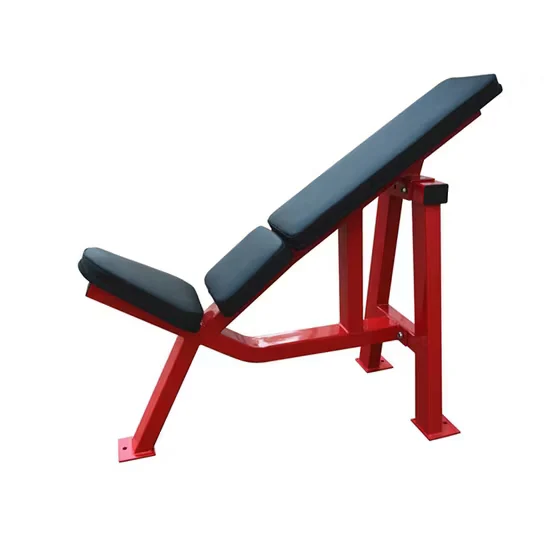
Heavy-Duty Frame Build — Reinforced steel construction tested to endure continuous commercial strength training cycles across high-traffic gym environments.
Technical Specifications
| Parameter | Value |
|---|---|
| Product Type | Incline Bench (Strength Equipment) |
| Model NO. | 5063 |
| Exercise Part | Chest |
| Material | Steel |
| Product Dimensions | 1225 × 549 × 960 mm |
| Net Weight | 36 kg |
| Incline Angle | 30 Degrees (Fixed) |
| Age Group | Adult |
| Gender | Unisex |
| Appliance | Gymnasium |
| Certification | ISO 9001, CE |
Application Suitability
| Deployment Scenario | Typical Use |
|---|---|
| Commercial gymnasium strength zone | Primary chest pressing and dumbbell fly work at fixed incline |
| Chain fitness center free weight area | High-frequency rotation among members performing upper body compound movements |
| Corporate wellness facility | Accessible strength training for employees during short break sessions |
| Sports performance training center | Supplementary chest isolation work within periodized athlete programs |
Why Structural Integrity Decides Whether a Bench Survives the Free Weight Zone
A bench either holds rigid under loaded barbells or develops wobble within months.
Commercial free weight zones see equipment loaded, dropped, and repositioned dozens of times per operating shift. Benches built with thin-wall tubing and single-point welds begin shifting under asymmetric loads, creating uneven press mechanics and member complaints. The frame on this commercial incline bench 30 degree gym equipment uses reinforced steel sections with full-perimeter welds to maintain planar stability through repeated high-load cycles [NEED_CITE: structural fatigue thresholds for commercial strength benches under cyclic loading].
Role Within the Strength Training Floor Layout
This bench occupies a specific position in the free weight hierarchy: fixed-angle chest pressing and incline dumbbell work where users require a stable, non-adjustable back pad. It complements flat benches and adjustable FID benches by handling the high-volume 30-degree incline pressing that accounts for a significant share of chest training sessions. The compact footprint fits standard spacing between dumbbell racks and plate-loaded stations, maintaining clear member traffic flow. Maximum user loading accommodates the full range of commercial gym demographics. This commercial incline bench 30 degree gym equipment is positioned where facilities need a dedicated, zero-adjustment station that removes setup friction during peak hours.
Continuous Use Demands and Floor Placement Requirements
Free weight zone benches experience cyclic loading patterns different from machines — members load, unload, and shift position continuously throughout operating hours. The 36 kg net weight provides enough base mass to resist lateral shifting during dumbbell pressing without requiring floor anchoring. Placement should account for clearance on all sides: sufficient room for spotters to stand at the head end and for loaded dumbbells to be picked up and racked without adjacent equipment interference [NEED_CITE: recommended clearance dimensions for free weight bench stations in commercial facilities]. Floor surface must be level; uneven slabs introduce frame rock that accelerates weld fatigue. No electrical supply or data connection is required, simplifying deployment in any zone of the facility.
Steel Gauge, Weld Pattern, and Load Path Engineering
The structural behavior of a commercial bench under load depends on tube wall thickness, cross-section geometry, and weld continuity. Thin-gauge rectangular tubing deflects under heavy dumbbell loads, translating into pad movement that compromises pressing stability. This bench uses steel sections sized to resist deflection across the 1225 mm length, maintaining a rigid press surface. The 30-degree fixed angle eliminates pivot mechanisms and adjustment pins — two common failure points on adjustable benches in high-frequency environments. Pad density and upholstery tension determine whether the contact surface remains supportive after months of sweat exposure and compression cycles. The 549 mm width positions the bench within standard dumbbell rack reach distances. Certification under EN 957 standards confirms the frame and pad assembly meets commercial load testing requirements [NEED_CITE: EN 957 static and dynamic load testing protocols for strength training benches].
The Hidden Cost of Specifying Below Commercial Grade
Facilities that procure light-commercial benches for high-traffic free weight zones typically see frame wobble develop within the first year of continuous operation. Wobbling benches force members to compensate for instability during pressing movements, generating complaints and eventually pulling equipment from the floor. A bench that rocks under load also accelerates pad separation from the frame as mounting bolts work loose through cyclic stress. Replacement cycles for under-specified benches compress procurement budgets and create gaps in strength zone equipment availability [NEED_CITE: lifecycle cost comparison between commercial and light-commercial strength benches]. Procurement decisions based on unit price alone frequently result in higher total cost when replacement and member dissatisfaction are factored in.
Why This Product Line Addresses Facility Procurement Priorities
Every strength bench in this product family undergoes structural load testing aligned with EN 957 commercial requirements before leaving the manufacturing floor. The six-series cardio and strength catalog allows facilities to source complete floor configurations from a single production line, ensuring finish consistency and lead time alignment. OEM customization covers frame color, pad upholstery, and logo placement at flexible minimum order quantities. The in-house R&D lab and CNC machining capability mean frame geometry adjustments can be evaluated without external tooling delays. Free 3D layout planning accounts for free weight zone spacing, member sightlines, and traffic flow — including the footprint and clearance requirements of this bench within the broader strength training area. Technical support remains available around the clock for commissioning questions and spare part identification.
Documentation & Test Records
- CE declaration of conformity covering structural and safety requirements
- EN 957 test report validating static and dynamic load performance
- ISO 9001 certificate confirming manufacturing quality management systems
- Durability test record documenting cyclic load testing on frame and welds
- Installation and commissioning guide with spare parts identification list
Installation, Commissioning & Maintenance
- Confirm floor levelness across the 1225 × 549 mm footprint before final placement to prevent frame rock
- Maintain minimum clearance on all sides for spotter access and dumbbell handling
- Inspect weld joints and bolt torque at pad mounting points after the first 30 days of operation
- Wipe down steel frame and upholstery after each operating shift to prevent sweat corrosion
- Check pad density and cover tension quarterly; replace if compression set is visible
- Verify frame stability by applying lateral force before returning bench to service after any relocation
Equipment Selection and Procurement Inquiry
Provide your strength zone floor area and equipment list to receive a 3D layout incorporating bench spacing, dumbbell rack positioning, and member traffic flow. Specify expected daily usage hours and member volume to confirm the frame specification matches your facility’s duty cycle. Indicate target market and deployment environment so finish and pad material recommendations align with local climate and maintenance practices. State whether OEM customization for frame color or logo placement is required for brand consistency across your facility network.
Frequently Asked Questions
Q: What separates a commercial incline bench from a home-use model?
A: Commercial benches use thicker steel tubing, continuous weld patterns, and high-density pad foam designed for thousands of loading cycles per month. Home benches typically employ lighter gauge materials and thinner padding that compress and degrade rapidly under gym-level usage. The frame mass and base geometry on commercial units also resist lateral shifting during heavy dumbbell pressing, which is critical for member safety in unsupervised free weight zones.
Q: Which exercises does a fixed 30-degree incline angle support?
A: The 30-degree angle targets the upper chest during incline dumbbell presses and barbell presses while reducing anterior deltoid involvement compared to steeper angles. It also supports incline dumbbell fly movements and seated shoulder press variations. The fixed angle eliminates adjustment mechanism complexity, making the bench faster to use during peak hours when members cycle through stations without needing to reconfigure equipment between sets.
Q: How is frame load capacity verified before shipment?
A: Each production batch undergoes static load testing per EN 957 protocols, applying force to the bench surface and frame joints to confirm structural integrity without deflection or deformation. Dynamic cyclic testing simulates repeated loading and unloading to identify potential fatigue points in welds and bolt connections. Test records are maintained and available for buyer review alongside the CE declaration and ISO 9001 documentation package.
Q: What spacing guidelines apply when placing multiple benches in a strength zone?
A: Adequate clearance on all sides of each bench allows spotters to position themselves safely and members to handle dumbbells without interference from adjacent equipment. A 3D layout plan accounts for the specific dimensions of each bench model, dumbbell rack positions, plate storage, and member traffic paths. Proper spacing prevents congestion during peak hours and reduces equipment collision damage.

![OS-H5084 Half Rack Commercial Gym Equipment [WARN] draft identifier mismatch](https://bicksport.com/wp-content/uploads/2026/08/os-h5084-half-rack-commercial-gym-equipment-warn-draft-identifier-mismatch-2989a4.webp)