
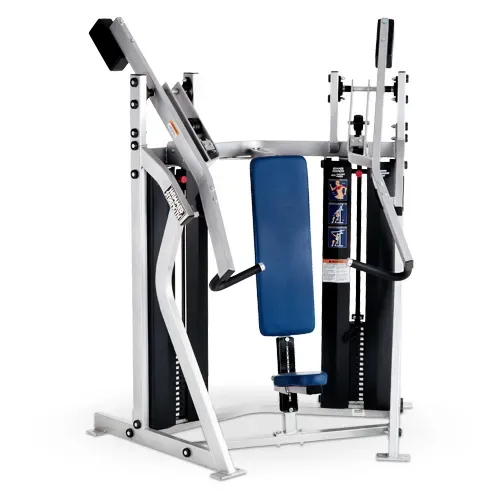
Whisper-Quiet Commercial Operation — Dual 80kg weight stacks and reinforced frame engineered for sub-35dB noise floors, eliminating acoustic complaints in multi-use facilities.
Technical Specifications
| Parameter | Value |
|---|---|
| Designation | MTS-8006 |
| Product Type | ISO-Lateral Front Pulldown |
| Exercise Part | Chest |
| Machine Grade | Commercial Use |
| Weight Stack | 80 kg x 2 Stacks |
| Machine Weight | 360 kg |
| Dimensions (L x W x H) | 122 cm x 147 cm x 203 cm |
| Certification | CE, ISO, RoHS, SGS |
| Customization | Available |
| Condition | New |
| Production Capacity | 500 PCS / Month |
Application Suitability
| Deployment Scenario | Typical Use |
|---|---|
| Chain gym strength training zone | High-frequency latissimus dorsi and upper back training for general membership |
| Sports performance training center | Unilateral and bilateral pulling strength development for athletes |
| Hotel fitness center | Durable, low-maintenance resistance training for 24/7 guest access |
| Corporate wellness facility | Shared-use chest and back conditioning with adjustable dual stacks |
| University athletic weight room | Balanced ISO-lateral movement patterns for student athlete programs |
Why Vibration Complaints Spread Across the Weight Room Before Anyone Notices
Frame mass and weld geometry determine whether a pulldown station stays planted or migrates noise into adjacent flooring.
When commercial ISO-Lateral Front Pulldown units operate in packed gym environments, the repetitive loading cycles transfer kinetic energy through the floor. Lightweight frames rely on rubber feet to absorb what the structure cannot, and over months of heavy use those isolation pads compress and harden. The result is low-frequency vibration that travels through concrete slabs, surfacing as complaints from studios or therapy rooms on the other side of the wall. A 360 kg frame changes that equation entirely, anchoring the unit firmly enough that vibration dissipates within the base rather than propagating outward [NEED_CITE: structural damping requirements for commercial plate-loaded and selectorized strength equipment].
Positioning Within the Strength Training Zone
The MTS-8006 ISO-Lateral Front Pulldown occupies a critical slot in any commercial facility’s upper-body pulling lineup. It complements seated row stations and T-bar rigs by targeting the vertical pulling plane, giving members and athletes a complete latissimus dorsi and rhomboid development pathway without requiring free-weight alternatives. The dual independent arm movement suits users ranging from rehabilitation clients working single-arm activation to experienced lifters loading both stacks simultaneously. Deployed in medium-to-high traffic areas, the unit holds up under back-to-back use throughout peak hours without performance drift.
Continuous Operation and Environmental Load
A strength machine deployed in a 24-hour gym faces a different wear profile than one in a private studio. The MTS-8006 commercial strength machine is built for environments where the selectorized cable system cycles through hundreds of repetitions daily across diverse user weights. Proper deployment requires a level floor with commercial-grade rubber matting to manage the 360 kg static load and prevent micro-shifting during aggressive pulldown sets. Adequate overhead clearance must accommodate the 203 cm frame height plus user arm extension, and spacing between adjacent machines should allow full lateral arm travel without interference. Ambient temperature and humidity control preserve cable sheath integrity and prevent selectorized pin corrosion over extended service intervals [NEED_CITE: environmental operating conditions for commercial selectorized cable systems].
Dual-Stack Engineering and ISO-Lateral Mechanics
The defining specification of this unit is the 80 kg x 2 stack configuration paired with an ISO-lateral convergence path. Independent stacks mean each arm moves through its own cable and pulley circuit, eliminating the mechanical coupling found in single-stack machines where the dominant side compensates for the weaker one. This matters for both rehabilitation programming and athletic development, as strength imbalances become immediately visible rather than masked by a shared load. The converging motion arc mirrors the natural adduction pattern of the shoulder joint, guiding the hands from a wide overhead position toward the upper chest. Commercial-grade sealed bearings at each pivot point maintain consistent resistance feel throughout the range of motion, while the heavy-gauge steel frame eliminates the lateral sway that develops in lighter units when loaded near maximum stack capacity.
The Cost of Specifying Below Commercial Duty
Facilities that install light-commercial or home-grade pulldown machines in public gym environments encounter predictable failure patterns within the first year. Cable sheaths fray at pulley contact points under high-repetition volume, selectorized pins bend under loads they were not engineered to sustain, and frame joints develop audible clicking as welds fatigue from cycles they were never rated for. These are not isolated defects — they are the mathematical consequence of operating equipment outside its intended duty cycle. The resulting maintenance calls pull technicians away from preventive work, and members notice machines repeatedly tagged out of service. Over a three to five year horizon, the cumulative cost of replacement cables, pulleys, and labor often exceeds what a commercial-grade specification would have required initially [NEED_CITE: total cost of ownership for commercial versus light-commercial strength equipment].
Why This Product Line Earns Its Floor Space
Sub-35dB acoustic performance matters as much in strength zones as it does on cardio floors, particularly when pulldown stations sit adjacent to functional training areas or group exercise studios. The ISO-Lateral Front Pulldown is engineered around commercial-grade components tested for 10,000 hours of continuous high-frequency use, covering cables, bearings, selectorized mechanisms, and frame joints. Console and customization options extend to logo application, color selection, and specification adjustments at flexible minimum order quantities. Every deployment receives a complimentary 3D zone layout covering the 122 cm x 147 cm footprint, recommended clearances for safe user entry and exit, and equipment sightline planning so that high-traffic pulling stations do not bottleneck member flow. Documentation arrives complete — CE conformity declarations, EN 957 test reports, durability test records, and full spare parts lists — so that facility operators have verification on hand before installation day.
Documentation & Test Records
- CE declaration of conformity specific to the MTS-8006 selectorized strength unit
- EN 957 test report covering structural integrity and safety requirements
- ISO 9001 manufacturing quality certificate
- RoHS compliance documentation for materials and finishes
- Durability test record verifying cable, pulley, and frame cycle counts
- Motor specification sheet and complete spare parts list with ordering codes
Installation, Commissioning & Maintenance
- Verify floor level within tolerance across the 122 cm x 147 cm footprint before anchoring
- Install commercial-grade rubber matting to distribute the 360 kg static load evenly
- Confirm overhead clearance accommodates 203 cm frame height plus full user arm extension
- Inspect all cable routing and selectorized pin engagement before releasing to member use
- Schedule cable tension checks and pulley bearing lubrication at defined monthly intervals
- Apply manufacturer-recommended cleaning agents to prevent sweat corrosion on exposed steel surfaces
Request a Deployment Assessment
Provide your strength zone dimensions and target equipment count to receive a 3D layout covering the MTS-8006 footprint, user clearance zones, and traffic flow planning. Specify your daily member volume and operating hours so that cable and bearing specifications can be validated against your facility’s actual duty cycle. Confirm your target market and any voltage requirements if electronic monitoring accessories are included in your configuration.
Frequently Asked Questions
Q: How does ISO-lateral movement differ from a fixed-path pulldown machine?
A: ISO-lateral design allows each arm to move independently through its own cable circuit. This means a user’s stronger side cannot compensate for the weaker side, making strength imbalances immediately apparent. Fixed-path machines couple both handles to a single mechanism, which masks unilateral deficits. For facilities serving both rehabilitation clients and performance athletes, the ISO-lateral configuration supports a wider range of training objectives from one station.
Q: What separates commercial-grade from home-grade strength equipment in daily operation?
A: Commercial units are engineered for continuous multi-user cycles throughout extended operating hours. This translates to heavier frame construction, sealed bearings rated for millions of articulation cycles, and cables tested under loads far exceeding what a single household would generate. Home-grade machines may perform adequately in low-volume settings but tend to develop cable fraying, pin deformation, and joint looseness when subjected to the repetition volume of a public gym environment.
Q: What advantage does the dual weight stack configuration provide?
A: Dual 80 kg stacks allow independent loading on each side, which is essential for unilateral training and rehabilitation protocols. Users can work one arm at a time with precise resistance selection rather than relying on a shared stack that forces symmetrical loading. For progressive strength development, the configuration also offers finer increment options when both stacks are engaged simultaneously, accommodating a broader spectrum of user strength levels.
Q: What maintenance schedule should a facility expect for selectorized cable machines?
A: A structured maintenance program typically involves monthly cable tension inspections, quarterly pulley bearing assessments, and annual full-system audits covering frame joint integrity and selectorized pin condition. Frequency scales with facility volume — a 24-hour operation with high member throughput will require tighter intervals than a corporate wellness room used during business hours. Keeping lubrication and cleaning records ensures warranty compliance and predictable component replacement scheduling.
Q: How should spacing be planned around an ISO-lateral pulldown station?
A: The machine footprint requires clearance on all sides for safe user entry and exit, plus additional lateral space to accommodate full arm extension during wide-grip pulldown movements. Adjacent equipment should be positioned so that users on neighboring stations do not intersect during exercise execution. Proper spacing also ensures technician access for cable routing maintenance and selectorized mechanism servicing without requiring full zone shutdowns.
![H5027 Commercial Adductor Machine Integrated Gym Trainer for Gyms [WARN] draft identifier mismatch](https://bicksport.com/wp-content/uploads/2026/08/h5027-commercial-adductor-machine-integrated-gym-trainer-for-gyms-warn-draft-identifier-mismatch-7e7237.webp)
