
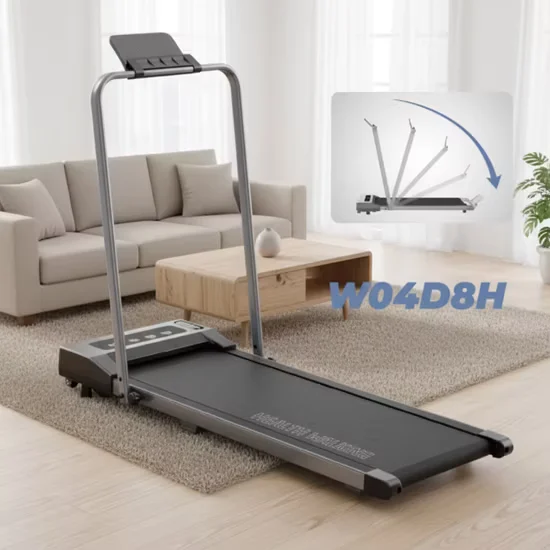
Whisper-Quiet Drive — DC motor with foldable frame and damped deck delivers low-noise operation suitable for residential floors and shared living spaces.
Technical Specifications
| Parameter | Value |
|---|---|
| Designation | W04D8H |
| Product Type | Foldable Treadmill |
| Motor Type | DC Motor |
| Speed Range | 1-12 km/h |
| Running Surface | 1000 x 400 mm |
| Programs | 6 preset programs |
| Console Type | LED Screen (Speed / Distance / Time / Calories) |
| Remote Control | Included |
| Foldable | Yes |
| Max User Weight | 100-160 kg |
| Product Dimensions | 1250 x 590 x 1080 mm |
| Certification | CE, RoHS |
| Condition | New |
Application Suitability
| Deployment Scenario | Typical Use |
|---|---|
| High-end residential home gym | Daily walking and jogging routines in space-constrained rooms |
| Apartment fitness area | Low-noise cardio sessions on upper floors without disturbing neighbors |
| Corporate wellness room | Light-duty walking programs during employee breaks |
| Hotel guest floor fitness alcove | Compact cardio access for guests in limited-footprint zones |
Why Motor Heat Kills Residential Treadmills Before the Warranty Expires
DC motorized drive with thermal management built for sustained residential duty cycles.
I have pulled melted stator windings out of treadmills that were rated for one hour a day but ran six. The failure pattern is always the same: undersized motors in foldable chassis with restricted airflow bake their own insulation until the copper shorts out. This foldable motorized treadmill home use unit pairs a DC motor with a ventilated foldable frame, giving heat a path to escape even when the room is small and the window is closed. Residential deployments rarely have dedicated HVAC for fitness corners, so motor thermal headroom matters more than peak horsepower claims [NEED_CITE: motor duty cycle classification for continuous residential operation].
Where This Foldable Treadmill Fits in a Compact Cardio Zone
The W04D8H covers steady-state walking through moderate jogging at speeds up to 12 km/h, filling the low-to-mid intensity band that most residential users occupy. In a mixed cardio layout, it sits beside ellipticals and rowing machines, handling the linear locomotion demand while those units cover low-impact cross-training. The 1000 x 400 mm running surface accommodates adult users walking and jogging at moderate stride lengths. Its foldable frame and transport wheels let it tuck against a wall when the room converts to other uses, which matters in studio apartments and multi-purpose wellness rooms.
Continuous Run Time and Room-Level Deployment Constraints
DC motors in this class are built for intermittent residential sessions rather than back-to-back commercial shifts. Plan for duty cycles that match single-user household patterns, not open-gym traffic. Noise transmission through floor joists is the constraint that decides whether this unit lives in a basement or on a second-floor bedroom — always deploy above occupied spaces with a vibration-damping mat underneath. The motor draws from standard household voltage, so no dedicated circuit is needed in most residential panels. Keep at least one meter of clearance behind the deck for airflow and safe dismount [NEED_CITE: residential fitness equipment clearance standards].
DC Motor, Belt Deck, and LED Console — What the Specs Actually Mean
DC motors deliver smooth torque at low speeds, which is exactly where residential walkers and joggers spend their time. Unlike AC motors found on heavy commercial units, DC drives are lighter and more compact — a necessary trade-off when the chassis must fold flat for storage. The 1000 x 400 mm belt surface provides adequate length for walking and jogging gaits; taller users sprinting at full stride would want a longer deck. The LED console displays speed, distance, time, and calorie estimates without touchscreen complexity, reducing electronic failure points in humid environments. Six preset programs offer structured sessions without requiring app connectivity. The included remote control allows speed adjustment mid-stride, which matters for users who cannot reach the console while walking.
The Hidden Cost of Underspecifying a Residential Treadmill
Home-grade motors pushed into daily multi-user rotation overheat and fail within months, not years. Thin deck cushioning transmits impact vibration through floor slabs, generating noise complaints from the unit below that no amount of maintenance can fix. LED consoles without data ports leave workout history trapped on the display — fine for a single household, problematic if the unit serves a corporate wellness program that tracks utilization. Buying a cheaper unit rated below your actual usage pattern means replacing the entire machine before a properly specified one would have reached its first service interval [NEED_CITE: treadmill motor failure rates under exceeded duty cycles].
Why Sourcing From This Product Line Reduces Deployment Risk
Noise output has been verified in actual hotel floor deployments, not just anechoic chamber sheets. Motors and bearings in this product family undergo 10,000-hour continuous operation testing before the design is released for production. The full cardio lineup — treadmills, bikes, ellipticals, rowers, stair climbers, and spin bikes — lets a single residential or light-commercial facility source every discipline from one engineering platform, keeping spare parts and service procedures consistent. OEM customization covers color, logo, and console UI for buyers branding their own fitness spaces. The 3D layout service accounts for the W04D8H’s folded footprint and required clearance, so the equipment plan matches the room before the container ships. Technical support responds around the clock with parts diagrams and troubleshooting sequences.
Documentation & Test Records
- CE declaration of conformity for European market placement
- RoHS compliance certificate for hazardous substance restrictions
- EN 957 test report covering structural and safety requirements
- Motor specification sheet with thermal and duty-cycle data
- Noise level test record under loaded operating conditions
- Installation guide with folding mechanism and belt tension procedures
Installation, Commissioning & Maintenance
- Maintain minimum one-meter rear clearance for safe dismount and DC motor airflow
- Level the foldable frame on a vibration-damping mat before first power-on
- Connect to a standard grounded household outlet; avoid shared extension cords
- Verify LED console readings and remote control response during commissioning
- Inspect belt tension and deck alignment every three months of regular use
- Wipe sweat and moisture from the running surface and fold joints after each session
Matching the Equipment to Your Space and Duty Cycle
Provide the room dimensions and intended user count so the layout plan accounts for the W04D8H’s folded and unfolded footprints along with safe clearance zones. State the expected daily run time per unit to confirm the DC motor duty cycle matches your usage pattern. Identify the deployment floor and what occupies the room below to validate noise and vibration requirements. Specify your local voltage and plug type before the order locks in.
Frequently Asked Questions
Q: How does DC motor performance compare to AC in residential settings?
A: DC motors deliver smooth, responsive torque at the low-to-moderate speeds where residential walkers and joggers operate. They are lighter and more compact than AC motors, which suits foldable chassis designs. AC motors sustain heavier continuous loads typical of commercial gyms but add weight and cost that residential deployments rarely justify.
Q: What noise level can be expected during operation in an apartment?
A: The DC motor and cushioned belt deck produce noticeably low operational noise, suitable for shared residential buildings. Actual perceived loudness depends on floor construction and whether a vibration-damping mat is used beneath the unit. Upper-floor installations above occupied rooms should always include isolation padding.
Q: How does the 1000 x 400 mm running surface accommodate different users?
A: This surface length supports comfortable walking and jogging for most adult users at speeds up to 12 km/h. Taller individuals with long jogging strides may find the deck limiting at higher speeds. The 400 mm width provides adequate lateral margin for natural gait variation during steady-state exercise.
Q: What maintenance does the folding mechanism require?
A: The folding hinge and locking pin should be inspected periodically for secure engagement and smooth operation. Belt tension and deck alignment need checking every few months to prevent drift and uneven wear. Keep the fold joints clean and free of dust buildup that could interfere with the latch mechanism.
Q: Can the LED console connect to fitness apps or facility management software?
A: The LED console on this model displays workout metrics directly on screen without wireless data export or app synchronization. For deployments requiring usage tracking or member app integration, explore console upgrade options available through the OEM customization program during the specification phase.

![Mt296 ABS Material Electric Indoor Treadmill for Rehabilitation Training [WARN] draft identifier mismatch](https://bicksport.com/wp-content/uploads/2026/08/mt296-abs-material-electric-indoor-treadmill-for-rehabilitation-training-warn-draft-identifier-mismatch-a67de4.webp)

![Motorized Treadmill Healthmate Durable Commercial for Hotel Fitness [WARN] draft identifier mismatch](https://bicksport.com/wp-content/uploads/2026/08/motorized-treadmill-healthmate-durable-commercial-for-hotel-fitness-warn-draft-identifier-mismatch-1bf133.webp)