
![Motorized Treadmill Healthmate Durable Commercial for Hotel Fitness [WARN] draft identifier mismatch](https://bicksport.com/wp-content/uploads/2026/08/motorized-treadmill-healthmate-durable-commercial-for-hotel-fitness-warn-draft-identifier-mismatch-1bf133.webp)
Quiet Operation Under Load — DC2.5HP motor with consistent torque output keeps audible signature contained during extended residential and hospitality deployment cycles.
Technical Specifications
| Parameter | Value |
|---|---|
| Designation | MT166 |
| Motor Type | DC |
| Motor Power | DC2.5HP* |
| Speed Range | 1–18 km/h |
| Running Surface | 1320 x 480 mm |
| Console Type | LCD (Speed / Distance / Time / Calories / Pulse) |
| Programs | 12 |
| Product Dimensions | 1735 x 770 x 1330 mm (unfolded) |
| Net Weight | 63.0 kg |
| Foldable | Yes |
| Certification | CE, RoHS |
| Color Options | Multicolor / Customized |
| Customization | Available (logo, packaging) |
*Peak or continuous rating not specified — request motor duty-cycle sheet before deployment.
Application Suitability
| Deployment Scenario | Typical Use |
|---|---|
| hotel fitness center on guest room floors | overnight access with noise-sensitive corridors nearby |
| corporate wellness room | compact footprint beside office common areas, low duty-cycle daytime use |
| high-end residential home gym | fold-away storage in multi-purpose rooms with shared wall boundaries |
What Peak Horsepower Conceals When Guests Complain at Midnight
The number on the spec sheet rarely tells you what happens at hour eight of continuous runtime.
Hotel fitness centers on guest floors face a repeating pattern: the motorized treadmill sits three rooms from the nearest occupied suite, the DC motor runs warm after two hours, and belt friction compounds audible vibration through the concrete slab. Front desk calls start before the night shift ends. The root cause is rarely total failure — it is the gap between peak horsepower marketing and continuous duty reality [NEED_CITE: motor duty cycle classification for continuous commercial operation]. We swapped an entire batch for a Middle Eastern five-star property after home-grade motors burned out inside one quarter of continuous public use. The foldable motorized treadmill DC motor commercial buyers evaluate must be judged by thermal headroom, not brochure numbers.
Where This Unit Fits in a Mixed Cardio Layout
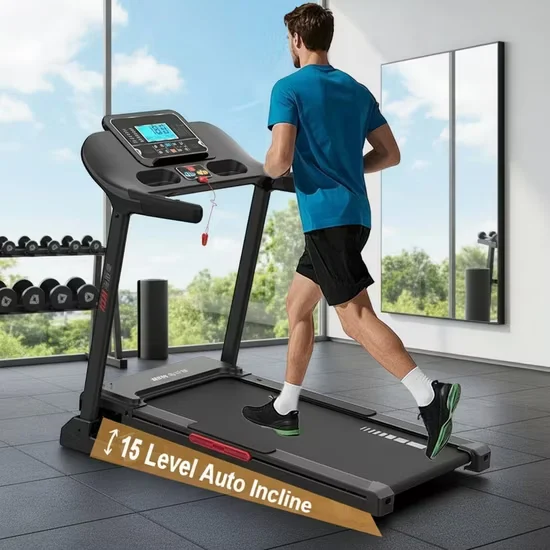
The MT166 covers steady-state walking through moderate-tempo running at speeds up to 18 km/h, placing it in the general endurance zone of a commercial cardio floor. In a mixed deployment, it sits alongside heavier commercial treadmills and pairs with ellipticals or rowing stations for impact-free alternatives. The 1320 x 480 mm belt accommodates adult users at walking and jogging cadences, while the foldable frame reduces floor commitment when a multi-purpose room requires clearance for group classes. The LCD console logs speed, distance, time, calories, and pulse, giving facility operators basic usage visibility across sessions.
Runtime Windows, Floor Transmission, and Power Delivery
This unit suits deployments where daily use stays within light-commercial duty cycles — private suites, corporate wellness rooms, and residential facilities with predictable traffic windows. Noise transmission through floor structures depends on sub-deck isolation and motor vibration amplitude; concrete slabs carry low-frequency hum further than timber frames [NEED_CITE: EN 957 requirements for commercial cardio equipment]. Facilities on upper hotel floors should verify structural coupling with vibration dampening mats beneath the feet. Standard AC mains compatibility varies by target market, and plug configuration must be confirmed before container loading to avoid arrival-side rewiring. The foldable motorized treadmill DC motor commercial procurement teams source should match the destination market’s voltage and frequency from the factory.
Reading the Drive, Deck, and Display Choices
DC motors deliver smooth torque curves at lower belt speeds, which favors walking and light jogging profiles common in hospitality settings. However, DC units generate more internal heat than AC equivalents under sustained high-speed load, making thermal management the limiting factor for daily runtime. The DC2.5HP rating on the MT166 should be cross-referenced with a continuous duty specification sheet — peak output alone does not predict survival under eight-hour operational windows. The 1320 x 480 mm running surface provides sufficient stride length for users up to moderate running cadences but narows lateral margin for wider-stance walkers. LCD consoles with pulse feedback deliver basic biometric capture through handlebar sensors, though handlebar readings tend to drift during interval work compared to chest-strap telemetry. The twelve preset programs structure sessions without requiring external app connectivity.
The Hidden Cost of Underspecified Drive Components
Facilities that spec cardio equipment by price-per-unit without verifying duty-cycle ratings repeat a predictable replacement cycle. Motors sized for thirty-minute home sessions overheat under continuous facility schedules, and the first failure rarely triggers an audit — it triggers a warranty claim. Noise complaints in hotel settings arrive before maintenance tickets, meaning the operational cost is guest satisfaction erosion, not just parts replacement [NEED_CITE: acoustic performance standards for hospitality cardio equipment]. Foldable frames under high-frequency use may develop pivot wear that introduces lateral deck movement, and units deployed without verifying voltage compatibility require on-site transformer installation or full return logistics. The foldable motorized treadmill DC motor commercial orders should always carry documented duty-cycle ratings attached to the proforma invoice.
Why This Line Was Built for Space-Constrained Deployments
Biketon Sport engineers each cardio unit around the noise and durability variables that facility managers actually report. The MT166 enters a six-series commercial cardio family where every discipline — treadmill, bike, elliptical, rower, stair climber, and spinning bike — sources from one production system. Sub-35dB operation is verified across the commercial range in hotel deployments where guest floor placement is non-negotiable. The 10,000-hour durability testing protocol on motors, frames, and bearings sets the floor for what qualifies as commercial grade, and the foldable motorized treadmill DC motor commercial configuration benefits from the same supply chain. OEM customization extends to console UI, frame color, and branding. Free 3D cardio-zone layout and airflow planning addresses square footage, sightlines, and member flow so this unit’s folded and unfolded footprint integrates into the broader deployment plan. Technical support runs on a 24/7 response cycle.
Documentation & Test Records
- CE declaration of conformity covering electrical safety and EMC compliance
- EN 957 test report documenting structural load and stability requirements
- ISO 9001 certificate for production system traceability
- RoHS compliance record restricting hazardous material content
- Noise level test report for acoustic verification in shared-structure deployments
- Motor specification sheet distinguishing peak versus continuous duty output
Installation, Commissioning & Maintenance
- Maintain clearance around the 1735 x 770 mm unfolded footprint for belt access and user dismount
- Place vibration isolation pads beneath feet to reduce low-frequency transmission to floor structures
- Confirm AC mains voltage and plug type match destination market before energizing the DC motor
- Calibrate LCD console speed readout against measured belt velocity during first power-on sequence
- Inspect belt tension and deck lubrication at intervals matching facility usage density
- Wipe console housing and handlebar pulse sensors after each session to prevent sweat corrosion
Planning Your Cardio Zone Procurement
Share your facility floor area and target unit count to receive a 3D layout with airflow and sightline planning that accounts for the MT166’s folded and operational footprint. Specify expected daily runtime per unit so the motor duty-cycle classification matches your traffic pattern. Confirm deployment floor level and adjacent occupied rooms to determine acoustic isolation requirements. State your target market voltage and plug standard to eliminate arrival-side rewiring, and indicate whether console data output must integrate with existing facility management software.
Frequently Asked Questions
Q: What separates continuous duty from peak horsepower, and why should it influence purchasing decisions?
A: Peak horsepower measures the motor’s maximum output for short bursts, while continuous duty reflects sustained thermal capacity under load. A DC2.5HP peak rating may correspond to a considerably lower continuous figure. Facility deployments running multiple hours daily must verify continuous duty ratings, as peak-only specifications do not predict motor survival under commercial operational cycles.
Q: Can the LCD console export session data to gym management platforms?
A: The MT166 LCD console displays real-time speed, distance, time, calories, and pulse readings. Current specifications do not confirm external data sync capability. Facilities requiring member app integration or usage analytics should request console technical documentation to verify available data output protocols before placing production orders.
Q: How does the foldable frame hold up under repeated commercial use?
A: Foldable mechanisms introduce pivot points that experience cyclic loading with each deploy-and-stow cycle. In light-commercial and residential deployments with moderate fold frequency, the structural rigidity remains adequate. High-frequency facility environments should evaluate whether daily folding is operationally necessary, or whether a fixed-frame unit better serves long-term durability requirements.
Q: Is the noise output suitable for hotel guest floor placement?
A: DC motors at walking and light jogging speeds produce lower audible signatures than equivalent AC drives at peak load. Actual noise transmission depends on floor structure, sub-deck isolation, and vibration dampening beneath the unit feet. Request the noise level test report to verify performance against your property’s acoustic thresholds before deployment on occupied floors.
Q: What voltage and plug options ship from the factory?
A: Voltage and plug configuration must be specified at order stage to match the destination market’s electrical standard. Mismatches discovered after container arrival require costly on-site transformers or complete rewiring. Confirm your target market requirements during the quotation phase so the MT166 ships factory-configured for immediate commissioning.
![MT296 Electric Fitness Home Use Treadmill for Training [WARN] draft identifier mismatch](https://bicksport.com/wp-content/uploads/2026/08/mt296-electric-fitness-home-use-treadmill-for-training-warn-draft-identifier-mismatch-8819c9.webp)
![Mt296 Motorized Running Machine Treadmill for Maintaining Health [WARN] draft identifier mismatch](https://bicksport.com/wp-content/uploads/2026/08/mt296-motorized-running-machine-treadmill-for-maintaining-health-warn-draft-identifier-mismatch-ace1e5.webp)