

Aircraft-Grade Rail Precision — Aluminium alloy frame construction eliminates metal-on-metal resonance during continuous studio class cycles.
Technical Specifications
| Parameter | Value |
|---|---|
| Designation | SRY-12B |
| Product Type | Pilates Reformer |
| Frame Material | Aluminium Alloy |
| Product Dimensions | 2570 x 730 x 270 mm |
| Net Weight | 90 kg |
| Standard Accessories | Long Box, Jump Board, Platform |
| Color Options | Black (custom colors available) |
| Customization | Logo and color options available |
| Age Group | Adult |
| Gender | Unisex |
| Warranty | 3 Years |
Application Suitability
| Deployment Scenario | Typical Use |
|---|---|
| Boutique Pilates studio | Daily group reformer classes running 8+ hours with continuous carriage transitions |
| Hotel wellness center on guest room floors | Low-noise reformer sessions adjacent to occupied rooms requiring minimal vibration transfer |
| Private training studio | One-on-one and small group sessions demanding versatile accessory configurations |
| Multi-disciplinary commercial fitness center | Reformer-based programming integrated alongside cardio and strength zones |
Why Studio Noise Complaints Begin at the Rail
Precision-machined aluminium rails prevent the carriage wobble that generates distracting sounds during class.
Budget reformers often develop noticeable rail noise within months of heavy studio scheduling. The carriage begins to rattle during transitions, and instructors must raise their voices over equipment sounds. I recall a deployment where steel-frame reformers transmitted low-frequency vibration through hardwood flooring into the lounge below, forcing the studio to reschedule classes away from peak hours [NEED_CITE: noise transmission through flooring in commercial fitness environments]. The SRY-12B commercial Pilates reformer aluminium alloy frame addresses this at the source by maintaining structural alignment under continuous load cycles, preventing the frame flex that causes rail misalignment and subsequent noise generation.
Positioning Within a Studio Equipment Layout
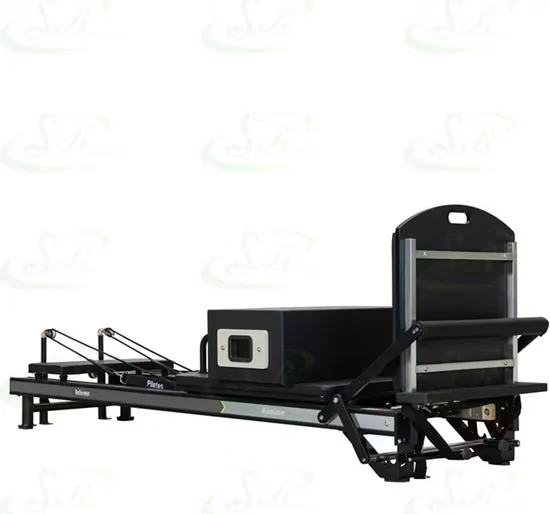
The SRY-12B covers full-range Pilates reformer programming from foundational mat-style movements to advanced spring-loaded resistance sequences. In a studio equipment plan, this reformer pairs with Cadillac and chair apparatus for comprehensive class formats, occupying a footprint that allows standard spacing between units for instructor circulation. The 2570 mm length accommodates users across a broad height range, while the modular accessory system — long box, jump board, and platform — supports programming variety without requiring additional dedicated equipment. This commercial Pilates reformer aluminium alloy unit fits high-density studio layouts where each machine must serve multiple class formats throughout the day.
Continuous Operation and Floor-Level Deployment Requirements
Studios running back-to-back classes from early morning through evening subject reformer carriages to near-constant use, making rail integrity and frame rigidity non-negotiable. The aluminium alloy construction keeps the SRY-12B at 90 kg, reducing structural load on elevated floors while maintaining the mass needed to resist walking during jump board exercises. Noise transmission through flooring remains a concern when studios occupy upper levels of mixed-use buildings, and the rigid frame minimizes the low-frequency vibration that penetrates ceiling assemblies below [NEED_CITE: vibration isolation requirements for fitness equipment on suspended floors]. Adequate ventilation around the unit is necessary to prevent moisture accumulation that could affect rail surface condition over time. Ground-level installations benefit from leveling feet to ensure consistent carriage glide across the full rail length.
Aluminium Alloy Frame and Rail System Engineering
The choice of aluminium alloy over welded steel for the SRY-12B frame serves two mechanical purposes relevant to commercial Pilates environments. First, aluminium alloy extrusions maintain tighter dimensional tolerances along the rail surface compared to steel frames that can develop micro-warping under uneven floor loading. This dimensional stability directly affects carriage glide consistency — a wobbly carriage forces users to compensate during controlled movements, degrading exercise quality. Second, the material naturally resists corrosion from the humidity and perspiration present in studio air, reducing the surface degradation that creates friction and noise over time. The precision-machined rail system operates without lubrication-dependent maintenance schedules, eliminating the downtime required for periodic greasing that steel rail systems demand. Accessory attachment points on the frame are reinforced to handle repeated mounting and removal of the long box, jump board, and platform without fastener loosening. The 90 kg net weight provides sufficient inertia to keep the unit stable during dynamic jump board work while remaining repositionable by studio staff when the floor plan needs adjustment [NEED_CITE: commercial Pilates reformer frame material comparison standards].
The Hidden Cost of Specifying Below Commercial Grade
Reformers built with lighter-gauge materials and simplified rail systems may perform adequately during initial testing but develop problems under sustained studio scheduling. Frame joints loosen under repetitive loading, creating play that manifests as audible clicking during carriage transitions. Rail surfaces wear unevenly, producing rough spots that instructors notice before maintenance staff do. Studios that selected lower-specification units have reported replacing entire fleets within two years due to accumulated complaints about equipment feel and noise [NEED_CITE: commercial fitness equipment lifecycle under high-frequency use]. The cost difference at procurement narrows quickly when factoring in downtime, member attrition, and full replacement cycles.
Why This Product Line for Your Studio
The SRY-12B reflects design priorities shaped by actual deployment feedback — sub-35dB operation standards developed for hotel environments translate directly to studio settings where noise control affects class quality. The 10,000-hour durability testing protocol applied to commercial cardio equipment informs the structural warranty confidence behind the 3-year coverage on this reformer. OEM customization including logo and color allows brand consistency across a studio’s equipment fleet. The six-series product family means a facility expanding into cardio can source treadmills, bikes, and ellipticals from the same manufacturer, simplifying maintenance relationships. Free 3D layout planning covers reformer spacing, sightlines for instructor supervision, and airflow considerations specific to studio environments. Round-the-clock technical support ensures that a carriage adjustment question on a Saturday morning does not wait until Monday for resolution.
Documentation & Test Records
- CE declaration of conformity for commercial fitness equipment
- EN 957 test report covering structural load and safety requirements
- ISO 9001 certificate for manufacturing quality management
- Noise level test report verifying carriage glide acoustics
- Durability test record documenting frame and rail cycle performance
- Installation and commissioning guide with spare parts list
Installation, Commissioning & Maintenance
- Maintain minimum clearance around the 2570 x 730 mm footprint for safe user entry and instructor access
- Verify floor levelness before assembly to ensure consistent carriage glide across the full aluminium rail length
- Inspect accessory attachment torque points on the long box, jump board, and platform after the initial 30-day use period
- Clean aluminium rail surfaces weekly with non-abrasive solutions to prevent perspiration residue buildup
- Check frame joint fasteners quarterly under the 3-year structural warranty maintenance schedule
- Confirm customization color and logo specifications match facility branding before final placement
Planning Your Studio Equipment Inquiry
Provide your studio floor area and planned reformer count to receive a 3D layout addressing spacing, instructor sightlines, and ventilation flow. Specify daily class scheduling intensity so the equipment recommendation matches your operational duty cycle. Identify the deployment floor level and adjacent occupied spaces to confirm acoustic requirements. Indicate whether OEM customization for logo or color is needed for brand consistency. Note any data integration requirements if your studio management system tracks equipment usage.
Frequently Asked Questions
Q: How does aluminium alloy compare to steel for reformer frame durability?
A: Aluminium alloy extrusions maintain tighter dimensional tolerances along the rail surface and resist corrosion from studio humidity without surface treatment. Steel frames can develop micro-warping under uneven floor loading, leading to carriage misalignment over time. The SRY-12B frame prioritizes consistent glide performance and reduced maintenance demands that commercial studios require for daily scheduling.
Q: What rail maintenance does this reformer require?
A: The precision-machined aluminium rail system operates without lubrication-dependent maintenance schedules, unlike steel rail systems that require periodic greasing. Studio staff should clean rail surfaces weekly with non-abrasive solutions to remove perspiration residue and dust accumulation. This design eliminates the equipment downtime associated with lubrication cycles in busy studio environments.
Q: Are the accessories compatible with other reformer models?
A: The long box, jump board, and platform included with the SRY-12B are designed for this specific frame configuration and attachment geometry. Accessory mounting points are reinforced for repeated installation and removal. When standardizing a studio fleet, confirm accessory compatibility across models to ensure programming flexibility without requiring separate accessory inventories for each reformer type.
Q: How does the reformer affect noise levels in multi-story buildings?
A: The rigid aluminium alloy frame minimizes low-frequency vibration transmission through flooring compared to lighter or less rigid constructions. Studios on elevated floors should consider vibration isolation pads beneath the unit to further reduce structure-borne noise reaching spaces below. The 90 kg net weight provides stability while remaining manageable for repositioning during studio layout adjustments.
Q: What user weight range does this reformer accommodate?
A: The SRY-12B is engineered for adult users across a broad demographic range, with the aluminium alloy frame and reinforced carriage system designed to maintain structural integrity under continuous commercial use. Studios serving diverse clientele benefit from equipment rated for high-frequency load cycles rather than single maximum weight figures. Contact the manufacturer for specific load specifications and testing documentation.


![Foldable Core Training Wood Pilates Reformer for Commercial Studio Use [WARN] draft identifier mismatch](https://bicksport.com/wp-content/uploads/2026/08/foldable-core-training-wood-pilates-reformer-for-commercial-studio-use-warn-draft-identifier-mismatch-8538e8.webp)