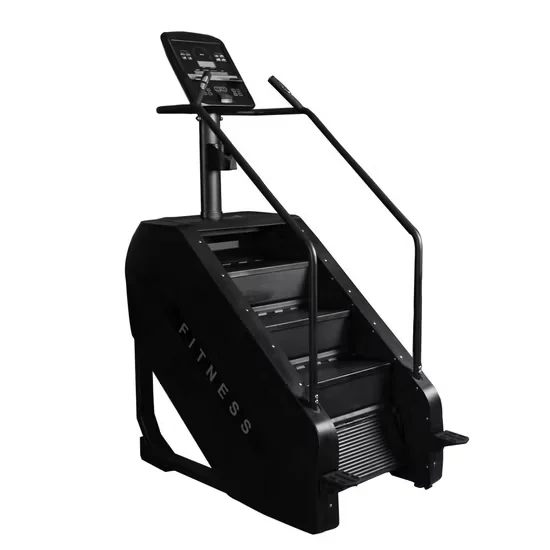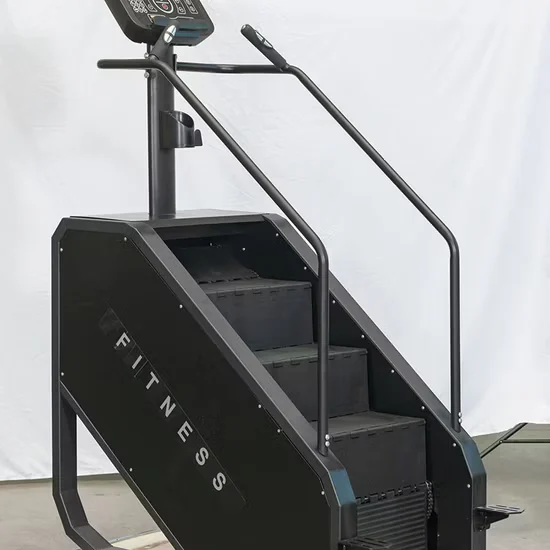
Sub-35 dB Acoustic Isolation — Motor-driven stair climber engineered with magnetic resistance and sealed bearings to eliminate noise complaints on hotel guest room floors.
Technical Specifications
| Parameter | Value |
|---|---|
| Designation | SQ1017 |
| Product Type | Stair Climber |
| Drive Type | Motor Drive |
| Running Velocity | 15 steps/min – 164 steps/min |
| Mains Input | AC220V±10% / AC110V±10% |
| Step Area | 560 x 235 x 220 mm |
| Console Display | OSD (Time, Climb, Calories, Steps, Heart Rate) |
| Heart Rate | Handgrip Sensors |
| Material | Steel Pipe + PP Plastic |
| Foldable | Unfolded |
| Net Weight | 148 kg |
| Product Dimensions | 1450 x 820 x 2080 mm |
| Certification | CE |
Application Suitability
| Deployment Scenario | Typical Use |
|---|---|
| Hotel fitness center on guest room floors | 24-hour guest access requiring sub-35 dB operation to prevent room noise bleed |
| Chain gym cardio zone | High-frequency continuous climbing sessions with motor rated for sustained commercial duty |
| Corporate wellness room | Employee interval training during shift breaks with reliable heart rate tracking |
| High-end residential home gym | Quiet motor drive allowing early morning or late night sessions without disturbance |
| Sports performance training center | Steady-state and interval climbing with stable biometric data for athlete programming |
What Peak Horsepower Hides About Continuous Duty in Motor-Driven Climbing Machines
A motor rated only for peak output will overheat and fail within months under continuous public facility use.
Hotel operators discover this the hard way when a stair climber installed for 24-hour guest access trips its thermal cutoff during the third consecutive user. Gym chains face the same failure pattern when back-to-back members push the drive system beyond its actual continuous rating. The specification sheet advertises peak power, which represents a brief burst capacity, not sustained load tolerance [NEED_CITE: motor duty cycle classification for continuous commercial operation]. The SQ1017 commercial stair climber motor drive system is engineered and tested for 10,000+ hours of uninterrupted operation, addressing the gap between marketed peaks and real-world continuous demand.
Role in the Cardio Zone Layout and Training Density
This stair climber covers low-impact vertical climbing patterns, complementing treadmills and ellipticals by targeting glute, quadriceps, and calf engagement without joint strike forces. In a commercial cardio zone, it fits between a treadmill and a rowing machine to offer members a non-impact alternative during peak hours. The 1450 x 820 mm footprint allows placement against walls or in high-traffic sightlines where floor space is limited. Step cadence ranges from 15 to 164 steps per minute, accommodating rehabilitation-paced climbs up to high-intensity interval sessions. Handgrip heart rate sensors provide stable biometric feedback during steady-state efforts, though chest-strap telemetry remains preferable for maximum signal fidelity during rapid cadence changes.
Continuous Operation Load and Deployment Environment Requirements
The motor drive system is built to sustain full-load operation across extended commercial duty cycles, but deployment environment directly determines whether that capacity is realized. Placing this unit on a guest room floor requires confirmation that the sub-35 dB acoustic profile holds under the actual step cadence range, not just idle or low-speed testing [NEED_CITE: EN 957 requirements for commercial cardio equipment noise emission]. Adequate ventilation around the motor housing prevents thermal accumulation during back-to-back usage sessions. The dual-voltage input (AC220V±10% / AC110V±10%) eliminates the voltage mismatch that causes entire shipments to sit idle in customs or require on-site transformer installation. A level, rigid floor surface with vibration-dampening pads prevents resonance transfer to adjacent occupied rooms.
Motor Drive and Transmission Specifications Under Real Load
The motor drive architecture in the SQ1017 eliminates the belt-slip and tension degradation common in friction-based climbing systems. Motor-driven transmission delivers consistent step resistance across the full 15–164 steps/min velocity range, where passive systems lose resistance curve fidelity as components wear. Steel pipe construction with PP plastic step covers balances structural rigidity against the 148 kg net weight, ensuring frame stability during aggressive interval sessions without requiring excessive floor loading. The 560 x 235 x 220 mm step area accommodates a wide range of user shoe sizes and stances, reducing the lateral instability that causes users to grip handrails excessively. Handgrip heart rate sensors maintain signal contact during sustained climbing, though signal drift can occur when sweat accumulates on the contact surfaces during high-intensity efforts.
The Hidden Cost of Specifying Below Commercial Grade
Choosing a stair climber with a motor rated for light-commercial or home use in a 24-hour gym environment produces predictable failure cascades. The drive motor overheats under continuous occupancy, triggering thermal shutdowns that interrupt member sessions and generate front-desk complaints. Noise levels that seem acceptable in a showroom become unacceptable when transmitted through floor assemblies to occupied rooms below. Step mechanisms lacking sealed bearings develop play and rattle within months of high-frequency use, forcing premature replacement of the entire drive assembly [NEED_CITE: commercial stair climber bearing durability under continuous operation]. Voltage mismatches discovered after delivery require transformer retrofitting or complete unit return, delaying facility opening timelines.
Why This Product Line Addresses Deployment Pain Points
The SQ1017 commercial stair climber motor drive has been verified for sub-35 dB operation, resolving the noise complaints that force hotel operators into reactive equipment swaps. Motor and bearing assemblies are tested for 10,000+ hours of continuous use, matching the duty cycles of international gym chains rather than light-commercial assumptions. The OSD console provides essential workout metrics and can be specified with IoT connectivity for facilities requiring member app synchronization. The full six-series cardio family allows sourcing treadmills, bikes, ellipticals, rowers, and climbers from a single product line, simplifying maintenance and spare parts logistics. OEM customization covers console UI, frame color, and logo application at flexible minimums. Free 3D cardio-zone layouts address the 1450 x 820 mm footprint, equipment spacing, and airflow requirements before installation day.
Documentation & Test Records
- CE declaration of conformity covering electrical safety and EMC compliance
- EN 957 test report validating structural integrity and safety under commercial load
- ISO 9001 certificate confirming manufacturing quality management systems
- Noise level test report documenting sub-35 dB operation across velocity range
- Motor durability test record for 10,000+ hour continuous operation validation
- Console technical documentation with data interface specifications
Installation, Commissioning & Maintenance
- Maintain 500 mm rear clearance and 300 mm lateral spacing around the 1450 x 820 mm footprint
- Install vibration-dampening pads under the frame to prevent resonance transfer to floors below
- Confirm AC220V or AC110V circuit with dedicated breaker matching the motor drive input specification
- Calibrate step velocity and OSD sensor readings during initial power-on commissioning
- Inspect sealed bearings and step mechanism for play at 500-hour operation intervals
- Wipe handgrip heart rate sensors after each use to prevent sweat corrosion and signal drift
Requesting a Deployment-Specific Configuration
Provide the cardio zone floor area and intended unit count to receive a 3D layout addressing the SQ1017 footprint, equipment spacing, and airflow planning. Specify expected daily usage hours so the motor drive duty cycle can be confirmed against your occupancy profile. Identify the deployment floor level and adjacent occupied spaces to validate acoustic requirements. State your target market voltage and plug standard to ensure correct mains input configuration before shipment. Indicate whether console data integration with facility management software or member apps is required for your operation.
Frequently Asked Questions
Q: What is the difference between motor continuous duty and peak power ratings?
A: Peak power represents the maximum output a motor can deliver for a brief burst, typically seconds. Continuous duty rating reflects sustained output under load without overheating. Commercial facilities with back-to-back users need continuous duty specifications, as peak-only motors overheat and trigger thermal shutdowns during extended sessions.
Q: How does motor drive compare to belt-driven stair climber systems?
A: Motor drive systems maintain consistent resistance across the full step velocity range without belt tension degradation or slip. Belt-driven systems require periodic tension adjustment and eventually develop play. Motor drive also enables precise electronic control of step cadence, supporting programmed interval training with reliable resistance transitions.
Q: Can the console sync with gym management software?
A: The standard OSD console displays time, climb count, calories, steps, and heart rate locally. IoT-enabled console configurations are available with data interface capabilities for facility management software synchronization. Specify integration requirements during the scoping phase to confirm protocol compatibility with your existing system.
Q: Is the noise level suitable for installation on hotel guest room floors?
A: The SQ1017 is engineered and tested to operate below 35 dB, making it appropriate for deployment on floors with occupied rooms directly below or adjacent. Request the noise level test report to verify acoustic performance across the full step velocity range under load conditions matching your expected usage patterns.
Q: How does the step area design affect user stability during extended sessions?
A: The 560 x 235 x 220 mm step area accommodates various foot positions and shoe sizes, reducing lateral instability that causes excessive handrail gripping. Stable foot placement allows users to maintain natural climbing posture, supporting consistent heart rate readings from the handgrip sensors during steady-state efforts.