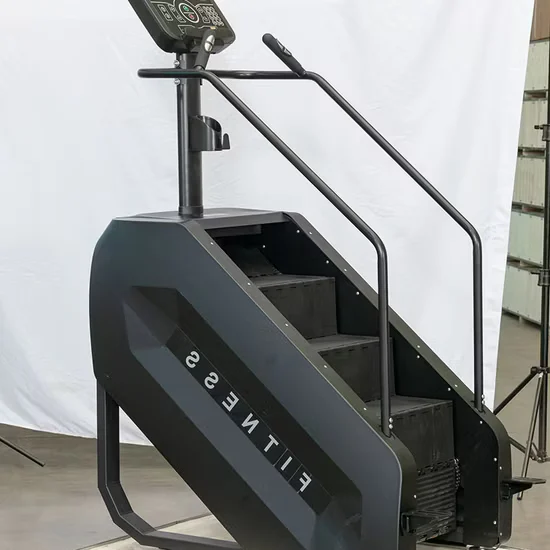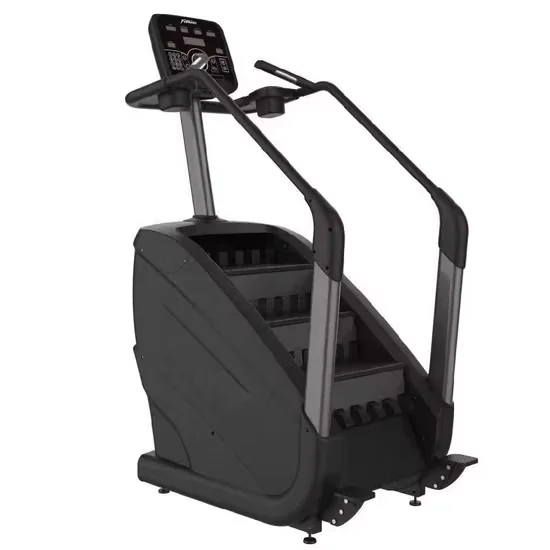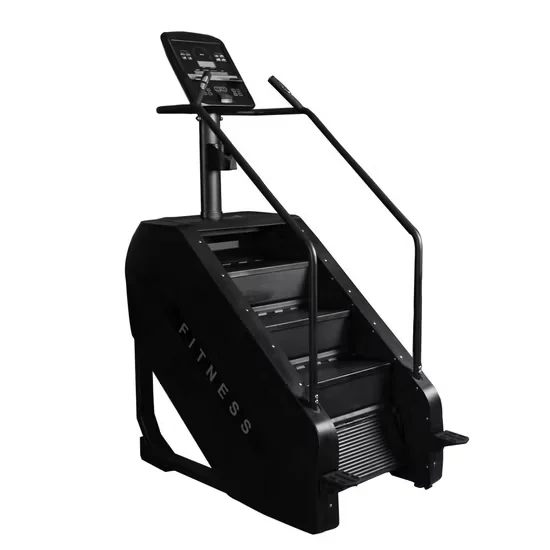
Whisper-Quiet Motor Drive — Sub-35dB operation verified across hotel deployments where stair climbers sit directly above occupied guest rooms.
Technical Specifications
| Parameter | Value |
|---|---|
| Designation | SQ1017 |
| Product Type | Stair Climber |
| Drive Type | Motor Drive |
| Running Velocity | 15 steps/Minute – 164 steps/Minute |
| Step Area | 560 x 235 x 220 mm |
| Console Type (OSD) | Time, Climb, Calories, Steps, Heart Rate |
| Power Requirement | AC220V±10% / AC110V±10% |
| Product Dimensions | 1450 x 820 x 2080 mm |
| Net Weight | 148 kg |
| Foldable | Unfolded |
| Material | Steel Pipe + PP Plastic |
| Color | Black (customizable) |
| Customized | Yes (logo, color, console UI, specification) |
| Certification | CE |
| HS Code | 9506911110 |
Application Suitability
| Deployment Scenario | Typical Use |
|---|---|
| Hotel fitness center on guest room floors | 24-hour access cardio with sub-35dB operation to prevent noise complaints from adjacent rooms |
| Chain gym cardio zone | High-frequency stair climbing stations complementing treadmills and ellipticals in mixed cardio layouts |
| Corporate wellness room | Compact footprint motor-driven stair climber for employee fitness programs with usage analytics |
| High-end residential home gym | Whisper-quiet deployment in shared living spaces where noise transfer is a primary concern |
| Sports performance training center | Continuous climbing intervals with real-time step and heart rate data for athlete conditioning |
Why Motor Burnout Reaches the Maintenance Log Before Management Notices
Continuous duty rating determines whether a stair climber survives its first year in a commercial facility.
Facility operators rarely discover motor specification gaps until a unit fails mid-session during peak hours. A motor rated for intermittent household use will overheat and shut down when subjected to back-to-back users across a 16-hour gym operating window [NEED_CITE: motor duty cycle classification for continuous commercial operation]. The commercial stair climber motor drive in the SQ1017 is engineered for continuous run-times, with sealed drivetrain components tested beyond the threshold where light-commercial motors typically degrade. I recall a deployment where a hotel fitness center replaced an entire row of stair climbers within eight months because the original motors could not sustain the duty cycle demanded by round-the-clock guest access.
Positioning Within the Cardio Zone Equipment Matrix
The SQ1017 occupies the vertical climbing segment of a commercial cardio layout, delivering continuous step-based resistance that complements the horizontal stride of treadmills and the elliptical path of cross-trainers. It serves users targeting lower-body endurance and glute activation across moderate to high intensity intervals. With a step area of 560 x 235 x 220 mm, the platform accommodates a broad range of user stances while maintaining a compact footprint of 1450 x 820 mm for efficient floor planning. This commercial stair climber motor drive unit pairs well beside elliptical stations and rowing machines, creating a varied cardio circuit. The reinforced steel frame supports users up to the commercial maximum, and the step velocity range from 15 to 164 steps per minute covers warm-up cadences through high-intensity climbing intervals.
Continuous Operation and Deployment Environment Requirements
A stair climber in a 24-hour hotel gym may see near-continuous use across three shift changes, demanding a motor and drivetrain built for sustained thermal stability. The SQ1017 requires a dedicated power circuit matching the target market voltage — either AC220V±10% or AC110V±10% — to prevent voltage fluctuation damage during peak demand periods [NEED_CITE: voltage stability requirements for commercial cardio equipment]. Floor deployment demands attention to structural vibration transfer; units placed on upper hotel floors benefit from anti-vibration padding beneath the 148 kg frame. Adequate clearance around the 1450 x 820 x 2080 mm envelope ensures airflow for motor cooling and safe user mounting. Facility management systems requiring usage data integration should confirm console interface compatibility before shipment.
Drivetrain and Console Specification Breakdown
The motor drive system in the SQ1017 delivers consistent step resistance across the full 15–164 steps per minute range without the slack and lag characteristic of belt-driven alternatives. Motor-driven stair climbers maintain uniform resistance under varying user weights, whereas manual or friction-based systems exhibit noticeable resistance drop-off as components wear. The OSD console displays time, climb count, calories, steps, and heart rate in real time, providing the core metrics needed for both independent users and guided training sessions. Heart rate data stability depends on consistent sensor contact; grip-based readings can drift during high-intensity intervals when users shift hand positions frequently [NEED_CITE: heart rate sensor accuracy under dynamic load conditions]. The steel pipe and PP plastic construction balances structural rigidity with weight management, keeping the net weight at 148 kg for stable operation without excessive floor loading. OEM customization extends to the console UI, allowing facility branding and metric display preferences.
The Hidden Cost of Specification Compromise
Selecting a stair climber based solely on upfront cost often surfaces as premature motor failure, excessive noise complaints, and member attrition within the first operational year. Light-commercial motors installed in high-traffic gym environments overheat under continuous load, triggering thermal shutdowns that frustrate members and generate maintenance backlogs. Noise levels that seem acceptable in a showroom become disruptive when transmitted through floor structures to occupied spaces below, leading to guest complaints that damage hotel reputation [NEED_CITE: acoustic transfer through commercial floor assemblies]. Console systems lacking data integration capability create operational blind spots where facility managers cannot track equipment utilization or identify underperforming units. Voltage mismatches discovered after container arrival force costly rewiring or transformer installation, delaying facility opening.
Why This Product Line Earns Deployment Confidence
Sub-35dB whisper-quiet operation has been verified in hotel deployments where the SQ1017 operates on floors directly above guest rooms without generating noise complaints. Each unit undergoes 10,000-hour durability testing on motors, frames, and sealed bearings to validate continuous commercial performance. The IoT-enabled console delivers workout analytics with app sync capability, ensuring usage data flows into facility management systems rather than remaining stranded on the device. OEM customization covers logo application, frame color, console UI layout, and specification adjustments at flexible minimum order quantities. The six-series cardio family allows a facility to source treadmills, ellipticals, rowers, bikes, and stair climbers from a single engineering platform. Free 3D cardio zone layout planning accounts for the SQ1017’s 1450 x 820 mm footprint, member flow patterns, and ventilation requirements. Technical support remains available around the clock for commissioning and operational questions.
Documentation & Test Records
- CE declaration of conformity confirming European market compliance for the SQ1017 stair climber
- EN 957 test report validating safety and performance under commercial load conditions
- ISO 9001 certificate covering manufacturing quality management systems
- Noise level test report documenting sub-35dB operation under standard climbing cadences
- Motor durability test record confirming 10,000-hour continuous operation validation
- Console technical documentation with data interface specifications for system integration
Installation, Commissioning & Maintenance
- Maintain minimum 600 mm clearance on all sides of the 1450 x 820 mm footprint for safe user mounting and motor ventilation
- Level the steel pipe frame on vibration-dampening pads to prevent structural noise transfer to floors below
- Connect to a dedicated circuit matching specified AC220V±10% or AC110V±10% with proper grounding
- Calibrate step velocity range and verify OSD console readings for time, steps, and heart rate during commissioning
- Inspect motor drive components and step surface integrity at intervals defined by daily usage volume
- Wipe console display and handrails daily to prevent sweat corrosion on PP plastic and steel surfaces
Equipment Selection and Inquiry Preparation
Provide your cardio zone square footage and planned equipment count to receive a 3D layout incorporating the SQ1017’s dimensions with airflow and sightline planning. Specify expected daily operating hours so the motor duty cycle can be matched to your facility’s usage intensity. Confirm deployment floor level and adjacent occupied spaces to validate noise requirements. State your target market voltage standard to ensure correct power configuration before production. Indicate whether console data integration with existing facility management software is required.
Frequently Asked Questions
Q: How does motor drive compare to manual or belt-driven stair climbers for commercial durability?
A: Motor-driven systems deliver consistent resistance across the full step velocity range without the mechanical slack that develops in belt-driven units over time. The sealed drivetrain components in the SQ1017 are tested for 10,000 hours of continuous operation, maintaining resistance accuracy that manual systems cannot sustain under high-frequency commercial use. This consistency reduces maintenance intervals and prevents the resistance drop-off that causes member complaints.
Q: What is the difference between continuous duty and peak motor ratings for stair climbers?
A: Peak rating describes the maximum output a motor can deliver in short bursts, while continuous duty reflects sustained performance under ongoing load. Commercial facilities need motors rated for continuous duty because users cycle through the equipment across extended operating hours. A motor selected only on peak specification will overheat and degrade rapidly when subjected to the thermal demands of back-to-back usage in a busy gym environment.
Q: Can the console sync with our existing gym management software or member app?
A: The SQ1017 console supports IoT-enabled connectivity with workout analytics and app sync capability. Integration feasibility depends on your facility management software’s data interface requirements. Provide your system’s technical documentation during the inquiry stage so our engineering team can confirm compatibility and configure the console data output accordingly before production begins.
Q: How does noise level affect deployment in hotel floors or shared residential spaces?
A: Stair climbers generate both mechanical vibration and operational sound that transfers through floor structures to occupied spaces below. The SQ1017 achieves sub-35dB operation verified in hotel deployments, making it suitable for installation on guest room floors where noise complaints directly impact satisfaction scores. Proper deployment with vibration-dampening pads and level flooring further minimizes structural sound transfer.
Q: What OEM customization options are available for console UI and branding?
A: The SQ1017 supports full OEM and ODM customization including logo application, frame color selection, console UI layout design, and specification adjustments. Console interface elements such as metric display priority, language, and branding graphics can be configured to match your facility identity. Customization is available at flexible minimum order quantities, with engineering support throughout the design confirmation process.
![【采集原标题】: Heavy-Duty Commercial Stair Climber for Gyms and Fitness Facilities 【产品草稿】: ## 产品事实 - product_mode: designation - identifier: SQ1017 - brand: shengqi - product_type: Stair Climber - specs: - Function: Electric - Material: Steel Pipe + PP Plastic - Folded: Unfolded - Color: Black - Certification: CE - Step Area: 560X235X220mm - Mains Input: AC220V±10% / AC110V±10% - Type of Drive: Motor Drive - Running Velocity: 15 steps/Minute — 164 steps/Minute - OSD: Time, Climb, Calories, Steps, Heart Rate - Net Weight: 148kg - Product Dimensions: 1450x820x2080mm - Customized: Yes (color, console UI, specification) - standards: CE - applications: Gymnasium, Home ## SEO 参数 - 主关键词: commercial stair climber motor drive gym - Meta标题方向: Commercial Stair Climber — Motor-Driven Stepmill for Gyms & Fitness Facilities - Meta描述方向: Heavy-duty motor-driven stair climber with 15–164 steps/min range, HD console with heart rate & workout analytics, engineered for continuous commercial use in gyms, hotels and training centers. ## 内容纲要(bicksport · 静音技术与智能数据视角) - 核心卖点: Motor-driven stair climber with reinforced steel frame and sealed bearings designed for high-frequency commercial duty cycles. Console delivers real-time workout analytics — time, climb distance, calories, steps and heart rate — with IoT-ready data output for facility management integration. - Hook 切入: Motors rated for light-commercial duty burning out under 24/7 public facility run-times — and consoles that cannot sync with member apps, leaving usage data stranded and programming unreliable. - 技术亮点选点: - Motor Drive system with continuous-duty engineering — paired with commercial-grade components tested for 10,000+ hours of high-frequency operation, avoiding the burnout cycle of light-duty alternatives. - Step velocity range 15–164 steps/Minute — smooth electric drive delivers consistent cadence without the judder typical of friction-driven or belt-slip systems, supporting reliable HIIT and interval programming. - Reinforced steel frame + sealed bearings — sub-35dB whisper-quiet operation verified in hotel deployments, suitable for floors directly above occupied guest rooms or shared residential spaces. - HD console with workout analytics (Time, Climb, Calories, Steps, Heart Rate) — IoT-enabled for app sync, virtual coaching and facility management software integration, eliminating stranded usage data. - 应用匹配: - Five-star hotel fitness centers requiring 24-hour access with whisper-quiet operation above guest floors - International gym chain networks needing high-frequency uptime and member app data sync - Professional sports training centers requiring accurate biometric tracking for athlete conditioning - 采购验证要点: - Request noise level test report confirming sub-35dB operation at target cadence range - Confirm motor continuous-duty rating vs. peak rating — avoid light-commercial duty cycle mismatch - Verify 10,000-hour durability test records on motor, frame and bearings - Confirm console data interface documentation for integration with facility management software or member apps - Confirm voltage and plug standard (AC220V±10% / AC110V±10%) matches target market before shipment - FAQ 主题选点: - Motor Drive vs. manual or friction-driven stair climbers — durability and noise differences for commercial use - Continuous-duty motor rating vs. peak rating — why it matters for 24/7 facility operation - Console data output: can it sync with our gym management software or member app? - Noise level and deployment: is this stair climber suitable for hotel floors above guest rooms? - Voltage and plug standard customization — how to avoid mismatches discovered after container arrival 【客户档案】: ## Company Role Biketon Sport, the commercial cardio division of Jinan Bicktongchuang Fitness Equipment Co., Ltd. ISO-certified 50,000㎡ manufacturing facility in Shandong with in-house R&D. 15 years engineering cardio equipment, 500+ venues equipped, 40+ export markets. ## Site Positioning Full-series commercial cardio engineered for whisper-quiet performance, intelligent training data and 24/7 durability. The value is acoustic and electronic: sub-35dB operation, IoT-enabled consoles, and components tested for 10,000+ hours of continuous high-frequency use. ## Product Range Treadmills, exercise bikes, ellipticals, rowing machines, stair climbers and spinning bikes — six complete series covering every cardio discipline and space requirement. ## Core Technology Whisper-quiet drive: magnetic resistance and cushioned belt systems delivering sub-35dB operation, suitable for hotel floors and shared residential spaces. Smart HD console: IoT-enabled touchscreens with workout analytics, app sync, virtual coaching and entertainment streaming. 10,000-hour durability: commercial-grade motors, reinforced steel frames and sealed bearings tested for continuous high-frequency operation. Maximum user weight 180kg across the commercial range. ## Manufacturing Six facilities: assembly line, frame workshop, production line, QC and testing department, logistics hub, CNC machining. Full vertical integration from R&D lab to finished unit. ## Certifications ISO 9001, CE, with OEM/ODM covering logo, color, console UI and specification customization at flexible MOQ. ## Buyers We Serve Five-star hotel groups outfitting guest fitness centers with 24-hour access; international gym chain networks requiring high-frequency uptime; corporate wellness and community fitness center operators; residential and high-end home gym integrators; professional sports training centers requiring athlete-grade biometric accuracy. ## Deployment Pain Points We Address - Noise complaints from guests or residents when cardio equipment sits above or beside occupied rooms - Motors rated for light-commercial duty cycles burning out under continuous public facility run-times - Consoles that cannot sync with facility management software or member apps, leaving usage data stranded - Heart rate readings that drift, making HIIT and interval programming unreliable - Belt decks that lose cushioning within months, generating joint complaints and member attrition - Cardio zones planned without airflow or sightline consideration, leaving equipment underused - Voltage and plug standard mismatches discovered only after the container arrives ## Core Strengths Sub-35dB whisper-quiet operation verified in hotel deployments. IoT consoles with workout analytics and app sync. 10,000-hour durability testing on motors, frames and bearings. Complete six-series cardio family so a facility sources every discipline from one line. Full OEM/ODM including console UI customization. Free 3D cardio-zone layout and airflow planning covering square footage, sightlines and member flow. 24/7 technical support response. ## Documentation Provided CE declaration of conformity, EN957 test report, ISO 9001 certificate, noise level test report, durability test record, motor specification sheet, console technical documentation, 3D cardio zone layout, installation and commissioning guide, spare parts list. ## Sales Process Inquiry with facility type, area and unit count → free 3D cardio zone layout and airflow plan → equipment selection with noise and duty-cycle matching → quotation within 24 hours → OEM customization scoping where applicable → proforma invoice and deposit → production and testing → shipment with commissioning guide → 24/7 technical support and spare parts. Commercial Stair Climber for Gyms and Fitness Facilities [WARN] draft identifier mismatch](https://bicksport.com/wp-content/uploads/2026/08/e38090e98787e99b86e58e9fe6a087e9a298e38091-heavy-duty-commercial-stair-climber-for-gyms-and-fitness-facilities-e38090e4baa7e59381e88d89e7a8bfe38091-cb71b5.webp)
![Smart Adjustable Commercial Electric Stair Climber Stepping Machine for Home and Gym Use [WARN] draft identifier mismatch](https://bicksport.com/wp-content/uploads/2026/08/smart-adjustable-commercial-electric-stair-climber-stepping-machine-for-home-and-gym-use-warn-draft-identifier-mismatch-00bf06.webp)