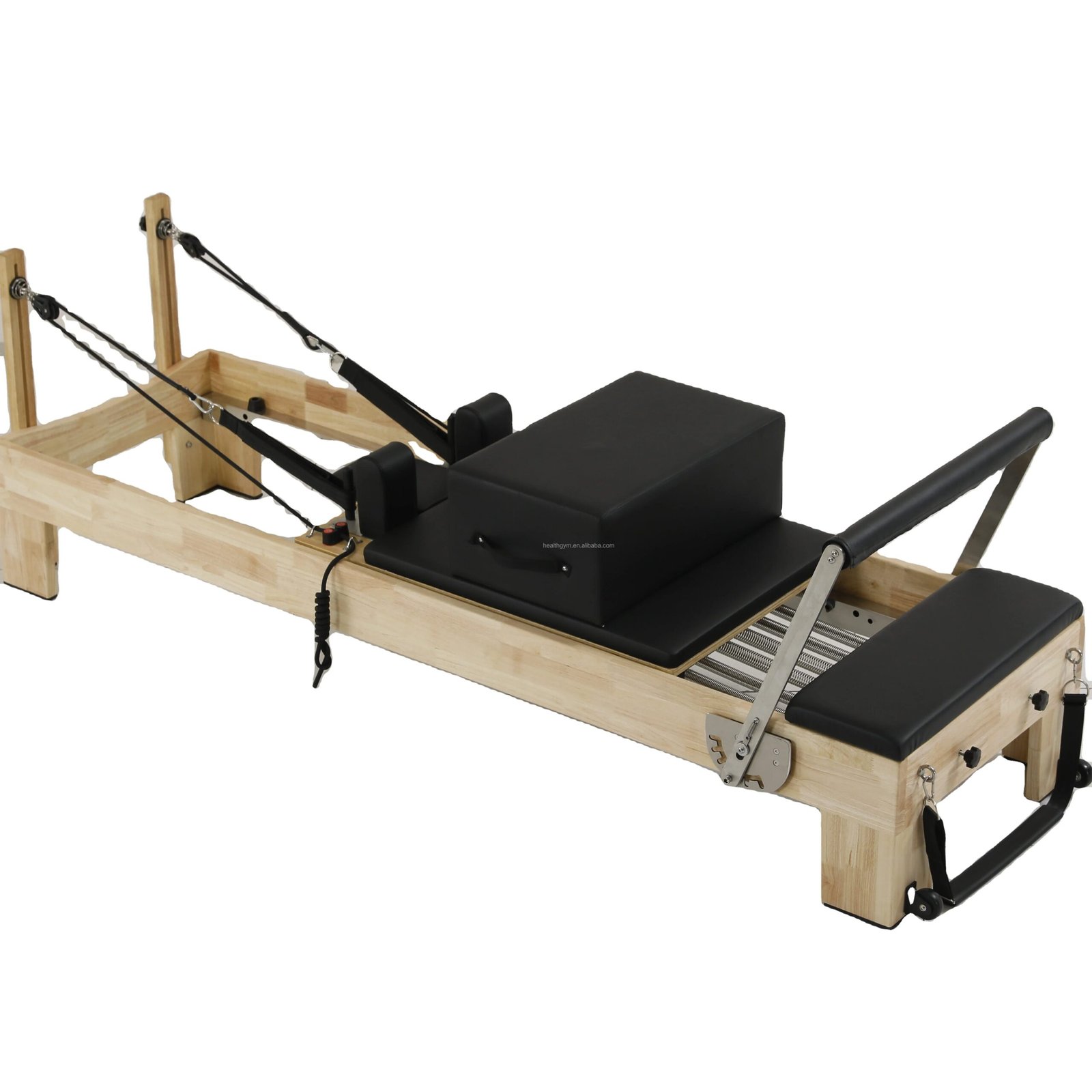
Acoustic-Grade Rigidity — Aluminum alloy frame isolates vibration transmission, keeping studio-adjacent spaces undisturbed during peak class hours.
Technical Specifications
| Parameter | Value |
|---|---|
| Designation | SRY-12A |
| Product Type | Foldable Pilates Reformer |
| Frame Material | Aluminum Alloy |
| Product Dimensions | 2570 × 730 × 270 mm |
| Net Weight | 90 kg |
| Foldable | Yes |
| Max User Weight | 180 kg |
| Accessories | Long Box / Jump Board / Platform |
| Color | White (customization available) |
| Logo | Customized Is Allowed |
| Certification | ISO 9001, CE, EN 957 |
| Warranty | 3 Years |
Application Suitability
| Deployment Scenario | Typical Use |
|---|---|
| Boutique Pilates Studio | Group reformer classes with adjacent treatment rooms requiring quiet operation |
| Multi-Use Fitness Facility | Shared cardio and mind-body zones with frequent equipment reconfiguration |
| High-End Residential Home Gym | In-unit placement where structural vibration must remain below threshold |
| Rehabilitation Center | Controlled resistance training with stable platform under clinical supervision |
| Hotel Wellness Floor | Guest-accessible reformer sessions in spa-adjacent fitness suites |
Why Studio Operators Lose Members Before They Spot the Problem
Frame material determines whether a reformer belongs on the schedule or on the complaint log.
When a Pilates studio occupies the floor below a co-working space or above guest suites, every carriage return transmits through the structure. Wooden frames absorb moisture, shift with humidity cycles, and amplify carriage noise over time — operators notice member drop-off long before they trace it to the equipment. The SRY-12A foldable Pilates reformer commercial aluminum alloy frame addresses this at the material level: aluminum maintains dimensional stability across seasonal humidity swings and dampens harmonic resonance that wooden counterparts transfer into subfloors. [NEED_CITE: vibration transmission comparison between aluminum and hardwood reformer frames]
Where This Reformer Fits in a Commercial Mind-Body Zone
The SRY-12A covers the full resistance spectrum from rehabilitation-grade spring tension through advanced athletic loading, making it suitable for studios that schedule back-to-back classes spanning introductory through advanced intensity bands. In a mixed cardio and mind-body facility, this unit complements mat zones and small apparatus areas by absorbing the highest-value class slots — reformer sessions that generate premium per-member revenue. The foldable Pilates reformer commercial aluminum alloy construction supports deployment densities where space between units must accommodate instructor circulation without sacrificing structural mass, and the 180 kg user capacity accommodates a broad anthropometric range across commercial membership bases.
Continuous Class Scheduling and Environmental Tolerances
Studios running four to six reformer classes daily subject carriage bearings, spring anchors, and frame joints to sustained cyclic loading that exceeds residential duty expectations. The aluminum frame resists the joint loosening and alignment drift that wooden frames develop under this cadence, maintaining rail parallelism through extended scheduling blocks. [NEED_CITE: commercial Pilates equipment duty cycle standards for multi-session daily operation] Deployments above occupied floors benefit from the material’s inherent vibration damping — facility managers should verify subfloor isolation and confirm that HVAC airflow across the reformer zone does not create draft interference during supine exercises. Standard single-phase power supply is sufficient since the unit operates without motorized components, though studios integrating digital resistance monitoring should confirm outlet proximity for ancillary sensor modules.
Reading the Specs That Determine Long-Term Studio Performance
The aluminum alloy frame choice directly affects two measurable outcomes: dimensional stability across humidity ranges from 30% to 70% relative humidity, and consistent carriage rail alignment that prevents uneven spring loading. The foldable mechanism relies on precision-machined pivot points rather than simple hinges — commercial folding cycles demand bearings rated for repeated engagement without play accumulation. Spring resistance staging across the accessory suite (Long Box for supine leg work, Jump Board for plyometric loading, Platform for standing balance sequences) requires the frame to resist torsional deflection during asymmetric exercises. The 2570 mm length accommodates full-range carriage travel for users up to the 180 kg rated capacity, while the 730 mm width maintains instructor access on both sides in standard studio grid layouts. White powder-coat finish provides sweat and humidity resistance appropriate for high-occupancy class environments, with custom color and logo application available for branded studio rollouts.
What Happens When Frame Specs Get Compromised
Studios that select reformers based on upfront cost discover the gap within twelve months: wooden frames warp under humidity fluctuation, carriage rails develop lateral play, and spring anchors lose seating precision — each degradation forces instructors to modify programming around equipment limitations rather than client needs. [NEED_CITE: Pilates reformer frame degradation timeline in commercial studio environments] Noise transmission through compromised frames escalates from minor annoyance to formal complaint when adjacent tenants or hotel guests attribute the disturbance to poor sound insulation rather than equipment selection, triggering lease renegotiations or capital replacement cycles that far exceed the original savings.
Why This Line Exists in the Biketon Sport Cardio and Mind-Body Portfolio
The sub-35dB engineering discipline applied across our motorized cardio range carries directly into the reformer line — acoustic performance is a material and assembly decision, not an afterthought. The SRY-12A undergoes 10,000-hour continuous cyclic testing on carriage travel and fold mechanism engagement, matching the durability protocol applied to treadmills and ellipticals in the same facility. Full OEM capability extends to frame color, logo placement, and accessory configuration, so studio chains receive equipment aligned with their brand standards without managing multiple vendors. Our 3D layout service covers reformer grid spacing, instructor circulation paths, and ventilation requirements specific to mind-body zones, ensuring the foldable Pilates reformer commercial aluminum alloy deployment accounts for actual class flow rather than catalog dimensions alone. Documentation and technical support remain available around the clock across export markets.
Documentation & Test Records
- CE declaration of conformity covering commercial Pilates equipment classification
- EN 957 test report verifying structural load and safety requirements
- ISO 9001 certificate confirming manufacturing quality management system
- Frame material certification with aluminum alloy grade and tensile data
- Foldable mechanism durability test record with cycle count and tolerance verification
- Noise level test report confirming operational acoustic performance
Installation, Commissioning & Maintenance
- Confirm 2570 × 730 mm footprint with minimum 600 mm clearance on all sides for instructor access
- Level floor surface within tolerance and install vibration isolation pads beneath aluminum frame contact points
- Inspect carriage rail alignment and spring anchor seating after initial 48-hour break-in period
- Lubricate carriage bearings and verify fold mechanism pivot tension at quarterly intervals
- Clean aluminum frame with pH-neutral solution to prevent sweat residue accumulation on powder-coat finish
- Verify accessory mounting security for Long Box, Jump Board, and Platform before each class session
Scheduling Your Facility Specification Review
Provide your mind-body zone dimensions and planned reformer count to receive a 3D layout addressing grid spacing, instructor sightlines, and airflow planning for your specific space. Confirm your daily class schedule and projected session volume so we can match the duty cycle specification to your operational cadence. Indicate your deployment floor and adjacent occupancy to determine whether additional subfloor isolation measures support your acoustic requirements, and specify your target market for any region-specific compliance documentation needed at delivery.
Frequently Asked Questions
Q: How does aluminum alloy frame construction compare to traditional wooden frames for noise control?
A: Aluminum maintains dimensional stability across humidity fluctuations that cause wooden frames to warp and amplify carriage vibration over time. The material’s inherent damping characteristics reduce structure-borne noise transmission to adjacent occupied spaces, making it suitable for deployments above guest rooms or beside treatment areas where acoustic complaints originate.
Q: What maintenance intervals does the foldable mechanism require in commercial settings?
A: Studios running multiple daily classes should inspect pivot bearings and engagement latches quarterly, verifying that repeated folding cycles have not introduced lateral play or alignment drift. The mechanism uses precision-machined components rated for commercial duty cycles, and replacement parts remain available through the standard support channel.
Q: Are all accessories compatible with the same frame without modification?
A: The Long Box, Jump Board, and Platform each mount to standardized attachment points on the SRY-12A frame, maintaining stable operation under dynamic loading conditions. Accessory compatibility is verified during production testing, and attachment security should be confirmed before each scheduled class session as part of standard studio protocol.
Q: What acoustic documentation supports deployment in noise-sensitive environments?
A: A noise level test report accompanies each unit, confirming operational performance against the sub-35dB benchmark established across our commercial range. Facility managers deploying reformers on elevated floors or adjacent to occupied rooms can reference this documentation when responding to tenant inquiries or lease compliance reviews.
Q: What customization options are available for studio branding integration?
A: Logo application, frame color, and accessory configuration can all be specified during the ordering process to align with studio brand standards. Customization scoping occurs before production, and MOQ flexibility accommodates both single-studio deployments and multi-location chain rollouts with consistent visual identity.

![Commercial Aluminum Alloy Half Trapeze Pilates Reformer Machine [WARN] draft identifier mismatch](https://bicksport.com/wp-content/uploads/2026/08/commercial-aluminum-alloy-half-trapeze-pilates-reformer-machine-warn-draft-identifier-mismatch-e689ff.webp)