
![Senrui SRY-02 Beech Wood Pilates Reformer for Studio and Home Use [WARN] draft identifier mismatch](https://bicksport.com/wp-content/uploads/2026/08/senrui-sry-02-beech-wood-pilates-reformer-for-studio-and-home-use-warn-draft-identifier-mismatch-d15a00.webp)
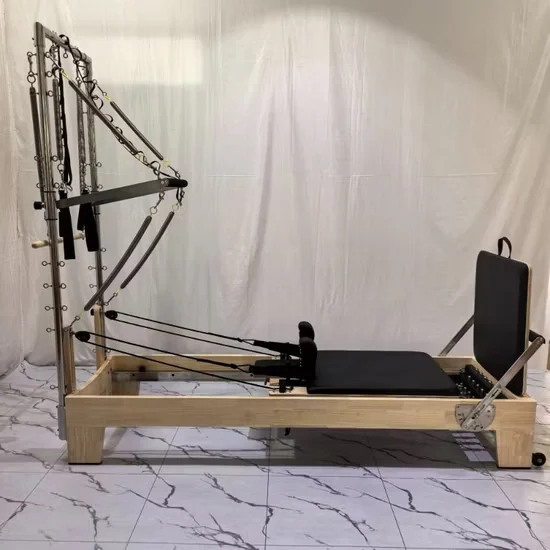
Senrui SRY-02 Beech Wood Pilates Reformer for Studio and Home Use
Rigidity Under Load — Solid beech wood frame with commercial-grade joinery maintains alignment through thousands of daily carriage cycles.
Technical Specifications
| Parameter | Value |
|---|---|
| Designation | SRY-02 |
| Product Type | Pilates Reformer |
| Frame Material | Solid Beech Wood |
| Product Dimensions | 2460 x 730 x 680 mm |
| Net Weight | 100 kg |
| Included Accessories | Long Box / Jump Board / Platform |
| Target User | Adult / Unisex |
| Color | Solid Color (Customizable) |
| Logo | Customized Is Allowed |
| Production Capacity | 80 Pieces/Month |
| Warranty | 3 Years |
| HS Code | 9506911900 |
Application Suitability
| Deployment Scenario | Typical Use |
|---|---|
| Boutique Pilates Studio | Group classical reformer classes requiring consistent frame geometry across units |
| Yoga Studio Expansion | Low-impact resistance training complementing mat-based instruction |
| Rehabilitation Center | Controlled linear resistance for post-injury joint mobilization and core stabilization |
| High-End Residential Home Gym | Studio-grade apparatus for private practice without commercial footprint requirements |
Why Studios Replace Residential-Grade Reformers Within Eighteen Months
Frame flex and pulley wear compound faster than maintenance budgets can absorb.
Pilates studios outfitting their floors with light-duty reformers encounter a predictable cycle: carriage drift develops on worn pulleys, spring tension becomes inconsistent across the resistance range, and frame geometry shifts under repeated loading [NEED_CITE: commercial reformer frame fatigue under continuous studio-frequency loading]. The result is exercise execution that drifts from classical form, client discomfort during footwork sequences, and equipment replacement cycles that compress studio margins. Deploying a commercial Pilates reformer beech wood frame from the start eliminates the flex that causes these downstream failures.
How This Reformer Fits Within a Studio Equipment Array
The SRY-02 covers the full classical and contemporary Pilates repertoire when paired with its included long box, jump board, and platform. Studios typically position reformers as the primary resistance apparatus, complemented by cadillacs and chairs for standing and hanging work. This unit accommodates users across a broad height and weight range, making it suitable for both introductory group classes and advanced private sessions. The 2460 mm frame length provides full carriage travel for tall users executing long spinal articulation sequences.
Daily Throughput and Studio Environment Requirements
A busy studio scheduling six to eight group classes per day places continuous compression cycles on every spring and pulley. The beech frame must maintain dimensional stability as ambient humidity shifts between seasons [NEED_CITE: hardwood dimensional stability in climate-controlled fitness environments]. Adequate lateral clearance between units allows instructors to cue form corrections without crowding adjacent stations. Floor leveling is critical—uneven surfaces introduce lateral carriage drift that accelerates pulley wear and compromises exercise alignment. Studios in upper-floor commercial spaces benefit from the acoustic dampening that solid hardwood provides compared to metal-frame alternatives.
Beech Frame Construction and Resistance System Architecture
Solid beech wood offers a density and grain structure that resists compression set under the repeated loading cycles of studio use. Unlike softer hardwoods that develop fastener play over time, beech maintains tight joinery at the rail attachment points where carriage forces concentrate. The pulley and carriage system relies on bearing quality and rail material finish to determine both noise level and long-term maintenance intervals. Spring-based resistance systems differ in their tension curve: progressive springs increase resistance through the compression range, while linear springs maintain consistent load per unit of travel. Accessory mounting points on the frame must be machined to tolerances that prevent wobble during jump board plyometric sequences and platform standing work.
What Light-Duty Frame Specifications Cost Over Three Years
Residential-grade reformers installed in commercial studios show frame rail wear and pulley bearing failure at intervals that force unplanned downtime [NEED_CITE: bearing replacement intervals under continuous commercial cycling]. Inconsistent spring tension across units makes group class instruction unreliable, as clients on different reformers experience different resistance at the same spring setting. Studios that specify undersized frames encounter client attrition when exercise execution feels unstable during advanced repertoire. These operational costs compound beyond the initial equipment savings.
Why Facilities Specify This Product Line
The SRY-02 is engineered with a solid beech wood frame verified for studio-frequency loading cycles. Components undergo durability testing that simulates continuous compression and travel under load. The complete accessory package—long box, jump board, platform—arrives integrated rather than sourced separately, ensuring mounting precision across the repertoire. OEM customization covers logo placement and color matching for studios building branded environments. Our facility planning service provides 3D studio layouts covering reformer spacing, sightlines for instructor supervision, and airflow considerations for high-occupancy class rooms. Documentation includes frame material certification, pulley system durability records, and spring tension consistency data.
Documentation & Test Records
- CE declaration of conformity for fitness equipment safety requirements
- EN 957 test report covering structural integrity and user safety
- ISO 9001 certificate for manufacturing quality management systems
- Frame material certification documenting beech wood treatment process
- Pulley and carriage system durability test record under continuous cycling
- Spring tension consistency data across full compression range
Installation, Commissioning & Maintenance
- Allow minimum 600 mm lateral clearance between units for instructor access and client entry
- Level the frame on solid flooring before first use to prevent lateral carriage drift
- Verify spring anchor points are seated correctly before initial client sessions
- Inspect pulley bearings and rail surfaces quarterly for wear and alignment
- Wipe down beech frame and carriage surfaces after each session to prevent sweat residue buildup
- Confirm accessory mounting hardware torque at commissioning and at six-month intervals
Equipment Selection and Deployment Planning
Provide your studio square footage and planned reformer count to receive a 3D layout covering unit spacing, instructor sightlines, and ventilation flow. Specify your typical daily class schedule so we can confirm spring and bearing duty-cycle suitability. Indicate whether units will be deployed on upper floors where acoustic transmission matters. State your target market if OEM branding and color matching are required for studio identity consistency.
Frequently Asked Questions
Q: How does beech wood compare to other hardwoods for reformer frame construction?
A: Beech offers high density and closed grain structure that resists compression set at fastener points. Maple and oak are also used in commercial reformers, but beech’s interlocking grain provides superior dimensional stability under the repeated lateral forces of carriage travel. Proper kiln drying and surface treatment ensure consistent performance across varying humidity levels in studio environments.
Q: What maintenance intervals apply to the pulley and carriage bearing system?
A: Pulley bearings should be inspected quarterly for smooth rotation and absence of lateral play. Rail surfaces require periodic cleaning to prevent debris accumulation that accelerates wear. Bearing replacement intervals depend on daily class volume, but commercial studios typically schedule preventive bearing service annually to maintain carriage travel smoothness and prevent noise development during sessions.
Q: How should spring tension be calibrated and when is replacement necessary?
A: Springs should be tested for consistent resistance across their full compression range at commissioning and annually thereafter. Springs that develop permanent set or show inconsistent load response during instructor checks should be replaced. Commercial studios benefit from maintaining a calibrated spring replacement schedule tied to documented class volume rather than waiting for visible deformation.
Q: Are accessories interchangeable between different reformer models in this line?
A: The long box, jump board, and platform supplied with this reformer are machined to match the mounting points on this specific frame geometry. Cross-model accessory compatibility depends on frame width and mounting hole spacing, which vary between models. Studios expanding their equipment array should confirm accessory interchangeability at the time of additional unit procurement to ensure consistent class instruction across the floor.


![White Aluminum Pilates Reformer Used for Pilates Studio [WARN] draft identifier mismatch](https://bicksport.com/wp-content/uploads/2026/08/white-aluminum-pilates-reformer-used-for-pilates-studio-warn-draft-identifier-mismatch-0953f0.webp)