
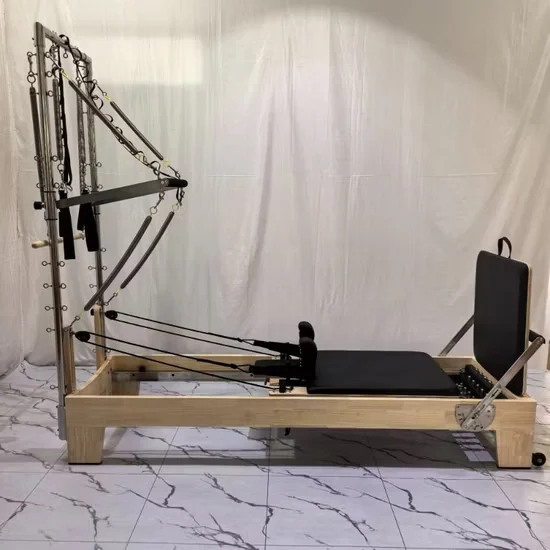
Whisper-Quiet Glide — Precision bearing pulleys and spring resistance deliver sub-35dB operation suitable for studio floors above occupied rooms.
Technical Specifications
| Parameter | Value |
|---|---|
| Designation | SRY-06 |
| Brand | Senrui |
| Product Type | Pilates Reformer with Tower |
| Specification | 24607301900mm |
| Net Weight | 150kgs |
| Accessories | Long Box / Jump Board / Platform |
| Color | Solid Color, customized options available |
| Logo | Customized Is Allowed |
| Certification | CE, EN 957, ISO 9001 |
| Warranty | 3 Years |
| Production Capacity | 80 Pieces/Month |
| HS Code | 9506911900 |
Application Suitability
| Deployment Scenario | Typical Use |
|---|---|
| Commercial Pilates studio | Daily multi-class reformer sessions requiring consistent spring resistance and smooth rail glide |
| Fitness center reformer class area | Group reformer classes with rapid accessory changeovers between class blocks |
| Boutique Pilates facility | One-on-one and semi-private sessions utilizing tower attachments for progressive programming |
| Rehabilitation and wellness center | Low-impact movement therapy with adjustable spring tension for varying patient capacity |
| High-end residential private gym | Quiet operation in shared residential environments without structural vibration transfer |
What Spring Fatigue Reveals About Studio Uptime
Commercial spring sets must hold resistance consistency across thousands of extension cycles, or private sessions degrade fast.
When a studio deploys reformers rated for home use, the springs lose tension within months. Instructors start compensating with verbal cues rather than letting the equipment do the work. Members notice the inconsistency between morning and evening classes, and retention drops before anyone files a formal complaint [NEED_CITE: spring fatigue testing standards for commercial reformer equipment]. The commercial Pilates reformer machine with tower addresses this through spring sets tested for repeated high-cycle stretching, maintaining resistance profiles that instructors can program against with confidence.
Positioning Within the Reformer Training Zone
This commercial Pilates reformer machine with tower covers full-spectrum movement patterns from supine footwork through standing tower exercises, serving beginner through advanced practitioners in a single station. In a studio layout, it pairs with mat-work zones and smaller apparatus to create class flow without bottlenecking at transition points. The 2460mm length accommodates tall users on the carriage while the tower attachment extends vertical exercise range without requiring additional floor footprint.
Continuous Operation and Studio Environment Demands
A boutique studio running six back-to-back reformer classes daily places different demands on equipment than a hotel wellness center with sporadic guest usage. Spring tension consistency must hold across temperature and humidity swings common in basement or converted retail spaces [NEED_CITE: environmental factors affecting spring resistance consistency]. Floor leveling becomes critical when reformer rails span uneven surfaces—any twist in the frame translates directly to carriage drag and uneven wear on pulley bearings. Studios on upper floors benefit from the dampened glide that prevents low-frequency vibration from reaching occupied spaces below.
Reading the Spring and Rail Specifications
The spring resistance system uses multiple tension springs rather than elastic cords, providing predictable load curves that instructors can reference when programming progressions. Each spring engages at a known resistance point, allowing quantifiable adjustments between sessions. The aluminum rail paired with precision bearing pulleys reduces friction to a level where carriage movement responds directly to user input rather than fighting mechanical drag. Steel frame construction at this weight class absorbs dynamic loading from jump board work without flex or audible resonance, maintaining structural alignment over extended deployment.
The Cost of Specifying Below Commercial Grade
Reformers built for residential duty cycles fail predictably in studio environments. Springs lose tension unevenly, creating asymmetrical resistance that instructors must work around. Rail surfaces develop wear patterns that cause carriage stutter during slow controlled movements—the exact movements that define reformer training [NEED_CITE: rail wear patterns in high-frequency reformer deployment]. Pulley bearings that lack sealing allow sweat and humidity ingress, leading to corrosion and noise within the first year of commercial use. The cumulative effect is equipment that feels different month to month, undermining the consistency that members pay for.
Why This Product Line for Studio Deployment
Sub-35dB operation verified across hotel deployments means this equipment operates without generating complaints in sound-sensitive environments. The spring and pulley assemblies undergo durability testing calibrated for 10,000+ hours of continuous high-frequency use. Full OEM customization extends to frame color, logo placement, and accessory combinations, allowing studios to maintain visual consistency across a multi-unit purchase. The 3D layout service accounts for reformer spacing, instructor sightlines, and airflow between units—critical when twelve reformers operate simultaneously in a single room. Documentation packages include spring specifications and maintenance intervals, enabling facility managers to plan preventive service rather than reacting to failures.
Documentation & Test Records
- CE declaration of conformity for commercial reformer equipment
- EN 957 test report covering structural load and safety requirements
- ISO 9001 certificate for manufacturing quality management
- Spring fatigue test record documenting resistance retention over extended cycles
- Rail and pulley durability test log
- Accessory compatibility and mounting specification sheet
Installation, Commissioning & Maintenance
- Verify floor leveling across the 2460mm footprint before frame assembly to prevent rail twist
- Maintain manufacturer-specified clearance around all sides for accessory attachment and instructor access
- Calibrate spring tension against reference values after initial break-in period
- Inspect pulley bearings and rail surfaces quarterly for wear or contamination
- Clean carriage wheels and rail contact points weekly to prevent debris accumulation
- Store Long Box, Jump Board, and Platform accessories on designated racks to prevent frame contact damage
Inquiry Guidance for Equipment Selection
Provide studio square footage and planned reformer count to receive a 3D layout addressing spacing, airflow, and instructor sightlines. Specify daily class volume and average session length to confirm the equipment matches your operational tempo. Indicate deployment floor and adjacent room usage to verify acoustic requirements. State your market’s voltage standards if tower attachments include any electronic components. Note whether OEM customization is required for brand alignment across your facility.
Frequently Asked Questions
Q: What structural differences separate commercial reformers from residential models?
A: Commercial reformers use thicker steel tubing, sealed bearing pulleys, and spring sets rated for thousands of daily cycles. Residential models often substitute elastic cords or lighter springs that degrade under continuous class scheduling. The frame rigidity in commercial units prevents flex during dynamic movements like jump board work, maintaining alignment and consistent carriage travel.
Q: When should a studio choose spring resistance over cord-based systems?
A: Spring systems provide quantifiable resistance levels that instructors reference when programming progressions across client skill levels. Cords offer smoother initial engagement but lose elasticity faster under high-frequency use. Studios running multiple classes daily benefit from spring durability and the ability to replace individual springs rather than entire cord assemblies when maintenance is required.
Q: What causes rail stutter and how is it prevented?
A: Rail stutter typically results from debris accumulation on contact surfaces, bearing degradation, or frame twist from improper leveling. Regular cleaning of carriage wheels and rail surfaces prevents most issues. Ensuring the frame sits on a level surface during installation eliminates twist-induced binding that accelerates wear on specific rail sections.
Q: How should reformer spacing be planned in a group class studio?
A: Spacing must account for full carriage travel plus instructor passage between units, typically requiring more clearance than equipment dimensions alone suggest. Airflow between reformers prevents heat buildup during intensive sessions. Sightlines from the instructor’s primary position ensure all participants remain visible during supine and standing exercises.
Q: What OEM customization options are available for studio branding?
A: Frame color, logo placement on the tower or carriage end, and accessory combinations can be specified to match studio visual identity. Custom colors allow coordination with interior design schemes, while consistent branding across multiple units creates a cohesive environment. Minimum order quantities apply and vary by customization scope.


![Reformer Maple Wood Pilates Full Track Flat Bed Core Training Equipment [WARN] draft identifier mismatch](https://bicksport.com/wp-content/uploads/2026/08/reformer-maple-wood-pilates-full-track-flat-bed-core-training-equipment-warn-draft-identifier-mismatch-3c39d2.webp)
