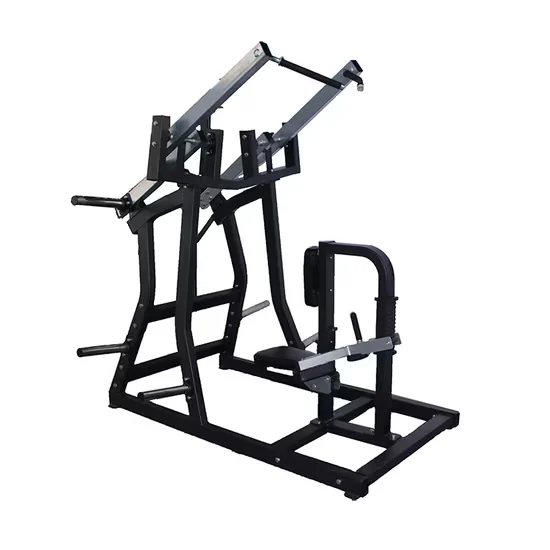
![Professional Gym Equipment ISO Lateral Leg Curl Fitness Machine for Commercial Gyms [WARN] draft identifier mismatch](https://bicksport.com/wp-content/uploads/2026/08/professional-gym-equipment-iso-lateral-leg-curl-fitness-machine-for-commercial-gyms-warn-draft-identifier-mismatch-1b8751.webp)
Continuous Operation Tested — SRH-21 reinforced with 501003mm steel tubing maintains frame rigidity through repeated high-frequency resistance cycles.
Technical Specifications
| Parameter | Value |
|---|---|
| Designation | SRH-21 |
| Product Type | ISO Lateral Leg Curl (Strength Equipment) |
| Tube Size | 501003mm |
| Machine Weight | 115kgs |
| Product Dimensions | 1400x1200x900mm |
| Material | Iron |
| Age Group | Adult |
| Gender | Unisex |
| Color | Customized |
| Certification | RoHS, ISO 9001, CE |
| Production Capacity | 200 Pieces/Month |
| Shipment Time | 30-40 Days by Sea |
Application Suitability
| Deployment Scenario | Typical Use |
|---|---|
| chain gym cardio zone | Isolated hamstring strengthening between compound lifts during peak rotation hours |
| hotel fitness center on guest room floors | Low-noise posterior chain work for guests avoiding heavy free-weight areas |
| corporate wellness room | Moderate-intensity leg conditioning for employees with limited training windows |
| sports performance training center | Athlete-grade hamstring isolation and injury prevention programming |
| high-end residential home gym | Dedicated curl station complementing rack and cable setups |
Why Frame Rigidity Dictates Equipment Lifespan in Commercial Facilities
Thicker tube walls resist micro-deformation that accumulates into catastrophic fatigue over thousands of loading cycles.
When strength equipment enters a commercial floor, the first failure is rarely catastrophic — it starts with a subtle wobble that members notice before maintenance staff does. A commercial ISO lateral leg curl strength machine must absorb repeated eccentric loading without the frame shifting beneath the user, because any lateral play translates directly into joint misalignment. Facilities that spec equipment based on aesthetics rather than steel cross-section routinely face early weld cracking and pivot pin wear [NEED_CITE: frame fatigue failure modes under continuous commercial loading].
SRH-21 Positioning Within the Strength Training Zone
The SRH-21 commercial ISO lateral leg curl strength machine targets hamstring isolation with a fixed movement path that removes stabilization demands from the user. In a fully equipped strength zone, it complements leg press and squat stations by allowing targeted posterior chain work without spinal loading. The 1400x1200mm footprint positions it as a mid-floor anchor between cable columns and plate-loaded stations, requiring standard clearance on three sides for safe loading and exit. The reinforced 501003mm iron frame accommodates users across a broad weight range while maintaining pad stability during maximal efforts.
Continuous Loading Demands and Floor-Level Deployment
This machine sees concentrated use in lower-body training blocks where multiple users rotate through in rapid succession. The 115kg net weight anchors the frame against walking loads, but proper ground leveling remains essential to prevent uneven stress on the tube joints. Noise transmission through the floor is minimal compared to dropping weights, yet facilities on upper hotel floors should still deploy isolation pads beneath the base feet to decouple vibration from the slab [NEED_CITE: vibration isolation requirements for upper-floor strength equipment]. No electrical supply is required, which simplifies placement — the only infrastructure consideration is adequate lighting for the adjustment pins and clear sightlines for staff monitoring form from the desk.
Steel Cross-Section and Pivot Engineering Explained
The 501003mm rectangular tube specification governs how the frame responds to off-axis loading during heavy curls. Thinner walls flex under eccentric contraction, creating a sensation of instability that users interpret as poor build quality. The 3mm wall thickness provides a stiffness-to-weight ratio that keeps deflection negligible even at maximum stack resistance. Iron construction was selected over aluminum alloys because the material’s higher modulus resists the cyclic bending moments generated at the pivot axis. The pivot bearings are sealed to exclude sweat and chalk dust that accelerate wear in high-traffic environments. Pad positioning is fixed relative to the pivot point, ensuring consistent biomechanical alignment across the user population without requiring complex adjustment mechanisms.
The Hidden Cost of Underspec’d Frame Sections
Facilities that source strength equipment based on unit price rather than tube gauge typically discover the gap within the first year of continuous operation. Frames built with 2mm or thinner walls develop visible flex under loads that 3mm sections handle without measurable deflection. This flex migrates into the welds, where stress concentrations initiate cracking long before the expected service interval. Members abandon machines that feel unstable, leaving expensive floor space underutilized [NEED_CITE: equipment utilization correlation with perceived structural stability]. Replacing an entire row of underspec’d machines disrupts floor layout and member routines far more than the initial procurement savings justify.
Why This Product Line Addresses the Gaps
Every SRH-21 unit leaves the facility after passing structural load testing that verifies the 501003mm frame performs within deflection limits under maximum rated resistance. The 115kg machine weight reflects material density rather than ballast, meaning the steel itself provides the stability. OEM customization extends to powder-coat color and branding, allowing facility operators to maintain visual consistency across a mixed-equipment floor without compromising the underlying specification. The six-family cardio and strength catalog means a single source covers the complete zone build-out, and the free 3D layout service accounts for the SRH-21’s footprint alongside adjacent stations to maintain traffic flow and sightlines. Technical support remains available around the clock for adjustment or parts inquiries.
Documentation & Test Records
- CE declaration of conformity confirming EU market compliance for the SRH-21
- EN 957 test report covering structural integrity and pinch-point safety
- ISO 9001 certificate validating manufacturing process control
- RoHS compliance documentation for material composition
- Frame load and deflection test records at maximum rated resistance
- Pivot bearing cycle test documentation for continuous-use validation
Installation, Commissioning & Maintenance
- Allow minimum 800mm clearance on three sides of the 1400x1200mm footprint for user entry and plate loading
- Shim base feet on uneven floors until the 115kg frame sits without rock or twist
- Inspect pivot bearing seals and re-grease at intervals defined by weekly usage volume
- Verify all fastener torque after the first 500 loading cycles and quarterly thereafter
- Wipe pads and frame contact points daily to prevent sweat corrosion on the iron tube surfaces
Specification Alignment and Procurement Next Steps
Provide your strength zone floor area and target equipment count to receive a 3D layout that positions the SRH-21 within traffic flow and sightline requirements. Confirm whether the deployment floor is above occupied space so vibration isolation specifications can be finalized early. Specify your target market for labeling and compliance documentation alignment. Indicate any color or branding customization requirements so powder-coat scheduling aligns with production lead times.
Frequently Asked Questions
Q: How does the 501003mm tube specification compare to lighter commercial frames?
A: The 3mm wall thickness in a 50x100mm rectangular section provides a higher second moment of area than thinner alternatives, meaning the frame resists bending under eccentric hamstring loads without perceptible flex. Users feel this as solidity during heavy sets, and the structure maintains alignment over thousands of cycles rather than developing the wobble that drives members away from poorly spec’d stations.
Q: What customization options are available for facility branding?
A: The SRH-21 supports custom powder-coat color on all tube surfaces, embroidered or printed pad vinyl, and logo placement on the frame shroud. Console and adjustment pin graphics can also be aligned with facility visual standards. Minimum order quantities apply for color runs outside the standard palette, and sample panels are available for approval before full production begins.
Q: What clearance does the SRH-21 require in a commercial strength zone layout?
A: The 1400x1200mm machine footprint needs a minimum of 800mm on the loading side and the user exit side to allow safe plate handling and unobstructed movement. The 900mm height clears standard overhead lighting and camera sightlines. When planning a dedicated leg zone, positioning two units back-to-back with a shared loading corridor maximizes floor efficiency.
Q: How should maintenance intervals be structured for the pivot and bearing assembly?
A: Pivot bearings are sealed against chalk dust and sweat ingress, but visual inspection should occur weekly in high-traffic facilities. Re-greasing intervals depend on daily cycle count rather than calendar time — a machine seeing fifty sets per day needs attention sooner than one in a low-volume corporate wellness room. Fastener torque checks should follow the first five hundred cycles and repeat quarterly.