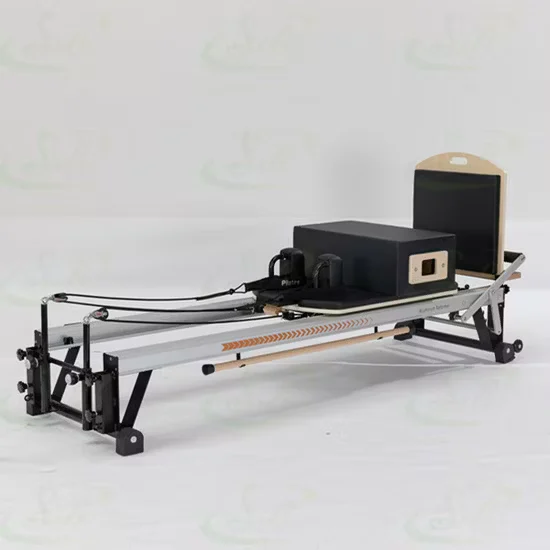
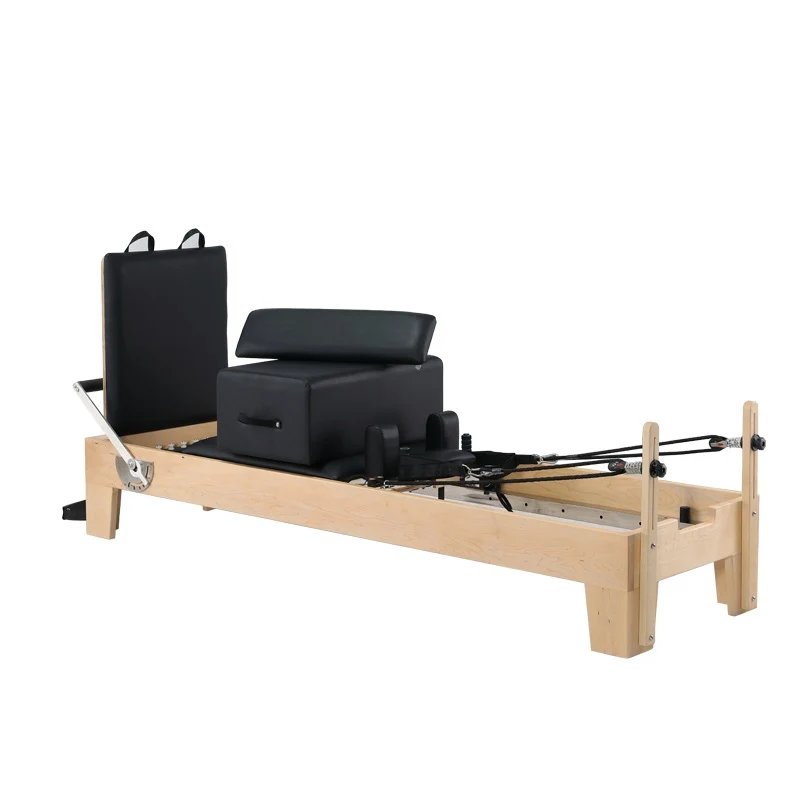
Whisper-Quiet Wood Frame — Solid wood construction absorbs carriage vibration at the source, keeping studio floors free from metallic resonance during spring recoil and high-impact jump board work.
Technical Specifications
| Parameter | Value |
|---|---|
| Designation | SRY-20B |
| Product Type | Foldable Pilates Reformer |
| Frame Material | Solid Wood |
| Finish | Solid Color |
| Product Dimensions | 2400 × 600 × 350 mm |
| Net Weight | 100 kg |
| Foldable | Yes |
| Included Accessories | Long Box, Jump Board, Platform |
| Maximum User Weight | Not specified |
| Customization | Available (Logo, Color) |
| Age Group | Adult |
| Gender | Unisex |
| Warranty | 3 Years |
Application Suitability
| Deployment Scenario | Typical Use |
|---|---|
| Boutique Pilates studio | Daily group reformer classes and semi-private sessions |
| Hotel fitness center on guest room floors | 24-hour self-service reformer access with minimal vibration transfer |
| High-end residential wellness suite | Private reformer training in shared-building environments |
| Rehabilitation center | Controlled low-impact conditioning with accessory support |
| Multi-discipline fitness facility | Flexible floor layout with rapid fold-away storage between classes |
Why Vibration Travels Through Floors Before Anyone Notices the Carriage
Wood-frame reformers absorb impact energy internally instead of transmitting it through steel to the subfloor.
In mixed-use commercial buildings, the sound of a carriage slamming into the stopper during explosive spring work travels through concrete slabs and into occupied rooms below. Steel-frame reformers act as resonant amplifiers, turning every controlled landing on the jump board into a percussive event that reaches adjacent spaces. Facility operators in shared-occupancy buildings often receive noise complaints from tenants who have no idea a Pilates studio operates one floor above. [NEED_CITE: structure-borne noise transmission through concrete floor assemblies in mixed-use buildings]
The foldable Pilates reformer wood commercial frame addresses this at the material level. Solid wood has inherent damping properties that dissipate kinetic energy as internal friction rather than passing it along as vibration. For studios operating early-morning or late-evening sessions in buildings with residential or office neighbors, the difference in complaint frequency is noticeable from the first week of deployment.
Where the SRY-20B Fits in a Multi-Discipline Studio Layout
The SRY-20B covers the full spectrum of reformer-based programming, from supine footwork through advanced suspension work and plyometric jump board sequences. In a studio equipped with both mat zones and apparatus areas, this foldable Pilates reformer slots into semi-private group configurations where space between units must be cleared rapidly for mat classes. The accessory package — Long Box for seated and prone work, Jump Board for cardiovascular loading, Platform for standing balance series — eliminates the need for supplementary equipment purchases. For facilities accommodating users across a broad range of body sizes, the solid wood frame provides stable load-bearing without flex under high-tension spring settings, and the 2400 mm length supports full extension for taller users.
Continuous Session Scheduling and Floor-Level Deployment Constraints
Studios running back-to-back classes from early morning through evening place continuous cyclic loading on every reformer component. The carriage wheels, spring anchors, and rope pulleys cycle hundreds of times per day across a full schedule. Wood frames do not fatigue the way welded steel joints can, but the foldable hinge mechanism requires periodic inspection to confirm locking pin engagement under repeated folding cycles. Deployment on upper floors of mixed-use buildings demands attention to both impact noise and low-frequency vibration; the solid wood construction reduces structure-borne transmission compared to metal alternatives, but supplementary isolation pads beneath the feet further limit what reaches the slab below. [NEED_CITE: vibration isolation requirements for fitness equipment on suspended concrete floors] Adequate ventilation around the stored position matters as well — wood frames left in stagnant, high-humidity rooms may experience dimensional swelling that affects carriage glide tolerance over time. Facilities should confirm that their power circuits can support adjacent equipment without shared grounding loops that introduce hum into audio systems used during classes.
Reading the Spec Sheet for Drive, Glide, and Damping Behavior
Solid wood frame construction is the primary noise and vibration variable in reformer selection. Unlike tubular steel, which transmits spring recoil energy directly to the floor through rigid welds, solid timber dissipates a significant portion of that energy internally. This means the carriage return at the end of each repetition lands with a lower acoustic signature, and the high-frequency buzz that steel frames produce during rapid directional changes is largely absent. The foldable mechanism introduces a structural discontinuity at the hinge point — engineering this joint to maintain rail alignment under load is where manufacturing precision determines whether the carriage tracks true after repeated folding and unfolding. The included Long Box, Jump Board, and Platform each attach to designated mounting points on the frame, and the load rating of these attachment points must be verified against the forces generated during plyometric sequences on the Jump Board. Spring selection determines resistance curve behavior: lighter springs for rehabilitation and controlled eccentric loading, heavier springs for strength conditioning and athletic populations. The 100 kg net weight of the SRY-20B provides sufficient mass to resist frame shift during aggressive footwork without requiring permanent floor anchoring, though the foldable capability means the unit can be relocated when floor plans are reconfigured for different class formats.
What Specification Shortcuts Cost After the First Quarter
Choosing reformers with undersized hinge pins in the foldable mechanism leads to progressive rail misalignment, and the carriage begins to bind or rattle within months of daily use. Studios that purchased based on initial price alone often find themselves replacing carriage wheels and re-tensioning ropes on a schedule that disrupts class bookings and generates member complaints. In hotel fitness centers where the reformer sits on a guest room floor, a steel frame that transmits every jump board impact to the room below generates front-desk complaints that escalate to equipment removal — the entire investment written off because vibration isolation was never specified. [NEED_CITE: equipment replacement cycles in commercial Pilates studios due to premature component wear] Facilities that skipped accessory packages and sourced third-party add-ons discover mounting-point incompatibilities that compromise safety during standing work on the Platform. The cost of these failures compounds: lost members, cancelled classes, and emergency procurement at premium lead times.
Why This Product Line Earns Its Place in the Deployment Plan
Every SRY-20B unit is checked for carriage glide smoothness, hinge lock engagement force, and spring anchor integrity before it leaves the factory — the same quality gates applied across the full cardio range. The foldable footprint of this reformer is factored into 3D studio layout plans that account for member flow, instructor sightlines, and ventilation clearance, ensuring the unit integrates into the room rather than consuming dead space. OEM customization extends to logo placement and frame color matching, so franchise operators maintain visual consistency across locations without managing multiple supplier relationships. The three-year warranty covers frame, mechanism, and accessory components, backed by the same 24/7 technical support channel that services the cardio fleet. [NEED_CITE: commercial Pilates reformer warranty coverage standards for frame and moving components] For facilities sourcing both reformer and cardio equipment from one supply chain, the documentation package, installation protocols, and spare parts logistics remain unified under a single point of coordination.
Documentation & Test Records
- CE declaration of conformity for the SRY-20B frame and accessory components
- EN 957 test report covering structural load and carriage glide performance
- ISO 9001 certificate for manufacturing quality management systems
- Noise and vibration test record for wood frame damping verification
- Foldable mechanism cycle durability test log
- Accessory load-rating verification for Long Box, Jump Board, and Platform
Installation, Commissioning & Maintenance
- Allow minimum 600 mm clearance on each side of the SRY-20B for safe carriage travel during group sessions
- Place vibration isolation pads beneath all four feet when deploying on upper floors of multi-story buildings
- Inspect foldable hinge locking pins monthly and re-torque fasteners to specified values
- Lubricate carriage wheels and check rail alignment quarterly under continuous studio scheduling
- Wipe wood frame surfaces with pH-neutral cleaner after each session to prevent sweat-induced finish degradation
- Verify spring anchor tension and rope condition weekly during high-frequency class rotations
Scheduling a Deployment Review
Share your studio floor plan and target class schedule so we can model reformer placement, member circulation paths, and ventilation clearance for the SRY-20B within your available square footage. Specify the building occupancy type — mixed-use commercial, hotel, or residential — so noise transmission requirements are matched to frame and isolation specifications. Indicate your target market voltage standards if motorized accessory equipment will share the same circuit. Clarify whether your studio management software requires data integration from connected devices elsewhere in the facility.
Frequently Asked Questions
Q: How does a solid wood frame compare to a steel frame for noise reduction in a commercial studio?
A: Solid wood has natural internal damping that absorbs vibration energy from carriage impacts and spring recoil, rather than transmitting it through the frame to the floor. In shared-occupancy buildings, this noticeably reduces structure-borne noise reaching adjacent rooms or floors below. Steel frames tend to resonate at higher frequencies during rapid directional changes, producing an audible buzz that wood frames largely eliminate without supplementary isolation hardware.
Q: How durable is the foldable mechanism under daily class rotation?
A: The hinge mechanism is engineered for repeated folding and unfolding cycles consistent with studio environments that reconfigure floor space between class formats. The locking pins and structural fasteners at the fold point require periodic inspection to confirm secure engagement and rail alignment. Facilities running multiple sessions daily should schedule quarterly mechanism checks as part of their standard maintenance rotation.
Q: Are the included accessories compatible with third-party reformer add-ons?
A: The Long Box, Jump Board, and Platform are designed to mount to the SRY-20B frame attachment points with verified load ratings for each accessory. Third-party add-ons may not align with the mounting geometry or load specifications of this frame, and using unverified accessories can compromise stability during standing or plyometric exercises. We recommend confirming attachment compatibility before sourcing supplementary components.
Q: What floor preparation is required before installing the reformer in an upper-floor studio?
A: A level subfloor is essential to prevent carriage drift and uneven rail loading. Vibration isolation pads placed beneath each foot further reduce structure-borne transmission to floors below, which is particularly important in buildings with occupied spaces underneath the studio. Floor load capacity should be confirmed against the combined weight of the reformer and maximum user load at each unit position.
Q: What customization options are available for branding and color matching across multiple locations?
A: The SRY-20B supports logo application and frame color customization to align with franchise or hospitality brand standards. Color and finish options can be specified per order, enabling consistent visual identity across multiple studio deployments. Customization scope and lead time depend on order volume and finish complexity, so early specification during the planning phase ensures alignment with opening timelines.