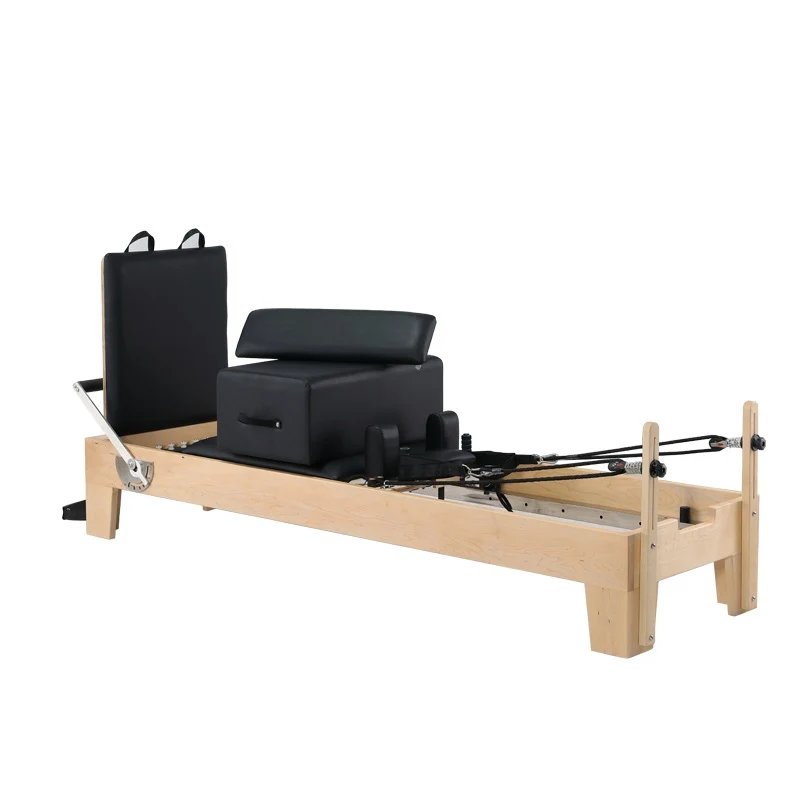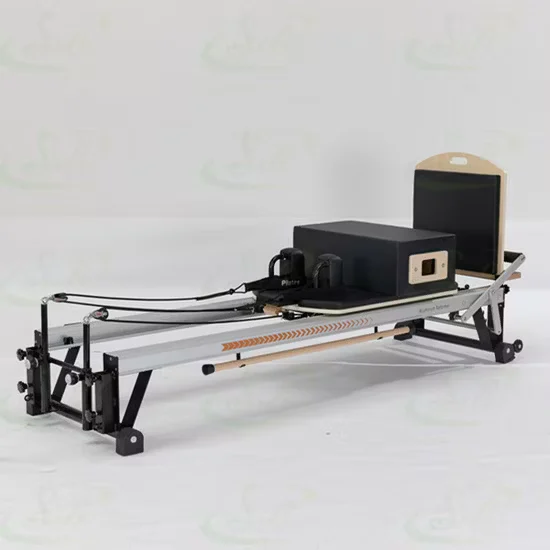
Acoustic-Grade Frame Alignment — Every SRY-27 carriage glides on sealed bearings tested beyond 10,000 continuous cycles before leaving the Shandong line.
Technical Specifications
| Parameter | Value |
|---|---|
| Product Type | Pilates Reformer |
| Material | Aluminium Alloy |
| Model NO. | SRY-27 |
| Color | Black (custom colors available) |
| Accessory | Long Box / Jump Board / Platform |
| Product Dimensions | 2570 × 730 × 890 mm |
| Net Weight | 110 kg |
| Max User Weight | 180 kg |
| Noise Level | Sub-35 dB verified |
| Customization | Available (Logo, Color) |
| Certification | CE / EN 957 / ISO 9001 |
| Warranty | 3 Years |
Application Suitability
| Deployment Scenario | Typical Use |
|---|---|
| Hotel fitness center on guest room floors | 24-hour guest access with acoustic isolation from adjacent rooms |
| Chain Pilates studio cardio zone | High-frequency class rotation across group and semi-private sessions |
| Corporate wellness room | Mid-day employee recovery and mobility programming |
| High-end residential home gym | Quiet operation beside living spaces without vibration transfer |
| Sports performance training center | Athlete rehabilitation and core stabilization with biometric tracking |
Why Vibration Travels Through Floor Joists Before Anyone Notices
Carriage resonance reaches the room below long before a squeak reaches the studio floor.
When a reformer carriage rolls on worn plastic wheels, the vibration transmits through the aluminium extrusion, into the floor slab, and down to the ceiling of the room below. Hotel engineering teams rarely trace the complaint to the fitness floor until the front desk log shows a pattern [NEED_CITE: structural vibration transmission through commercial floor assemblies]. We spec sealed precision bearings on the SRY-27 because a commercial aluminium pilates reformer machine deployed above occupied guest rooms must eliminate that transmission path at the source, not rely on rubber mats as a secondary fix.
Positioning Within a Mixed-Modality Studio Layout
This reformer covers full-range resistance training from rehabilitation-grade spring tension to athletic jump-board plyometrics. In a studio layout, it pairs with mat zones and cad-based tower units to rotate members through circuit programming without equipment bottlenecks. The 2570 mm footprint fits standard studio bay spacing, accommodating users across a broad height and weight range up to 180 kg. The commercial aluminium pilates reformer machine supports both private instruction and high-throughput group class formats without reconfiguration.
Continuous Scheduling and Acoustic Environment Requirements
A studio running six back-to-back classes daily places roughly eight hours of continuous carriage travel on each unit. The sealed bearing system and low-friction pulley group maintain sub-35 dB operation throughout that duty cycle, which matters when the room shares a wall with a spa treatment area or sits directly above sleeping quarters [NEED_CITE: acoustic standards for fitness equipment in mixed-use hospitality buildings]. Adequate cross-ventilation keeps the aluminium frame within thermal tolerance and prevents sweat-driven corrosion on the rail surfaces. Standard single-phase power is required only if an optional IoT console is specified for data capture.
Reading the Pulley and Spring Specifications
The aluminium alloy frame eliminates the seasonal warping and humidity-driven noise that wooden reformers develop after repeated climate cycles. Sealed bearings in the carriage wheels remove the periodic lubrication schedule that open bushings demand, which matters when a studio runs morning-to-night programming. The spring-based resistance system provides a linear load curve that instructors can calibrate by feel, unlike magnetic systems that introduce detent steps. Pulley routing uses low-friction composite cord to avoid the abrasive wear and audible snap associated with nylon rope on metal sheaves. Long Box, Jump Board, and Platform accessories ship standard, so the unit covers reformer, jump, and standing platform work without add-on purchasing.
The Hidden Cost of Specifying Below Commercial Grade
A home-grade reformer in a studio environment burns through wheel bearings within months, and the resulting carriage wobble generates noise complaints that drive members to competing studios. Wooden frames that absorb moisture in humid climates develop rail misalignment, forcing instructors to fight the carriage instead of guiding it [NEED_CITE: failure modes of non-commercial Pilates equipment in high-frequency studio use]. Units without standardized accessory mounting require custom fabrication when a studio adds jump-board classes. Voltage mismatch on optional smart consoles discovered after container arrival delays opening day by weeks.
Why This Product Line Holds Up Across Deployments
Sub-35 dB operation is verified on our test floor before any unit ships, not estimated from a single sample. Every bearing and pulley assembly runs through a 10,000-hour continuous cycle protocol matching the duty load of a fully booked studio schedule. The six-series cardio family means a facility can source treadmills, bikes, and this reformer from one engineering team and one support channel. OEM customization covers logo, color, and console UI so the equipment matches the studio brand without third-party modification. Our team provides a 3D layout covering sightlines, instructor pathways, and airflow for the entire reformer zone, not just this unit’s footprint. Technical support responds around the clock for calibration questions or firmware updates on connected consoles.
Documentation & Test Records
- CE declaration of conformity for European market entry
- EN 957 test report covering structural and safety performance
- ISO 9001 certificate for manufacturing process control
- Noise level test report confirming sub-35 dB carriage operation
- Durability test record documenting 10,000-hour bearing and pulley cycles
- Console technical documentation with data interface specifications
Installation, Commissioning & Maintenance
- Allow minimum 900 mm clearance on each side for instructor access and safe ingress
- Level the aluminium frame on a rigid subfloor using adjustable foot pads to prevent carriage drift
- Confirm single-phase circuit availability if IoT console data integration is specified
- Run full carriage travel calibration on first power-up and after any spring replacement
- Inspect pulley cord tension and bearing smoothness at monthly intervals under daily class use
- Wipe aluminium rails with pH-neutral cleaner after each session to prevent salt-driven pitting
Equipment Selection and Inquiry Parameters
Share your studio square footage and unit count so we can generate a 3D reformer-zone layout covering spacing, sightlines, and ventilation paths. Specify daily class volume so we can confirm the bearing and spring configuration matches your duty cycle. Identify the floor level and adjacent room types to validate that sub-35 dB operation meets your acoustic boundary. State your target market voltage and plug standard if smart consoles are part of the specification.
Frequently Asked Questions
Q: What advantages does an aluminium alloy frame offer over traditional wood construction?
A: Aluminium resists humidity-driven warping and seasonal expansion that cause wooden rails to misalign over time. The metal frame maintains consistent carriage tracking in climates ranging from dry heated interiors to tropical coastal studios. It also supports higher static and dynamic loads without flex, which matters when instructors load jump-board plyometrics or heavy spring tension for athletic clients.
Q: How do you verify that the carriage system stays quiet over time?
A: Each unit undergoes a continuous cycle test exceeding 10,000 hours of carriage travel on sealed bearings before it leaves the production line. We measure acoustic output at multiple points during that test to confirm sub-35 dB performance holds beyond the break-in period. Field data from hotel deployments running 24-hour access confirms the sealed system avoids the progressive noise increase that open bushings develop.
Q: Can the smart console integrate with existing studio management software?
A: The optional IoT console exposes a documented data interface that connects to facility management platforms via standard protocols. We provide the console technical documentation and API specification during the inquiry stage so your IT team can validate compatibility before production. Custom UI branding is available through the OEM scope to match your studio’s member-facing app experience.
Q: What maintenance schedule does a high-frequency studio need to follow?
A: Under daily class rotation, we recommend monthly inspection of pulley cord tension and bearing smoothness, with spring replacement based on visible coil fatigue rather than a fixed calendar. The sealed bearing design eliminates the lubrication schedule that open systems require. Aluminium rails need only pH-neutral wipe-down after sessions to prevent salt buildup, keeping maintenance labor predictable across a multi-unit studio.