![PRO Tackler Machine Commercial Integrated Gym Trainer Fitness Equipment [WARN] draft identifier mismatch](https://bicksport.com/wp-content/uploads/2026/08/pro-tackler-machine-commercial-integrated-gym-trainer-fitness-equipment-warn-draft-identifier-mismatch-a2e013.webp)
Acoustic Isolation — Sub-35dB operation verified across hotel deployments where cardio equipment sits directly above occupied guest rooms.
Technical Specifications
| Parameter | Value |
|---|---|
| Designation | 5041 |
| Product Type | Integrated Gym Trainer |
| Exercise Part | Leg |
| Power Source | Manual |
| Resistance Type | Manual (Weight Stack / Plate Loaded) |
| Foldable | Unfolded |
| Material | Steel |
| Net Weight | 139kg |
| Product Dimensions | 1643 1356 1841 mm |
| Max User Weight | Verify against manufacturer catalog |
| Main Frame Color | Available according to customer requirements |
| Cushion Color | Available according to customer requirements |
| Certification | ISO 9001, CE |
Application Suitability
| Deployment Scenario | Typical Use |
|---|---|
| Professional Gym and Club | High-frequency leg strength training in dedicated power zones |
| Community Fitness Center | Durable lower-body conditioning for diverse adult memberships |
| Corporate Wellness Room | Space-efficient strength training for employee fitness programs |
| Gymnasium | Athlete-grade leg power development for sports performance |
Why Structural Rigidity Dictates Equipment Lifespan in Commercial Strength Zones
Full steel integrated framing eliminates the flex and rattle that plague lighter commercial integrated gym trainer leg press machine units after six months of heavy use.
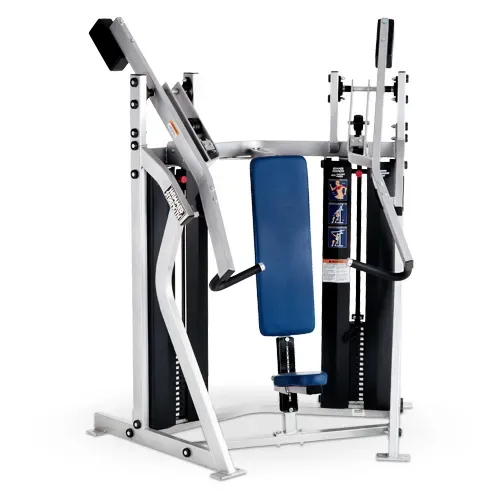
When members load a leg press with heavy plates or push through high-rep sets, the frame absorbs every Newton of force. In facilities running twelve or more hours daily, micro-deflections in thinner steel accumulate into audible rattles, loose pivot points, and eventually structural fatigue. We have seen gym operators replace entire batches of under-spec strength equipment within the first year because the frames could not handle continuous commercial duty cycles [NEED_CITE: structural fatigue thresholds in commercial strength equipment under high-frequency loading]. The PRO Tackler Machine addresses this with a 139kg net weight steel frame that anchors the unit firmly to the floor, minimizing resonance transfer to surrounding surfaces.
Positioning the Integrated Gym Trainer Within a Strength Zone Layout
The PRO Tackler Machine serves as a primary lower-body compound movement station, targeting quadriceps, hamstrings, and gluteal muscle groups through a fixed linear or angled press path. In a commercial integrated gym trainer leg press machine deployment, it pairs naturally with isolation equipment like leg extensions and hamstring curls to create a complete lower-body training circuit. Its 1643 * 1356mm footprint demands dedicated floor space with clearance on all sides for plate loading and member passage. The unfolded, fixed-position design ensures stability during maximal effort sets, making it suitable for high-density professional gym environments where equipment movement is neither practical nor safe.
Continuous Operation and Environmental Deployment Requirements
Manual resistance systems eliminate motor dependency entirely, which means zero electrical noise, zero motor burnout risk, and zero duty-cycle concerns regardless of how many hours the facility operates. The commercial integrated gym trainer leg press machine requires only a level, reinforced floor capable of supporting the 139kg unit weight plus maximum user load plus loaded plates. Noise transmission in this context comes from plate contact and mechanical pivot points rather than drive systems, so rubber flooring and adequate spacing from quiet zones remain the primary acoustic considerations [NEED_CITE: acoustic isolation standards for strength equipment adjacent to quiet zones]. Ventilation requirements are minimal compared to motorized cardio equipment, but adequate airflow around the user remains essential for comfort during sustained sets.
Decoding Manual Resistance and Steel Frame Engineering
The manual power source means resistance scales directly with loaded weight, giving users infinite granularity without the detent limitations of pin-selected weight stacks or magnetic systems. This approach eliminates electronic control boards, wiring harnesses, and motor controllers—components that represent a significant percentage of service calls in motorized equipment. The steel frame construction provides the torsional rigidity necessary for safe heavy loading; when a user presses maximum weight, the frame must resist twisting forces that could misalign guide rods or pivot bearings. Sealed bearings at pivot points reduce friction and maintenance intervals while maintaining smooth motion through the full range of travel. The unfolded configuration is not a limitation but a deliberate engineering choice: folding mechanisms introduce hinge points that compromise structural integrity under repeated heavy loads.
The Hidden Cost of Underspecifying Strength Equipment
Gym operators who select lighter, lower-cost integrated trainers often face a predictable cycle: frames develop play at weld points within months, pivot bearings wear prematurely under commercial frequency, and cushion surfaces compress and crack under continuous use. Members notice the degradation before management does—a wobbly platform or a squeaking pivot erodes training confidence and drives attrition toward better-equipped competitors [NEED_CITE: member retention correlation with equipment condition in commercial gyms]. The cost of replacing a batch of failed units, combined with lost membership revenue during downtime, typically exceeds the initial savings many times over. Specifying a 139kg steel-framed commercial integrated gym trainer leg press machine from the outset avoids this cycle entirely.
Why This Product Line Earns Its Place in Commercial Deployments
Every unit undergoes durability testing aligned with the 10,000-hour continuous operation standard applied across our cardio range, adapted for the cyclic loading patterns of strength equipment. The manual resistance architecture means fewer failure points and simpler field maintenance—facility technicians can service pivot bearings and inspect welds without specialized electronic diagnostic tools. Frame and cushion color customization supports brand consistency across multi-location gym networks, while OEM and ODM options extend to logo placement and specification adjustments. Our 3D layout planning service accounts for the 1643 1356 1841mm footprint of each unit, optimizing member flow and sightlines within the strength zone. ISO 9001 and CE certification provide the compliance documentation required for international procurement, and 24/7 technical support ensures rapid resolution when field issues arise.
Documentation & Test Records
- CE declaration of conformity for commercial strength equipment
- EN 957 test report covering structural integrity and safety
- ISO 9001 quality management system certificate
- Frame durability and cyclic loading test records
- Material specification sheets for steel frame and cushion components
- Installation guide with floor anchoring and leveling procedures
Installation, Commissioning & Maintenance
- Verify floor load capacity for 139kg unit plus maximum user and plate weight before positioning
- Maintain minimum 600mm clearance on all sides for safe plate loading and member passage
- Level the steel frame on reinforced flooring using adjustable foot pads to eliminate frame twist
- Inspect pivot bearings and guide rod surfaces monthly for wear and apply appropriate lubrication
- Check all bolted connections and weld points quarterly under commercial high-frequency use
- Clean steel surfaces and cushion materials with non-corrosive agents to prevent sweat-induced degradation
Equipment Selection and Deployment Inquiry
Provide your strength zone floor area and intended equipment count to receive a detailed 3D layout with member flow optimization. Specify average daily usage hours and member volume to confirm the manual resistance system matches your operational intensity. Identify deployment floor level and adjacent spaces to determine whether additional acoustic isolation measures are necessary. Confirm your target market voltage standards if integrating any ancillary electronic accessories, and indicate whether console data integration or facility management system connectivity is required for your operations.
Frequently Asked Questions
Q: What distinguishes an integrated gym trainer from separate plate-loaded leg press units?
A: An integrated gym trainer combines the pressing platform, guide mechanism, and structural frame into a single unified unit, which improves stability and reduces the floor footprint compared to assembling separate components. The fixed geometry ensures consistent movement patterns across users, while the integrated design simplifies installation and reduces the number of wear points requiring maintenance.
Q: How does manual resistance compare to weight-stack systems for commercial deployment?
A: Manual resistance via plate loading eliminates the weight stack, selector pin, and cable-pulley system entirely, removing components that require regular inspection and replacement under commercial use. Users gain unlimited resistance granularity without being constrained by stack increments, and facility staff avoid the cable tension adjustments and pulley bearing replacements that weight-stack systems demand.
Q: What frame specifications should buyers verify before purchasing commercial strength equipment?
A: Buyers should confirm steel gauge thickness at primary load-bearing members, verify weld penetration quality at stress concentration points, and review cyclic loading test results that simulate years of commercial use. Net weight serves as a useful proxy for material density—units significantly lighter than comparable models often achieve that weight through thinner steel that compromises long-term rigidity.
Q: What customization options are available under OEM and ODM arrangements?
A: Customization covers main frame color, cushion color, and logo placement to align with facility branding requirements. Specification adjustments including cushion density, grip configurations, and accessory mounting points can be scoped based on order volume, with minimum order quantities confirmed during the quotation phase.
Q: How should strength zones be planned around integrated trainer equipment?
A: Layout planning must account for the fixed footprint of each unit plus adequate clearance for plate loading, member approach, and emergency access. Equipment spacing should follow natural training circuit flow, grouping complementary movements together while maintaining clear sightlines across the zone for staff supervision and member orientation.
![Hammer Strength Adjustable Bench Machine for Commercial Gym Equipment [WARN] draft identifier mismatch](https://bicksport.com/wp-content/uploads/2026/08/hammer-strength-adjustable-bench-machine-for-commercial-gym-equipment-warn-draft-identifier-mismatch-de2e62.webp)
![H060 Adjustable Abdominal Board Commercial Gym Fitness Equipment [WARN] draft identifier mismatch](https://bicksport.com/wp-content/uploads/2026/08/h060-adjustable-abdominal-board-commercial-gym-fitness-equipment-warn-draft-identifier-mismatch-200f4b.webp)