

Structural Load Endurance — Reinforced steel frame with manual resistance eliminates motorized failure points in high-frequency strength zones.
Technical Specifications
| Parameter | Value |
|---|---|
| Designation | OS-H5079 |
| Product Type | Stand Calf Raise |
| Power Source | Manual |
| Resistance Type | Manual (weight-loaded) |
| Target Muscle Group | Calf |
| Frame Material | Steel |
| Product Dimensions | 1300 x 1260 x 1495 mm |
| Net Weight | 70 kg |
| Max User Weight | 180 kg |
| Foldable | Unfolded |
| Certification | ISO 9001, CE |
| OEM/ODM | Available |
| Age Group | Adult |
| Gender | Unisex |
Application Suitability
| Deployment Scenario | Typical Use |
|---|---|
| Professional gym and health club strength zones | High-frequency loaded calf training during peak member hours |
| Community fitness center | Durable station for unsupervised daily access by diverse users |
| Corporate wellness facility | Compact footprint calf isolation for time-efficient employee workouts |
| Sports performance training center | Athlete-specific lower-leg strengthening and injury prevention work |
| High-end residential home gym | Space-efficient manual station requiring zero electrical infrastructure |
Why Frame Welding Quality Dictates Replacement Cycles for Commercial Stand Calf Raise Machines
Heavy-gauge steel with reinforced pivot joints prevents the structural fatigue that forces premature equipment retirement.
When a commercial stand calf raise machine enters a busy strength zone, it endures repeated eccentric loading from users dropping heavily onto the shoulder pads. Inferior frames develop stress fractures at the pivot welds within months, creating safety hazards and forcing facility operators into costly mid-cycle replacements. We have seen gym owners pull entire stations from the floor because the base plate separated under load. [NEED_CITE: structural fatigue patterns in commercial strength equipment pivot joints]
Positioning the Calf Station Within a Commercial Strength Floor
The OS-H5079 occupies a specific niche in the lower-body training matrix: isolated calf development that free-weight squats and leg presses cannot fully address. In a professional gym layout, this commercial stand calf raise machine complements compound movement stations by providing a dedicated terminal joint exercise. It suits high-density placement along wall perimeters where its upright footprint conserves floor area. The 180 kg user weight capacity accommodates the full spectrum of commercial gym membership demographics without requiring weight-class segregation.
Continuous Load Cycles and Environmental Tolerances for Manual Stations
A manually loaded stand calf raise operates without motors or electronics, meaning daily runtime is limited only by member throughput rather than duty-cycle constraints. There is no thermal buildup to manage and no ventilation clearance to calculate. Deployment on any floor level is straightforward because vibration transmission is negligible compared to motorized cardio equipment. [NEED_CITE: load transmission characteristics of manual strength equipment on multi-story structures] The 1300 x 1260 mm footprint requires standard rubber matting for floor protection and minor leveling adjustments on uneven surfaces. Power infrastructure planning simply does not apply here.
How Manual Resistance Mechanics Eliminate Electronic Failure Points
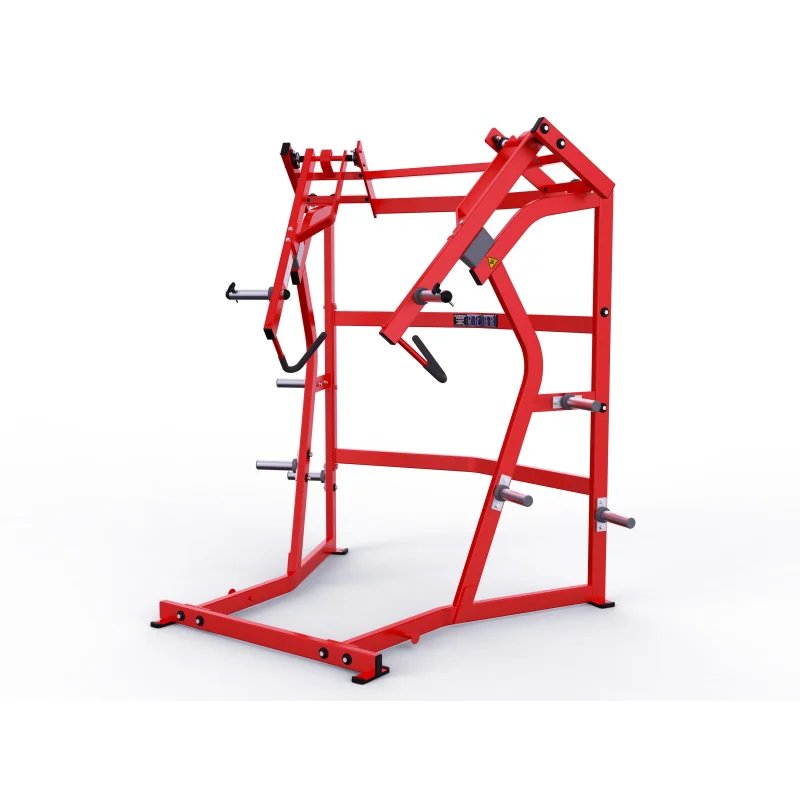
The absence of motors, circuit boards, and electronic sensors in the OS-H5079 removes the three most common failure categories in commercial gym equipment. Manual weight-loaded resistance means the only moving parts are the pivot mechanism and the guide rails, both constructed from hardened steel components designed for repeated loading. The pad positioning uses fixed ergonomic geometry rather than adjustable electronic actuators, so there is no motorized angle adjustment to drift out of calibration. A non-slip foot platform surface maintains grip stability under loaded repetitions without relying on electronic monitoring systems.
What Happens When Pad Compression Is Overlooked During Procurement
Shoulder pads on calf raise machines compress under cumulative loading, and low-density foam loses structural support within a single fiscal year of commercial use. Members notice the hardening before maintenance staff do, and the result is reduced station utilization as users seek alternatives that do not bruise trapezius tissue. [NEED_CITE: padding compression rates under repeated commercial strength training loads] We have observed facilities replace pad sets repeatedly because the original specification used residential-grade density foam in a high-traffic deployment.
Why This Product Line Addresses Procurement Pain Points
The steel frame construction targets the specific failure mode — pivot weld fatigue — that pulls calf stations off commercial floors prematurely. The 70 kg net weight provides stable grounding without requiring bolt-down installation, simplifying layout changes. OEM customization extends to pad material selection, allowing operators to specify higher-density foam for high-throughput deployments. The manual resistance mechanism means zero electrical compatibility concerns regardless of export market voltage standards. Our 3D layout planning accounts for the upright footprint of this station when mapping member flow through strength zones. Full documentation packages include EN 957 test reports and structural load records for compliance verification.
Documentation & Test Records
- CE declaration of conformity covering mechanical safety requirements
- EN 957 test report for stationary strength training equipment
- ISO 9001 manufacturing quality system certificate
- Frame structural load test record with pivot joint inspection data
- Pad material compression testing results over simulated use cycles
- Installation and commissioning guide with maintenance schedule
Installation, Commissioning & Maintenance
- Position the 1300 x 1260 mm footprint with clearance for plate loading on both sides
- Install on leveled rubber matting to absorb vibration and protect floor surfaces
- Inspect pivot mechanism smoothness and guide rail alignment before member release
- Verify shoulder pad density and secure mounting bolts at initial commissioning
- Schedule pivot bearing lubrication based on facility traffic volume
- Wipe down steel frame and non-slip platform weekly to prevent sweat corrosion
Specifying the Right Station for Your Strength Zone Layout
Provide your strength area dimensions and equipment roster so we can model the OS-H5079 placement within your member traffic flow. Specify whether deployment is supervised or unsupervised to guide pad material and finish selections. Confirm target market so we align any optional branding and documentation language. Indicate if this station integrates with a broader lower-body zone procurement for consolidated layout planning.
Frequently Asked Questions
Q: What frame construction indicators signal commercial durability in a stand calf raise?
A: Look for reinforced welding at the pivot joint and base plate connections, as these bear the highest cyclic stress. The steel gauge thickness and overall net weight indicate material investment — a 70 kg unit signals substantial construction. Frame geometry should show triangulated bracing near load paths rather than single-tube spans. Inspect weld bead consistency and penetration depth at visible joints before approving procurement.
Q: How does manual resistance compare to selectorized systems for maintenance requirements?
A: Manual weight-loaded resistance eliminates cable routing, weight stack guide rods, and selector pin mechanisms — all components that wear and require periodic replacement. The only maintenance points are the pivot bearings and guide rails, which need occasional lubrication. This reduces preventive maintenance visits and eliminates the risk of cable snap incidents that take selectorized machines offline unexpectedly.
Q: What pad materials resist compression over extended commercial use?
A: High-density closed-cell foam maintains structural integrity under repeated loading far longer than open-cell alternatives. The pad covering should be heavy-duty vinyl with reinforced stitching at stress seams to prevent splitting. Some facilities specify dual-layer constructions with a firm base layer and a comfort surface layer to balance durability with member comfort during heavy loaded repetitions.
Q: How should calf stations integrate into strength zone traffic flow?
A: Position calf raise machines along perimeter walls or between compound movement stations where they serve as terminal isolation exercises. The upright footprint of the OS-H5079 allows placement in narrow zones between larger equipment. Ensure adequate clearance on both sides for plate loading and unloading so member movement does not create congestion during peak hours.

![Hammer Strength Flat Bench Press Machine for Commercial Gym Equipment[WARN] draft identifier mismatch](https://bicksport.com/wp-content/uploads/2026/08/hammer-strength-flat-bench-press-machine-for-commercial-gym-equipmentwarn-draft-identifier-mismatch-12966b.webp)