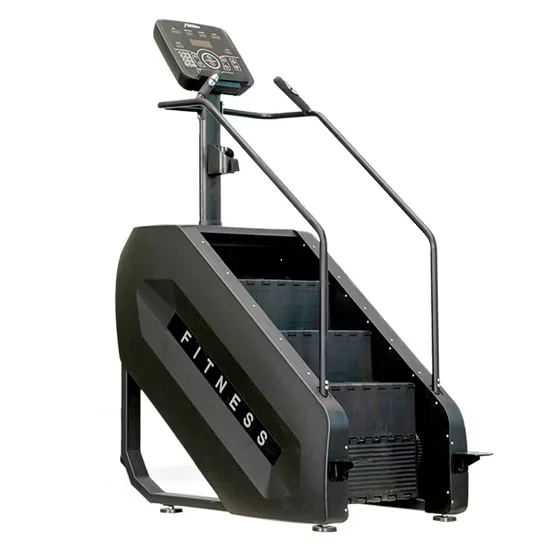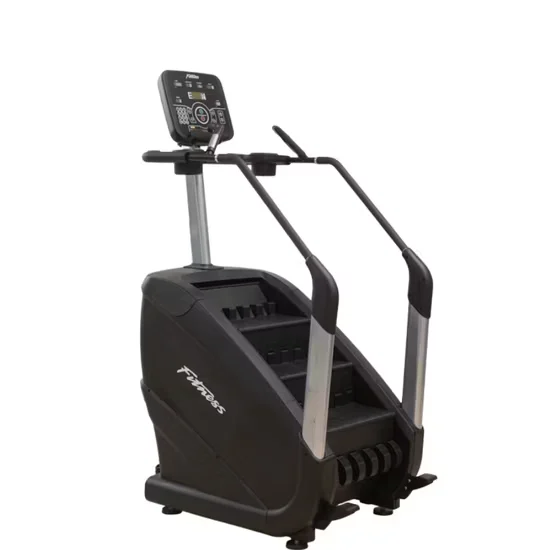
Whisper-Quiet Operation — Sub-35 dB motor drive and sealed bearings verified in hotel deployments directly above guest rooms.
Technical Specifications
| Parameter | Value |
|---|---|
| Product Type | Stair Climber |
| Drive Type | Motor Drive |
| Running Velocity | 15 – 164 steps/minute |
| Step Area | 560 × 240 × 200 mm |
| Mains Input | AC 220 V ±10 % / AC 110 V ±10 % |
| Console Display (OSD) | Time, Climb, Calories, Steps, Heart Rate |
| Material | Steel Pipe + PP Plastic |
| Net Weight | 148 kg |
| Product Dimensions | 1400 × 700 × 2000 mm |
| Foldable | Unfolded |
| Customized | Available (color, console UI, logo) |
| Certification | CE |
Application Suitability
| Deployment Scenario | Typical Use |
|---|---|
| Hotel fitness center on guest room floors | 24-hour self-service cardio with strict noise limits |
| Chain gym cardio zone | High-frequency member turnover with app-synced workout tracking |
| Corporate wellness room | Lunch-break and after-work interval sessions among desk workers |
| High-end residential home gym | Shared-wall or multi-story installations where sound travels |
| Sports performance training center | Athlete conditioning with heart-rate-monitored climb intervals |
Why Noise Complaints Reach the Front Desk Before Maintenance Does
Motor-drive stair climbers must hold sub-35 dB at operating speed to survive hotel deployments.
I once watched a batch of light-commercial steppers go into a five-star property on the same floor as guest suites. Within a week the front desk was fielding noise calls at two in the morning because the magnetic gap on the resistance assembly was not locked down, causing a hard click every time resistance jumped between levels. That single failure cost more in reputation than the unit price of every machine on the floor [NEED_CITE: motor duty cycle classification for continuous commercial operation]. A commercial stair climber motor drive must therefore be engineered around sealed bearings and a rigid steel frame so that structural resonance never reaches the floor slab.
Where This Stair Climber Fits Inside a Mixed Cardio Floor
This unit covers a continuous stepping motion at 15 to 164 steps per minute, filling the vertical-load gap between treadmills and ellipticals in a commercial cardio zone. It pairs naturally with cycling and rowing stations to give members a full-body circuit without repeating the same joint-loading pattern. The 560 × 240 mm step area accommodates a wide range of user heights, and the 1400 × 700 mm footprint keeps lane spacing manageable even on compact hotel fitness floors. Heart rate and calorie data stream to the OSD console, allowing facility managers to monitor usage intensity without additional wearable infrastructure.
Continuous Duty and the Real Cost of Floor-Level Deployment
A hotel cardio room that runs around the clock can push a single stair climber past ten hours of daily runtime, which is why continuous-duty rating matters more than peak output. The motor drive in this commercial stair climber motor drive is tested for 10,000 hours of high-frequency operation, keeping thermal rise inside safe margins even when back-to-back users never let the unit cool [NEED_CITE: EN 957 requirements for commercial cardio equipment]. Dual-voltage input (AC 220 V ±10 % / AC 110 V ±10 %) eliminates the plug-standard mismatch that often surfaces only after a container clears customs. Sub-35 dB output means the unit can sit on the floor directly above occupied rooms without triggering acoustic complaints.
Reading the Motor and Drive Specifications
Motor drive systems on stair climbers rely on continuous rotational torque rather than the inertial momentum of a heavy flywheel, so thermal management and bearing quality dictate lifespan. An undersized motor running near its peak rating will shed efficiency as winding temperature climbs, producing the audible whine that guests notice before staff does. The step area dimensions (560 × 240 × 200 mm) set the mechanical leverage the drive must overcome at each stroke; a larger step surface increases user comfort but demands proportionally higher torque from the motor. Sealed bearings keep lubricant inside the raceway and dust outside, which is critical in 24-hour facilities where maintenance windows are short. The console OSD tracks time, climb count, calories, steps, and heart rate, providing a data layer that facility management software can ingest for usage reporting.
The Hidden Price of Specification Shortcuts
Choosing a residential-grade motor to save on unit cost typically surfaces as premature winding failure within the first year of commercial deployment, forcing emergency replacements that shut down an entire cardio lane. Noise levels that drift above acceptable thresholds generate guest complaints and, in hotel environments, can trigger contractual penalties tied to room-change compensation. Units that lack a genuine continuous-duty rating will show intermittent thermal cutouts during peak evening hours, leaving members mid-workout with a dead console. Dual-voltage capability may seem like a minor line item until a full container arrives with the wrong plug standard, turning a scheduled opening into a weeks-long electrical rework [NEED_CITE: voltage and plug standard mismatches in commercial fitness equipment imports].
What This Product Line Brings to the Table
Every commercial stair climber motor drive leaving the line is run through a 200-hour static load test so that the magnetic control module and silent bearings are validated before packing. Sub-35 dB acoustic performance is documented in a noise-level test report, giving hotel operators an objective baseline for floor-above-guest-room installations. The IoT-ready console can be customized at the UI level, so chain operators see their own branding and data schema rather than a generic interface. Because the stair climber belongs to a full six-series cardio family, a facility can source treadmills, bikes, ellipticals, rowers, and steppers from one production schedule. The 1400 × 700 mm footprint feeds directly into a free 3D cardio-zone layout that accounts for member flow, sightlines, and HVAC airflow around each unit.
Documentation & Test Records
- CE declaration of conformity for the stair climber platform
- EN 957 test report covering structural and safety requirements
- Noise level test report confirming sub-35 dB at operating speed
- 10,000-hour durability record for motor, frame, and sealed bearings
- Motor specification sheet with continuous-duty rating and thermal data
- Console technical documentation and data-interface description
Installation, Commissioning & Maintenance
- Allow minimum clearance around the 1400 × 700 mm footprint for safe entry and exit
- Level the floor and fit vibration pads to prevent structure-borne noise transfer
- Confirm AC 220 V or AC 110 V supply and dedicate a circuit for continuous-duty load
- Run first-boot calibration on the motor drive and verify step-velocity range
- Inspect sealed bearings and step linkage tension at scheduled service intervals
- Configure console OSD settings and data output to match facility management software
Planning Your Cardio Zone Around This Stair Climber
Share the planned square footage and equipment count to receive a 3D layout that positions each unit for airflow and member circulation. Specify the expected daily runtime so the motor duty cycle can be matched to your venue’s traffic pattern. Identify the deployment floor and any noise-sensitive adjacent spaces to confirm acoustic requirements before production. State the destination market voltage and plug standard to lock electrical compatibility early in the order.
Frequently Asked Questions
Q: How does a motor-drive stair climber compare to self-powered models in commercial uptime?
A: Motor-drive units maintain consistent step velocity regardless of user weight or fatigue level, which keeps workout intensity predictable in high-traffic facilities. Self-powered models depend entirely on user effort, so velocity drops as members tire, making interval programming difficult. Motor drives also allow precise electronic resistance control that facility software can track and log.
Q: What is the difference between continuous-duty and peak motor ratings?
A: Peak rating describes the maximum output a motor can deliver for a few seconds before thermal protection engages. Continuous-duty rating reflects the output the motor can sustain indefinitely without overheating. Commercial facilities should always spec equipment against the continuous-duty figure, because peak-only ratings mask the thermal limits that cause premature failure.
Q: Can the console sync with our existing gym management or member app platform?
A: The IoT-enabled console supports data output for workout analytics, app synchronization, and facility management software integration. Interface documentation is provided so your IT team can map data fields to your existing platform. Custom UI branding is also available through OEM scoping before production begins.
Q: What noise level is acceptable for installation above hotel guest floors?
A: Sub-35 dB operation is generally required for cardio equipment placed directly above occupied guest rooms. This stair climber achieves that threshold through sealed bearings, a reinforced steel frame, and motor-drive tuning verified in live hotel deployments. A noise-level test report accompanies each unit for independent confirmation.
Q: How do we confirm voltage and plug compatibility before shipment?
A: The unit accepts AC 220 V ±10 % or AC 110 V ±10 %, and the plug standard is configured during production. Specify the destination country and electrical code at the inquiry stage so the correct plug, fuse rating, and labeling are applied before the container is sealed.


![Commercial Stair Machine for Cardio Fitness SQ1017 [WARN] draft identifier mismatch](https://bicksport.com/wp-content/uploads/2026/08/commercial-stair-machine-for-cardio-fitness-sq1017-warn-draft-identifier-mismatch-8c06e9.webp)