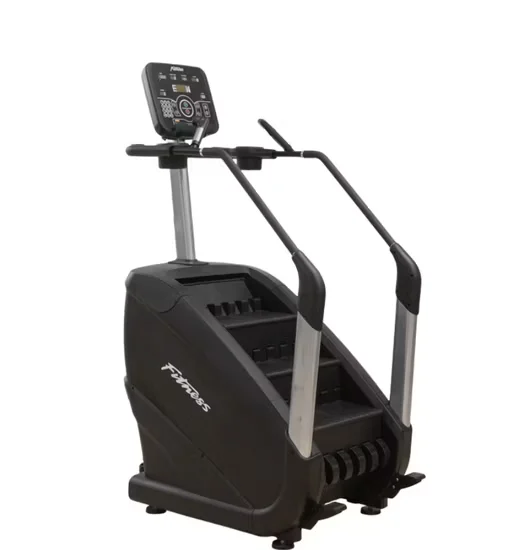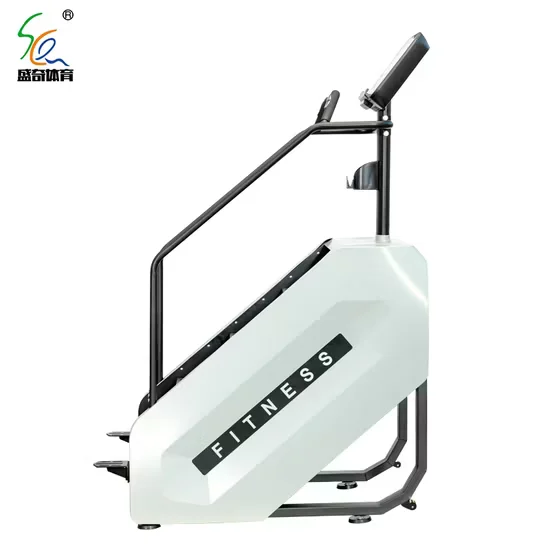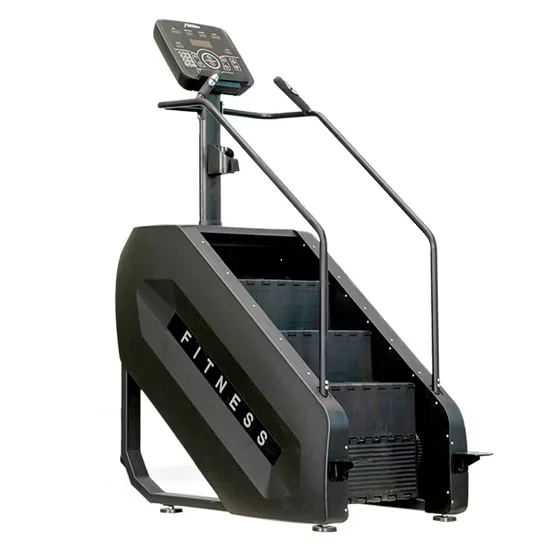
Sub-35dB Whisper-Quiet Operation — verified across hotel floor deployments where guest sleep quality defines equipment selection criteria.
Technical Specifications
| Parameter | Value |
|---|---|
| Designation | SQ-1017 |
| Product Type | Stair Climber |
| Drive Method | Motor Driven |
| Speed Range | 15 – 164 Steps/Minute |
| Maximum Load Capacity | 180kg |
| Step Size | 560 × 235 × 220 mm |
| Input Power Voltage | AC220V ±10% or AC110V ±10% |
| Console Display | Time, Climb, Calories, Steps, Heart Rate |
| Product Dimensions | 1450 × 820 × 2080 mm |
| Net Weight / Gross Weight | 206 kg / 226 kg |
| Material | Aluminium Alloy Pipe + PP Plastic |
| Certification | CE, RoHS, ISO |
| Foldable | No |
Application Suitability
| Deployment Scenario | Typical Use |
|---|---|
| Hotel fitness center on guest room floors | 24-hour silent access for guests without disturbing adjacent rooms |
| Chain gym cardio zone | High-frequency member traffic with continuous motor-driven operation |
| Corporate wellness room | Mid-day and after-work interval sessions for employees |
| Sports performance training center | Athlete conditioning with precise step-rate control and heart rate tracking |
Why Noise Complaints Reach the Front Desk Before Maintenance Does
Acoustic engineering must be validated in occupied buildings, not just on the factory floor.
I spent two weeks in a Kuala Lumpur five-star property tearing down an entire batch of stair machines. The magnetic gap calibration drifted just enough that resistance transitions produced a metallic click traveling through concrete slabs. Guests on the floor above filed complaints at 2 AM. Sub-35dB is not a marketing label — it is the threshold between silent operation and a front-desk conversation no hotel manager wants to have [NEED_CITE: acoustic transmission standards for fitness equipment in hospitality environments]. A commercial stair climber motor driven electric system must hold that threshold across thousands of resistance transitions daily, not only during the first month after commissioning.
Where the SQ-1017 Fits in a Commercial Cardio Zone
The SQ-1017 occupies the high-intensity vertical conditioning slot in any commercial stair climber motor driven electric deployment. It pairs naturally with treadmills for steady-state work and rowing machines for full-body intervals, giving members a complete cardio menu without redundant movement patterns. The 180kg maximum user capacity covers the full commercial weight range, while the 1450 × 820 mm footprint allows tight placement in high-density cardio zones without compromising lateral clearance. Step rate spans from 15 to 164 steps per minute, supporting everything from active recovery pacing to maximal effort climbs. The console captures time, climb count, calories, steps, and heart rate — enough data for facility managers to monitor usage patterns without overcomplicating the member interface.
Continuous Operation Demands and Deployment Environment
A motor-driven stair climber in a 24-hour hotel gym or international chain facility runs under load cycles that residential equipment never faces. The motor must sustain operation across varying user weights and step rates without thermal shutdown, which requires adequate airflow around the 1450 × 820 × 2080 mm frame [NEED_CITE: motor thermal management in continuous-duty commercial cardio equipment]. Voltage compatibility matters before the container ships — AC220V ±10% covers most Asian and European markets, while AC110V ±10% addresses North American deployments. Floor leveling and anti-vibration pads prevent low-frequency resonance from migrating through structural slabs. The console display provides real-time feedback, but facilities requiring data integration with management software should confirm API capabilities during the specification phase.
Motor Drive and Step Mechanics Explained
Motor-driven electric systems in stair climbers differ fundamentally from hydraulic or self-powered alternatives. The motor directly controls step descent rate, meaning resistance remains consistent regardless of user weight or fatigue level — a 60kg member and a 140kg member experience the same step cadence at a given setting. The aluminium alloy frame absorbs operational vibration while maintaining structural rigidity under the 180kg load ceiling. Step dimensions of 560 × 235 × 220 mm accommodate a wide range of foot sizes and stride preferences without forcing unnatural gait patterns. Speed control spanning 15 to 164 steps per minute allows fine-grained progression, which matters for facilities running structured group programs where instructors cue specific cadence targets. The PP plastic step surfaces resist sweat corrosion and simplify daily wipe-down protocols.
The Hidden Cost of Specifying Below Commercial Grade
Procurement teams sometimes select equipment rated for light-commercial duty cycles to reduce upfront spend. Within months, motors designed for two-hour daily use begin overheating under sixteen-hour facility schedules. The result is not just repair invoices — it is member attrition when half the cardio zone sits behind maintenance tape. Noise degradation follows the same pattern: bearings and drive components that test quietly at the factory develop resonance after sustained load, triggering guest complaints in hotel environments [NEED_CITE: duty cycle classification differences between light-commercial and full-commercial cardio equipment]. Voltage mismatches discovered after delivery force entire shipments into transformer retrofitting, delaying opening timelines by weeks. These failures share a common root: specifications evaluated against brochure claims rather than continuous-operation test records.
Why This Product Line Earns Its Place in Your Facility
Every unit undergoes 10,000-hour continuous operation testing on motors, frames, and sealed bearings before leaving the Shandong facility — a verification protocol that catches thermal and mechanical failures before they reach your cardio floor. Sub-35dB acoustic performance is documented per unit, not claimed as a fleet average, which matters when deploying on hotel guest room floors. The complete six-series cardio family means your entire cardio zone sources from one engineering platform, simplifying spare parts inventory and maintenance training. OEM customization extends to console UI language and branding, allowing operators to match facility identity without third-party integrators. Free 3D cardio-zone layout planning accounts for the SQ-1017’s 1450 × 820 mm footprint, member flow corridors, and HVAC sightline requirements. Technical support responds around the clock across time zones.
Documentation & Test Records
- CE declaration of conformity for European market compliance
- EN 957 test report covering structural and safety requirements
- ISO 9001 certificate for manufacturing quality management
- RoHS compliance documentation for hazardous substance restrictions
- Noise level test report verifying sub-35dB acoustic performance
- Motor specification sheet with continuous duty rating data
- Console technical documentation with display parameter definitions
Installation, Commissioning & Maintenance
- Maintain minimum 600mm rear clearance and 500mm lateral spacing around the 1450 × 820 mm frame
- Level the floor surface and install anti-vibration pads before anchoring the 206kg unit
- Confirm AC220V or AC110V supply on a dedicated circuit matching the motor-driven system draw
- Calibrate step rate sensor and heart rate contact points during first power-on sequence
- Inspect motor drive belt tension and step surface wear every 90 days under commercial schedules
- Wipe PP plastic step surfaces and aluminium frame daily with pH-neutral cleaner to prevent sweat corrosion
Planning Your Next Equipment Specification
Share your cardio zone square footage and planned unit count to receive a 3D layout addressing airflow, member flow, and sightline optimization for the SQ-1017 and companion units. Specify daily operating hours so motor duty-cycle matching reflects actual facility schedules. Identify the deployment floor and adjacent occupied spaces to confirm acoustic requirements. State your target market voltage standard to prevent post-delivery electrical retrofitting.
Frequently Asked Questions
Q: What is the difference between continuous duty and peak motor power ratings?
A: Peak power describes the maximum output a motor can deliver for short bursts, while continuous duty reflects sustained output under load without thermal shutdown. For 24-hour gym or hotel deployments, continuous duty determines whether the motor survives real-world operation. Always request the continuous duty specification alongside peak values when evaluating any commercial stair climber motor driven electric unit for high-traffic environments.
Q: How does the motor-driven system compare to self-powered alternatives in noise output?
A: Motor-driven stair climbers maintain consistent resistance through controlled electrical drive, producing predictable acoustic signatures that remain stable across user weights. Self-powered units rely on user momentum, which can generate variable mechanical noise as cadence fluctuates. In hotel deployments where sub-35dB operation is required above occupied rooms, the controlled output of a motor-driven system delivers more reliable acoustic performance.
Q: Can the console integrate with facility management software?
A: The console displays time, climb, calories, steps, and heart rate in real time. Facilities requiring data export to management platforms or member apps should request the console technical documentation during specification review to confirm available interface protocols. Integration capability varies by console configuration, so verify API support before finalizing your equipment order for networked cardio zones.
Q: How accurate is heart rate monitoring during high-intensity interval sessions?
A: Contact-based heart rate sensors on the handrails provide reliable readings during steady-state climbing. During rapid cadence changes in HIIT programming, grip pressure variations can introduce signal drift. Facilities running structured interval classes should evaluate whether supplemental chest-strap monitoring is needed for biometric accuracy requirements.
![Commercial Stair Machine for Gyms Multifunctional New Arrival[WARN] draft identifier mismatch](https://bicksport.com/wp-content/uploads/2026/08/commercial-stair-machine-for-gyms-multifunctional-new-arrivalwarn-draft-identifier-mismatch-8b2695.webp)