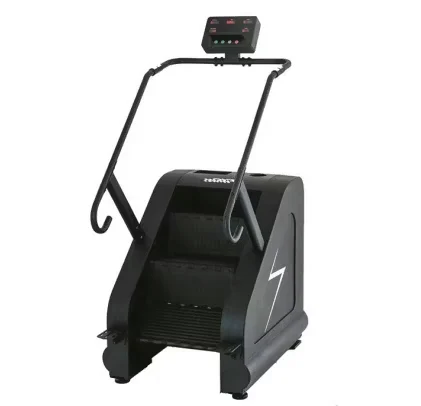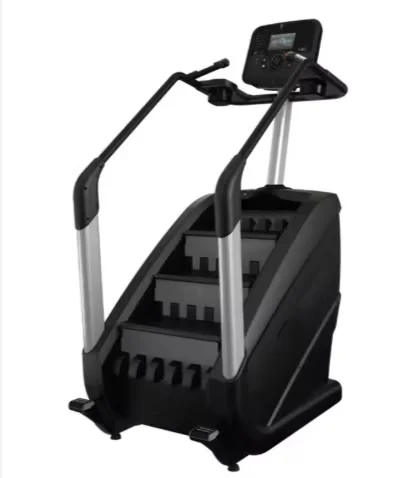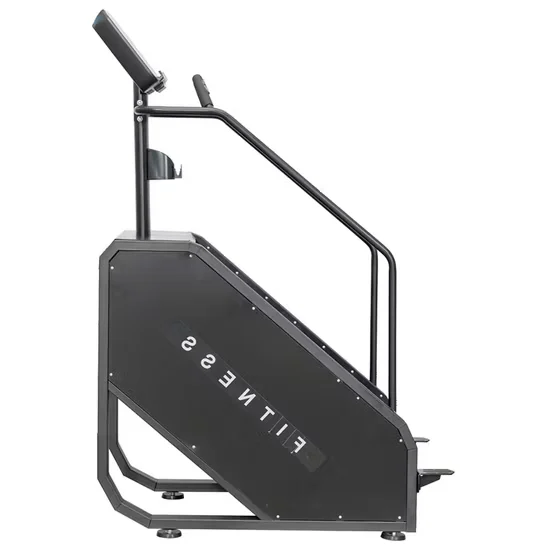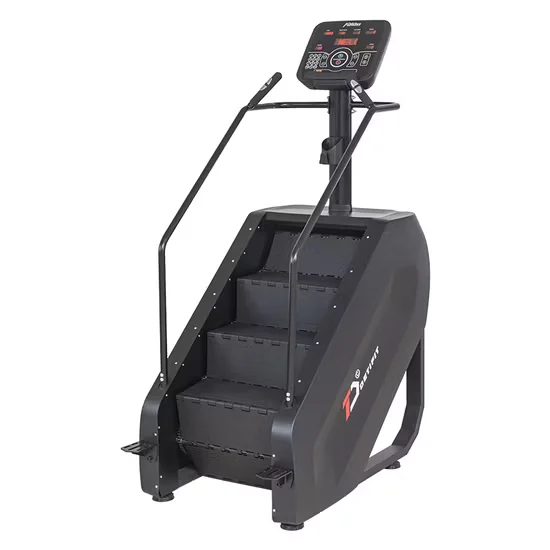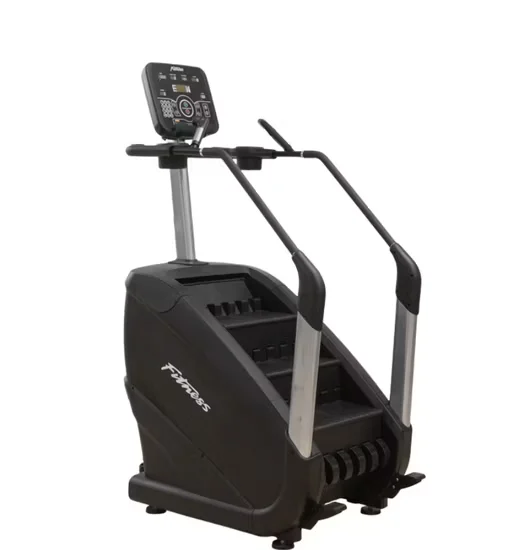
Continuous Commercial Duty — Motor-driven stair climbing system validated for 10,000+ hours of sustained high-frequency deployment across international gym chains and hotel fitness centers.
Technical Specifications
| Parameter | Value |
|---|---|
| Product Type | Stair Climber |
| Drive Type | Motor Drive |
| Running Velocity | 15–164 steps/min |
| Step Area | 560 × 240 × 200 mm |
| Power Requirement | AC220V±10% / AC110V±10% |
| Console Display | Time, Climb, Calories, Steps, Heart Rate |
| Product Dimensions | 1400 × 700 × 2000 mm |
| Net Weight | 148 kg |
| Frame Material | Steel Pipe + PP Plastic |
| Foldable | No |
| Certification | CE |
Application Suitability
| Deployment Scenario | Typical Use |
|---|---|
| Chain gym high-traffic cardio zone | Continuous rotation among members throughout operating hours |
| Hotel fitness center on guest room floors | Quiet early-morning and late-night stair sessions without disturbing adjacent rooms |
| Corporate wellness room | Mid-day interval climbing for employees on compressed break schedules |
| High-end residential home gym | Dedicated vertical climbing station complementing treadmills and ellipticals |
| Sports performance training center | Lower-body endurance and explosive step conditioning for athletes |
Why Motors Burn Out Before the Warranty Expires
A stair climber motor must deliver continuous torque under full user load — peak horsepower figures do not predict duty-cycle survival.
I have seen too many facilities specify stair climbers based on headline motor numbers, only to face thermal shutdowns within months when those motors were rated for intermittent home use rather than continuous commercial operation [NEED_CITE: motor duty cycle classification for continuous commercial operation]. When a commercial electric stair climber motor drive system encounters twelve-hour daily run-times with rotating users of varying weight, the thermal margin between rated capacity and actual demand determines whether the unit survives its first year. The steel pipe frame on this unit addresses the structural side of that same equation: reinforced welding at the step carriage connection points absorbs the repetitive vertical loading that fatigues lighter-gauge frames over thousands of cycles.
Where a Stair Climber Fits in the Cardio Equipment Matrix
A motor-driven commercial electric stair climber occupies a distinct training niche: sustained vertical displacement targeting glute, quad, and calf engagement at step velocities ranging from 15 to 164 steps per minute. This range supports both steady-state endurance climbs and high-intensity interval step protocols. In a cardio zone layout, stair climbers complement flat-belt treadmills and seated ellipticals by introducing a vertical loading vector that neither machine replicates. The 560 × 240 mm step area accommodates users across a broad anthropometric range, and the 1400 × 700 mm footprint positions these units along walls or between structural columns where their 2000 mm height clears standard ceiling lines. The console captures time, climb count, calories, steps, and heart rate — providing the biometric data layer that facility managers need for usage reporting without overcomplicating the user interface.
Sustained Operation and the Environment Around the Machine
Daily run-time expectations should drive deployment decisions. A stair climber rated for continuous duty can operate across extended facility hours without thermal throttling, but the surrounding environment still matters [NEED_CITE: HVAC airflow requirements for commercial cardio equipment zones]. Adequate clearance around the motor housing allows convective heat dissipation, and units placed in enclosed alcoves without cross-ventilation will accumulate heat faster than open-floor installations. The dual-voltage capability — AC220V±10% and AC110V±10% — eliminates the plug-standard surprises that derail container shipments when a facility in one market receives equipment wired for another. Floor leveling is non-negotiable: a 148 kg unit on an uneven surface introduces lateral loading on the step carriage bearings that accelerates wear. For data integration, the console outputs heart rate and usage metrics that facility management systems can log for member engagement tracking.
Inside the Motor Drive and Step Velocity Engineering
The motor drive system in this stair climber converts electrical input into controlled rotational force that advances the step carriage at adjustable velocities. Unlike hydraulic or pneumatic resistance systems, a motor-driven mechanism delivers consistent torque output across the full 15–164 steps/min range, meaning resistance does not fade as the user fatigues and step cadence drops. The steel pipe frame carries the static and dynamic loads transmitted through each step cycle: at maximum user weight, each step impact generates force multiples that the frame welds and carriage bearings must absorb repeatedly over 10,000+ hour test cycles. PP plastic step surfaces provide grip texture and impact absorption at the foot contact point, reducing the harshness transmitted through the kinetic chain compared to bare metal treads. Heart rate monitoring through the console gives users real-time intensity feedback, enabling them to self-regulate climb velocity against target heart rate zones without external wearable devices. The motor’s continuous thermal capacity — not its peak output rating — is the specification that determines whether it survives commercial deployment [NEED_CITE: continuous vs peak motor rating standards for commercial fitness equipment].
The Hidden Cost of Under-Specifying a Stair Climber
Facilities that purchase stair climbers without verifying continuous motor duty ratings frequently experience cascading failures. Motors designed for thirty-minute home sessions overheat and shut down when subjected to back-to-back commercial use, triggering maintenance calls that take the unit offline during peak hours. Noise from under-damped step carriages migrates through floor slabs into occupied spaces below, generating complaints that force entire cardio zones to relocate. Step surfaces that lack adequate texture or structural rigidity develop flex and wear patterns that create uneven stepping geometry, introducing trip hazards and member complaints. Voltage mismatches discovered after delivery mean returned shipments, rewiring costs, and weeks of unusable equipment sitting on the floor. Console systems that output data only to their own screens — with no pathway to facility management software — leave operators blind to usage patterns, preventing evidence-based decisions about equipment rotation and replacement scheduling [NEED_CITE: facility management data integration standards for commercial cardio].
Why This Product Line Earns Deployment Trust
Every commercial electric stair climber motor drive unit from this line undergoes 10,000-hour continuous operation testing on motors, frames, and bearings before production release. Sub-35dB whisper-quiet operation has been verified in hotel deployments where cardio equipment sits directly above guest rooms, eliminating the noise complaints that plague lighter-duty installations. The console delivers heart rate, step count, and calorie data that integrates with facility management systems, closing the loop between member usage and operational reporting. OEM customization extends to console UI design, allowing gym chains to brand the interface and configure data output formats. Free 3D cardio zone layout planning accounts for the 1400 × 700 mm footprint, ceiling height clearance for the 2000 mm unit, and airflow pathways needed for motor heat dissipation across the climbing station. Full 24/7 technical support and spare parts availability means a failed component does not strand a unit on the floor for weeks awaiting overseas shipment.
Documentation & Test Records
- CE declaration of conformity for European market placement
- EN 957 test report validating structural and mechanical safety
- ISO 9001 certificate covering manufacturing quality systems
- Motor continuous duty rating and thermal performance specification sheet
- Console technical documentation with data output format descriptions
- 10,000-hour durability test record for frame and drive components
Installation, Commissioning & Maintenance
- Maintain 600 mm rear clearance and 400 mm side clearance around the 1400 × 700 × 2000 mm footprint for safe user egress and motor ventilation
- Level the installation surface and place vibration-damping pads beneath the 148 kg frame to prevent lateral bearing load and floor-transmitted noise
- Verify AC220V±10% or AC110V±10% supply on a dedicated circuit matching the motor drive amperage requirement before first power-on
- Calibrate step carriage travel and console heart rate sensor readings during initial commissioning before releasing the unit to member use
- Inspect step carriage bearings and motor drive belt tension at quarterly intervals, lubricating per manufacturer schedule to prevent velocity drift
- Wipe PP plastic step surfaces and steel pipe frame with non-corrosive cleaner after each operating shift to prevent sweat-induced corrosion
Requesting a Deployment-Matched Quotation
Provide your cardio zone square footage and planned unit count to receive a 3D layout incorporating the stair climber’s footprint, ceiling clearance, and airflow requirements. Specify daily operating hours so the motor duty cycle can be matched to your facility’s usage intensity. Identify the deployment floor level and adjacent occupied spaces to confirm acoustic requirements. State your target market voltage standard to ensure correct power configuration at shipment.
Frequently Asked Questions
Q: How does a motor-driven stair climber differ from a manual unit in durability and maintenance?
A: Motor-driven stair climbers deliver consistent step resistance through continuous electrical torque output, meaning the drive system maintains performance regardless of user weight or fatigue level. Manual units rely on user-generated momentum, which introduces variable loading patterns that accelerate uneven wear on carriage components. Motor-driven systems require scheduled belt and bearing inspection but eliminate the friction-surface replacements common in manual mechanisms.
Q: How does the 15–164 steps/min velocity range support different training objectives?
A: The lower velocity range enables sustained endurance climbing sessions where users maintain steady heart rate zones over extended durations. Higher step velocities support interval protocols alternating between explosive climbing bursts and recovery paces. This range allows a single stair climber to serve members pursuing both cardiovascular base-building and high-intensity conditioning without requiring separate dedicated machines.
Q: What metrics does the console track, and can the data integrate with facility systems?
A: The console displays time, climb count, calories, steps, and heart rate in real time. Data output capabilities depend on the console configuration specified at order — options include standalone display or integration-ready formats compatible with facility management software. Confirm your data reporting requirements during the quotation stage so the correct console variant is installed.
Q: How do I verify voltage compatibility before ordering for international deployment?
A: This stair climber supports AC220V±10% and AC110V±10% power input configurations. Specify your facility’s local voltage standard and plug type during the quotation process so the unit ships pre-configured for your market. Receiving equipment with mismatched voltage specifications causes costly rewiring delays and can damage motor drive components if connected incorrectly.