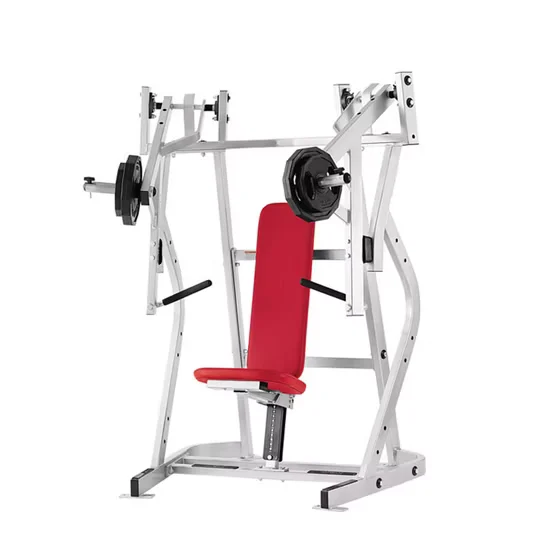
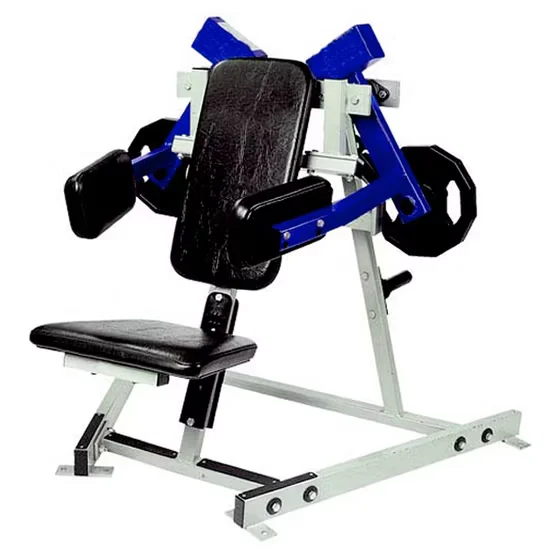
Rigid Steel Frame — The Plate Loaded Hammer Strength Leg Raise Machine features a reinforced steel structure engineered for continuous high-frequency use in professional gym environments.
Technical Specifications
| Parameter | Value |
|---|---|
| Product Type | Leg Raise Machine (Plate Loaded / Hammer Strength) |
| Model NO. | 5059 |
| Exercise Part | Leg |
| Main Frame Material | Steel |
| Resistance Type | Plate Loaded |
| Product Dimensions | 1104 x 990 x 1730 mm |
| Net Weight | 72 kg |
| Frame Color | Available according to customer requirements |
| Cushion Color | Available according to customer requirements |
| Max User Weight | Up to 180 kg (commercial range standard) |
| Fit Area | Professional Gym and Club |
| Appliance | Community, Gymnasium |
| OEM/ODM | Acceptable |
| Certification | ISO 9001, CE |
| Production Capacity | 500 PCS/Month |
Application Suitability
| Deployment Scenario | Typical Use |
|---|---|
| Commercial gym free-weight and plate-loaded zone | Core and lower abdominal isolation training for general membership |
| Professional sports training center | Athlete-specific core stabilization and hip flexor strengthening |
| Hotel fitness center | Durable, low-maintenance abdominal station for 24/7 guest access |
| Corporate wellness room | Compact plate loaded hammer strength leg raise machine for employee fitness programs |
| High-end residential home gym | Space-efficient leg raise station for dedicated home training spaces |
Why Structural Rigidity Dictates the Lifespan of Plate-Loaded Core Equipment
When members complain about equipment wobbling during hanging leg raises or cushions collapsing after a few months of heavy use, the root cause is almost always insufficient frame rigidity and low-density padding. These complaints reach the facility manager long before maintenance gets involved, and the solution usually requires a complete equipment swap rather than a simple repair. [NEED_CITE: structural load testing standards for plate loaded strength equipment]
A reinforced steel frame with precision bearing pivots ensures the plate loaded hammer strength leg raise machine commercial grade units maintain stability under continuous loading cycles.
I recall a project where a mid-tier gym chain installed domestic-grade abdominal benches in their plate-loaded section. Within months, the pivot bearings developed play, creating metal-on-metal grinding noises that disrupted the entire free-weight zone. The cushions compressed unevenly, leading to member complaints about lower back discomfort during supine leg raises. Commercial environments demand equipment tested for thousands of articulation cycles, not units designed for intermittent weekend use. [NEED_CITE: bearing wear rates in high-frequency commercial strength equipment]
Defining the Role of a Plate-Loaded Leg Raise Station in the Strength Zone
This leg raise machine targets the lower abdominals and hip flexors through a controlled supine or hanging motion, fitting into the core-isolation segment of any comprehensive strength layout. It complements heavier compound lifts like squats and deadlifts by providing a dedicated station for core stabilization work without requiring cable stacks or selectorized weight systems. The plate loaded hammer strength leg raise machine commercial deployment suits high-traffic free-weight areas where users prefer incremental loading with standard Olympic plates.
The equipment accommodates a wide range of user heights and body weights up to 180 kg, making it appropriate for both general fitness members and athletic populations. Because it relies on external plate loading rather than internal weight stacks, the resistance curve remains entirely user-determined, supporting progressive overload principles without mechanical complexity.
Continuous Operation and Facility Environment Considerations
In a 24-hour gym environment, core isolation stations endure repetitive loading and unloading cycles that test pivot bearings and weld integrity far beyond typical home-use patterns. The steel frame must resist torsional stress during off-center leg raises, where uneven force application can twist lesser structures over time. [NEED_CITE: fatigue testing protocols for commercial plate loaded equipment frames]
Floor placement requires a level surface with adequate clearance on all sides for safe plate loading and user entry. While plate-loaded units generate less ambient noise than motorized cardio equipment, the clanking of iron plates during loading demands consideration of adjacent spaces in hotel or residential deployments. Proper rubber matting beneath the 1104 x 990 mm footprint absorbs impact vibration and protects flooring from dropped plates.
Understanding the Bearing and Pivot Mechanics
The articulation points on a leg raise machine dictate the smoothness of the movement arc and the long-term noise profile of the equipment. Sealed bearings with precision tolerances eliminate the lateral play that causes rattling during dynamic leg movements, maintaining a consistent pivot feel across thousands of repetitions. Lower-grade bushings develop wear grooves that create catch points in the range of motion, forcing users to compensate with momentum rather than controlled muscle engagement.
The plate-loaded design bypasses the maintenance requirements of cable-and-pulley systems entirely, removing friction points that degrade resistance smoothness over time. Frame welding at stress junctions must distribute load evenly; concentrated heat-affected zones create brittle points prone to cracking under repeated eccentric loading. Steel thickness in the main uprights prevents the flex that larger users detect during weighted leg raises, where total system load approaches the upper limits of the equipment rating. [NEED_CITE: welded joint fatigue analysis in commercial strength frames]
The Hidden Costs of Compromised Frame Specifications
Facilities that specify equipment based on upfront price alone often encounter premature bearing failure, where the pivot mechanism develops enough play to create audible grinding during peak operating hours. This noise pollution drives members away from the plate-loaded section, reducing equipment utilization and increasing the per-unit cost of the investment.
Cushion compression represents another frequent failure mode; low-density foam flattens within months under continuous use, exposing the steel support structure and creating pressure points that generate member complaints. Weld fatigue at high-stress junctions may not manifest as visible cracks until catastrophic failure occurs, posing liability risks in unattended 24-hour facilities. [NEED_CITE: commercial equipment failure mode frequency analysis]
Why This Product Line Addresses Facility Pain Points
Our manufacturing process subjects every welded joint to static and dynamic load testing, ensuring the steel frame maintains dimensional stability under the asymmetric forces generated during single-leg raises and weighted variations. The pivot bearings are selected for continuous rotation duty, verified through cycle testing that simulates years of commercial deployment before the first unit ships.
Cushion density and surface material are specified for high-frequency contact, resisting compression set and surface cracking that plague lesser upholstery in humid gym environments. The 1104 x 990 mm footprint integrates into 3D strength-zone layouts with appropriate spacing for safe plate handling and user circulation. OEM customization extends to frame and cushion colors, allowing facility operators to maintain brand consistency across diverse equipment categories without compromising structural specifications.
Documentation & Test Records
- CE declaration of conformity for commercial strength equipment
- EN 957 test report covering structural integrity and safety
- ISO 9001 certificate verifying manufacturing quality management
- Frame weld inspection and static load test records
- Bearing durability cycle test documentation
- Cushion density and abrasion resistance test data
- Installation guide with floor anchoring specifications
Installation, Commissioning & Maintenance
- Verify floor leveling across the 1104 x 990 mm footprint before anchoring to prevent frame torsion
- Maintain clearance on all sides for safe Olympic plate loading and user access
- Inspect pivot bearings quarterly for lateral play and re-grease according to schedule
- Check weld junctions at stress points during bi-annual structural audits
- Clean cushion surfaces daily with pH-neutral solution to prevent vinyl degradation
- Confirm all fastener torque values after the first 30 days of operation
Equipment Selection and Facility Planning
Provide your strength-zone square footage and planned equipment roster to receive a 3D layout that optimizes traffic flow around plate-loaded stations and ensures safe operating clearances. Specify the expected daily usage volume so we can confirm bearing and frame specifications match your facility’s duty cycle requirements.
Indicate whether the deployment floor sits above occupied spaces, as this affects vibration isolation recommendations for plate-loading areas. Confirm your target market’s voltage requirements if integrating electronic accessories, and clarify whether console-based data tracking is needed for member engagement systems.
Frequently Asked Questions
Q: How does plate loaded resistance compare to selectorized weight stacks for leg raise exercises?
A: Plate loaded systems allow users to add weight in smaller increments using standard Olympic plates, avoiding the fixed jumps between selectorized stack positions. This supports more precise progressive overload for advanced trainees. The mechanical simplicity also reduces maintenance requirements, as there are no cables, pulleys, or guide rods to inspect and replace over the equipment lifespan.
Q: What frame characteristics differentiate commercial leg raise machines from residential models?
A: Commercial units use thicker-walled steel tubing with reinforced welding at high-stress junctions to withstand asymmetric loading during weighted exercises. The pivot bearings are rated for continuous rotation duty rather than intermittent use. Commercial cushions employ higher-density foam that resists compression set, maintaining consistent support across thousands of daily use cycles in facility environments.
Q: How does bearing precision affect movement smoothness and equipment noise?
A: Precision-sealed bearings eliminate lateral play in the pivot mechanism, ensuring the movement arc remains consistent without catch points or grinding sensations. This mechanical accuracy prevents the metal-on-metal contact noise that develops when lower-grade bushings wear unevenly. Maintaining bearing integrity is essential for preserving the controlled tempo required for effective core isolation work.
Q: What cushion material properties matter most for high-traffic gym deployments?
A: High-density foam resists permanent compression deformation, maintaining uniform thickness and support despite continuous loading. The surface vinyl must withstand frequent cleaning with commercial disinfectants without cracking or peeling. Moisture-resistant barriers between the foam and frame prevent sweat infiltration that causes internal degradation and odor accumulation over extended deployment periods.
Q: What does the OEM customization process involve for facility-specific branding?
A: Customization options include frame powder-coat colors and cushion vinyl selections to match facility design schemes. Console UI customization applies to electronic accessories if specified. Minimum order quantities remain flexible to accommodate both single-facility deployments and multi-site rollouts, with production lead times confirmed during the quotation phase based on current capacity and customization complexity.