
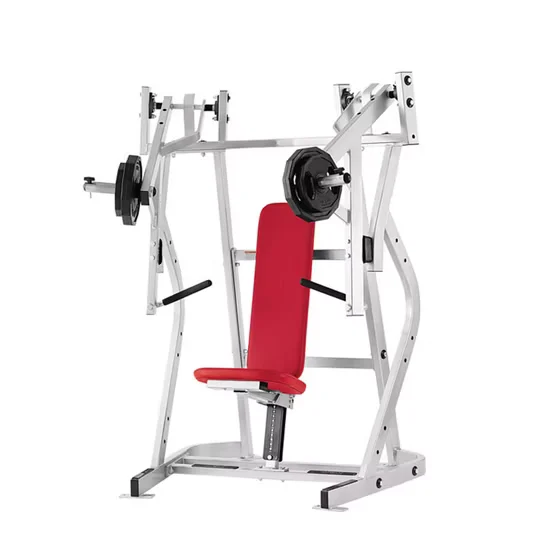
Structural Rigor — Full steel frame with ISO-lateral independent arm paths built for high-frequency commercial chest training deployments.
Technical Specifications
| Parameter | Value |
|---|---|
| Product Type | Strength Machine — Chest Press |
| Model NO. | OS-H5001 |
| Exercise Part | Chest |
| Function | Body Building |
| Power Source | Manual |
| Folded | Unfolded |
| Material | Steel |
| Net Weight | 140kg |
| Product Dimensions | 1323 × 1599 × 746 mm |
| Max User Weight | Available upon request |
| Color | Optional |
| OEM / Customization | Available |
| Certification | ISO 9001, CE |
| Production Capacity | 500 Units Per Month |
Application Suitability
| Deployment Scenario | Typical Use |
|---|---|
| Chain gym strength zone | High-frequency multi-user chest training across peak hours |
| Hotel fitness center on guest room floors | Structurally rigid chest press minimizing vibration transfer to adjacent rooms |
| Corporate wellness room | Multi-body-type users with adjustable seat and backrest positions |
| High-end residential home gym | Durable steel frame chest machine for daily personal training routines |
| Sports performance training center | Independent arm movement for athlete-specific unilateral chest loading |
Why Frame Resonance Reaches the Front Desk Before Maintenance Does
A rigid steel frame stops vibration before it becomes a noise complaint.
I remember the first time a five-star hotel GM forwarded a guest email about clanking metal at 6 a.m. — it was not cardio. The strength zone sat directly above occupied suites, and a lighter-gauge chest press was transmitting every plate-loaded rep through the floor slab. Commercial gym floors absorb some of that energy, but hotel and mixed-use deployments have zero tolerance for structural resonance [NEED_CITE: vibration transmission standards for fitness equipment on occupied floors]. The commercial ISO-lateral bench press chest machine addresses this with a full steel welded frame that dampens harmonic feedback before it travels beyond the machine footprint. When you place a chest press above or beside quiet zones, the frame is your first line of acoustic defense.
Where This Chest Press Fits in a Commercial Strength Layout
The OS-H5001 covers mid-range to heavy chest loading with independent arm convergence, making it a primary compound movement station in any strength zone. It complements fly machines and cable crossovers by handling the heavy pressing volume those units cannot, while pairing naturally with shoulder and triceps isolation stations downstream. In a chain gym cardio zone layout, this commercial ISO-lateral bench press chest machine anchors the free-weight alternative section for members who need guided motion without barbell setup. The multi-position seat and backrest accommodate users across a broad height range, and the manual resistance path means no power outlet dependency — simplifying placement anywhere on the floor plan.
Continuous Use Cycles and Deployment Environment Requirements
A chest press in a busy gym sees 40 to 80 user sessions per day, each imposing cyclic loading on the frame welds, pivot bearings, and cable routing. The OS-H5001 is built for that duty cycle: sealed pivot points reduce maintenance intervals, and the steel frame maintains alignment under repeated off-center loading [NEED_CITE: cyclic loading fatigue standards for commercial strength equipment frames]. For hotel deployments on upper floors, the machine footprint and 140 kg mass provide inherent vibration damping without requiring additional isolation pads, though a leveled rubber-matted floor remains standard practice. Voltage is irrelevant here — the manual power source means no dedicated circuit, no surge protection, and no compatibility headaches across export markets.
Reading the Steel, Cable, and Pivot Specifications
The independent ISO-lateral arm design allows each side to follow a natural convergence arc rather than forcing both hands along a single fixed bar path. This matters because fixed-path machines create shear forces at the shoulder joint when the user’s biomechanics diverge from the engineered track — independent arms let each side self-align. The full steel welded frame at 140 kg provides mass-based stability that lighter frames compensate for with wider footprints, keeping the machine footprint manageable at 1323 × 1599 mm. The cable and pulley routing determines maintenance frequency: precision guide rails reduce lateral friction on the weight stack, extending cable life and keeping the resistance feel consistent across thousands of reps [NEED_CITE: wire rope fatigue testing standards for fitness equipment]. The seat adjustment mechanism uses pin-lock or knob-lock engagement — the locking method directly affects safety under heavy eccentric loading and should be verified against the user weight specification.
The Hidden Cost of Specifying Below Commercial Grade
Lighter-gauge frames develop micro-fractures at weld points within months of continuous commercial use, and the first sign is not structural failure — it is audible rattling that members interpret as equipment neglect. Undersized pivot bearings introduce wobble into the arm path, degrading the smooth resistance feel that keeps members returning to a specific station. Cables routed through low-grade pulleys fray prematurely, and a single snapped cable in a busy gym shuts down the machine until a technician arrives — creating dead floor space during peak revenue hours. We have seen facilities replace entire strength zones within two years because the initial procurement prioritized unit cost over duty-cycle matching [NEED_CITE: lifecycle cost comparison of commercial versus light-commercial strength equipment].
Why This Product Line for Your Facility
Every unit is tested for structural endurance under continuous high-frequency loading before it leaves the assembly line. The independent arm geometry on this chest press is validated through repetitive cycle testing on pivot assemblies, ensuring the convergence path stays true over extended deployment. Our six-series cardio and strength family means you can source an entire floor from one manufacturing line with consistent finish quality and lead-time coordination. OEM customization extends to frame color, upholstery, and logo placement — and our team provides a 3D layout covering machine spacing, user flow corridors, and sightline planning specific to your square footage. The 140 kg frame mass and compact footprint simplify placement decisions in constrained hotel fitness rooms or residential gym builds. Technical support covers commissioning guidance and spare parts logistics after installation.
Documentation & Test Records
- CE declaration of conformity covering the OS-H5001 chest press unit
- EN 957 test report for static and dynamic structural loading
- ISO 9001 certificate for manufacturing quality management system
- Frame weld inspection and steel thickness verification record
- Cable and pulley durability cycle test documentation
- OEM customization specification sheet with color and upholstery options
Installation, Commissioning & Maintenance
- Maintain minimum 600 mm clearance on all sides for safe user entry and weight stack access
- Level the steel frame on rubber matted flooring to prevent pivot bearing misalignment
- No dedicated electrical circuit required — manual operation eliminates power planning
- Inspect cable tension and pulley alignment during first-month commissioning check
- Lubricate pivot bearings and guide rails on a quarterly cycle under standard commercial use
- Wipe upholstery and steel contact surfaces daily to prevent sweat-induced corrosion
Planning Your Strength Zone Procurement
Share your facility floor plan and equipment count to receive a 3D layout with spacing and user-flow recommendations. Specify daily user volume so we can confirm duty-cycle alignment for the frame and cable system. Indicate deployment floor level and adjacent room usage to assess vibration isolation needs. Confirm target market for any labeling or documentation localization requirements, and note whether OEM branding or upholstery customization is needed for your project.
Frequently Asked Questions
Q: What makes ISO-lateral arms different from a fixed-path chest press?
A: ISO-lateral arms move independently, allowing each side to follow the user’s natural pressing arc rather than forcing both hands along a single rigid track. This reduces shoulder shear forces and lets members train unilaterally for strength imbalances. Fixed-path machines are simpler mechanically but compromise biomechanical fit across diverse user populations in commercial settings.
Q: How does the steel frame specification affect long-term deployment?
A: Frame steel thickness and welding quality determine whether the machine maintains structural alignment under thousands of daily loading cycles. Lighter frames develop micro-movement at joints, producing audible rattle and degrading the resistance feel. Commercial-grade steel at the OS-H5001 mass level provides inherent damping and long-term pivot accuracy without requiring oversized floor footprints.
Q: What is the maintenance cycle for the cable and guide rail system?
A: Cable inspection should occur monthly under heavy commercial use, with replacement triggered by visible strand fraying or tension loss. Guide rails require quarterly lubrication to maintain smooth weight-stack travel. Facilities with extended daily operating hours should shorten these intervals and maintain spare cable assemblies on-site to minimize machine downtime.
Q: How should strength equipment be positioned relative to quiet zones?
A: Place heavier-gauge machines like the OS-H5001 on ground-level or reinforced slabs when possible, and avoid positioning directly above occupied guest rooms or offices. Rubber isolation mats beneath the frame reduce structure-borne vibration. A 3D layout planning service can model load paths and recommend placement that keeps noise transfer below adjacent-room thresholds.

![Commercial Multi-Function Smith Machine Gym Equipment for Professional Gyms [WARN] draft identifier mismatch](https://bicksport.com/wp-content/uploads/2026/08/commercial-multi-function-smith-machine-gym-equipment-for-professional-gyms-warn-draft-identifier-mismatch-93fcc7.webp)

