

Whisper-Quiet Drive — Magnetic resistance and reinforced steel frames tested for continuous high-frequency operation in commercial facilities.
Technical Specifications
| Parameter | Value |
|---|---|
| Product Type | Plate Loaded Strength Machine |
| Model NO. | H052 |
| Exercise Part | Chest |
| Material | Steel |
| Resistance Type | Plate Loaded |
| Drive System | Precision bearing and pivot assembly |
| Main Frame Color | Available per customer requirements |
| Cushion Color | Available per customer requirements |
| Product Dimensions | 1500 × 1150 × 1280 mm |
| Net Weight | 65 kg |
| Certification | ISO 9001, CE |
| OEM/ODM | Acceptable |
Application Suitability
| Deployment Scenario | Typical Use |
|---|---|
| Chain gym strength training zone | High-frequency chest isolation during peak member hours |
| Corporate wellness room | Professional-grade decline pressing for employee fitness programs |
| Community fitness center | Durable plate loaded station accessible to varied user experience levels |
| Sports performance training center | Targeted pectoral development for athlete conditioning protocols |
Why Structural Resonance Reaches Members Before Maintenance Notices
A plate loaded hammer strength decline press bench commercial unit that shifts or vibrates under heavy loading creates audible metal-on-metal contact across the gym floor. Members notice it first — and attribute the noise to overall facility quality rather than a single aging joint.
Commercial strength equipment faces repeated asymmetric loading that tests every weld and fastener. When frames lack sufficient cross-bracing or pivot bearings wear beyond tolerance, the entire movement path develops play. That play translates into vibration that travels through the floor and into adjacent spaces [NEED_CITE: structural vibration transmission in multi-zone gym layouts]. Facilities replacing units due to member complaints often find the root cause is bearing wear, not frame failure.
Chest Isolation Role Within the Strength Training Floor Plan
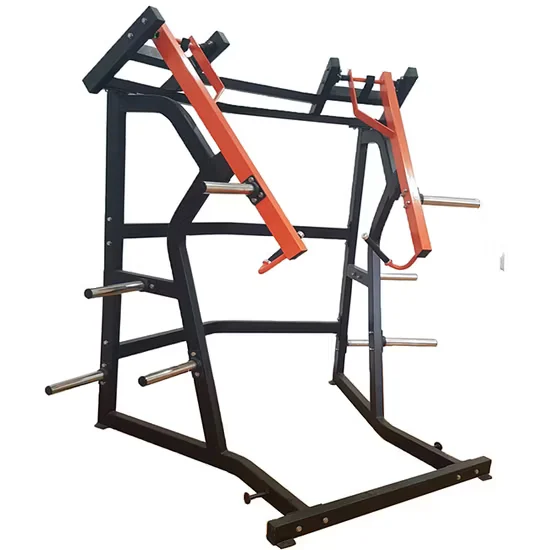
This decline press occupies a specific intensity band: heavy compound pressing at a fixed downward angle targeting the lower pectoral fibers. In a commercial strength zone, it complements flat and incline press stations to give members a complete pressing arc without requiring adjustable benches. The fixed-angle design suits high-traffic areas where equipment must be intuitive — users load plates, position themselves, and press without dialing in settings. The 1500 × 1150 mm footprint allows placement against walls or between racks while maintaining safe loading clearance on both sides. A plate loaded hammer strength decline press bench commercial configuration fits users across a wide body mass range, supported by the steel frame’s load tolerance.
Daily Load Cycles and Floor-Level Deployment Considerations
A decline press in a busy chain gym may see hundreds of sets per day, each introducing dynamic force well beyond the static plate load. The 65 kg steel frame must dissipate that energy through its contact points without transferring vibration to the subfloor. Ground-level deployment avoids structural resonance issues, but upper-floor installations require vibration-dampening pads between the frame feet and the finished surface [NEED_CITE: impact load transmission standards for commercial fitness equipment on suspended floors]. Adequate clearance around the unit ensures spotters and loading partners have safe access during heavy sets, and overhead lighting must not create glare on the user’s line of sight during the pressing motion.
Pivot Mechanics and Frame Rigidity Under Repeated Loading
The movement quality of a plate loaded decline press depends on the precision of its pivot bearings and the torsional stiffness of the main frame. Steel tubing gauge and weld penetration depth determine whether the frame deflects under off-center loading — a common occurrence when members load plates unevenly. Sealed bearing assemblies at the pivot point reduce friction and prevent grit ingress that accelerates wear. Cushion density and upholstery tension affect user stability during the pressing motion; high-density foam resists compression set over thousands of sessions, maintaining consistent contact geometry. The fixed decline angle eliminates the adjustment mechanisms that fail most often on multi-position benches.
What Specifying Below Commercial Grade Actually Costs
Facilities that source light-duty decline presses for commercial floors typically encounter pivot bearing failure first — the bearings develop play under repeated heavy loading, producing lateral wobble that members perceive as instability. Frame weld fatigue follows, particularly at the junction between the seat rail and the main upright, where cyclic stress concentrates [NEED_CITE: fatigue failure patterns in welded gym equipment frames]. Uneven cushion compression forces users into compensatory pressing patterns. Facilities then face partial fleet replacement while the remaining units continue degrading, creating inconsistency across the strength zone.
Engineering Decisions Behind This Product Line
The H052 frame undergoes durability testing aligned with the 10,000-hour continuous operation standard applied across our equipment range. Sealed bearings at every pivot point resist sweat and chalk contamination common in commercial strength zones. The ISO 9001 manufacturing process controls weld penetration and frame alignment, ensuring consistent movement geometry across production batches. OEM customization extends to frame and cushion color, allowing facilities to match existing branding without compromising structural specification. Our 3D floor planning service accounts for the H052’s 1500 × 1150 mm footprint when laying out the strength zone, ensuring safe loading clearance and member flow between stations. 24/7 technical support covers bearing replacement and frame inspection protocols.
Documentation & Test Records
- CE declaration of conformity for commercial strength equipment deployment
- EN 957 test report covering static and dynamic load requirements
- ISO 9001 manufacturing quality management certificate
- Frame weld inspection and structural durability test record
- Bearing load cycle and cushion compression test documentation
- OEM color specification sheet and custom finishing guide
Installation, Commissioning & Maintenance
- Confirm 1500 × 1150 mm footprint clearance with loading space on both sides
- Level the steel frame on vibration-dampening pads to prevent floor resonance
- Inspect all pivot bearings and fasteners upon initial commissioning
- Establish quarterly bearing play inspection and lubrication schedule
- Clean upholstery with pH-neutral solution to prevent cushion material breakdown
- Verify frame weld joints annually under loaded conditions
Request the Right Configuration for Your Facility
Share your strength zone floor area and planned equipment count to receive a 3D layout that positions the decline press within safe loading corridors and member flow paths. Specify your expected daily set volume so we can confirm bearing and frame suitability for your usage pattern. Indicate your target market for any regional compliance documentation. State whether OEM frame or cushion color matching is required for brand consistency across your equipment fleet.
Frequently Asked Questions
Q: What distinguishes commercial-grade strength equipment from light-duty alternatives?
A: Commercial units use heavier-gauge steel tubing, deeper weld penetration, and sealed bearing assemblies designed for hundreds of daily sets. Light-duty equipment typically relies on bushings and thinner frames that develop play under continuous loading, leading to movement instability and accelerated wear in high-traffic gym environments.
Q: How should a facility evaluate long-term durability before purchasing?
A: Request weld inspection reports, bearing cycle test data, and cushion compression recovery measurements. These records indicate how the frame, pivot points, and contact surfaces perform under repeated loading. A manufacturer that documents these tests typically stands behind the product’s commercial duty cycle.
Q: What maintenance does a plate loaded steel frame require?
A: Regular tasks include checking pivot bearing play, retightening frame fasteners under loaded conditions, and inspecting weld joints for hairline cracks. Cushion surfaces need routine cleaning with appropriate solutions to prevent material degradation from sweat exposure and UV light near windows.
Q: Are there limitations on OEM color customization for frames and cushions?
A: Most powder-coat color ranges are available for the steel frame, and cushion vinyl can be matched to standard Pantone references. Specialty finishes or custom patterns may require higher minimum quantities. Confirm your brand color codes early to ensure consistency across a full equipment order.
Q: How should strength zone layout account for plate loaded equipment?
A: Allow sufficient clearance on both sides for safe plate loading and unloading, typically one meter minimum. Position decline presses where users have clear sightlines to mirrors or training partners. Ensure overhead lighting does not create glare during the pressing motion and that adjacent equipment does not obstruct the movement path.
![Commercial Vertical Leg Press Machine for Professional Gyms [WARN] draft identifier mismatch](https://bicksport.com/wp-content/uploads/2026/08/commercial-vertical-leg-press-machine-for-professional-gyms-warn-draft-identifier-mismatch-f84664.webp)
![OS-H5072 Hammer Strength Barbell Rack Integrated Gym Trainer Steel [WARN] draft identifier mismatch](https://bicksport.com/wp-content/uploads/2026/08/os-h5072-hammer-strength-barbell-rack-integrated-gym-trainer-steel-warn-draft-identifier-mismatch-a8b1dd.webp)