
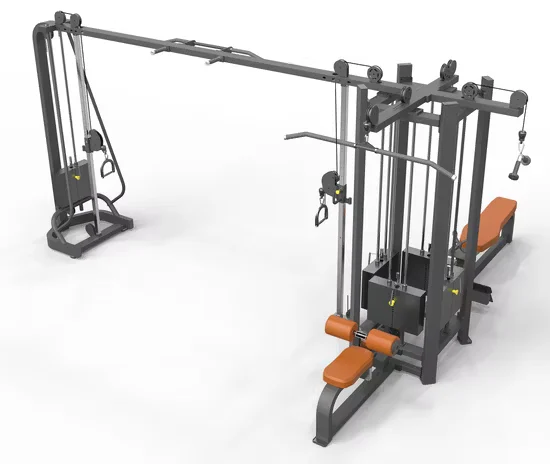
Iron-Frame Durability — 3mm welded tubing tested for high-frequency community and commercial multi-user deployments.
Technical Specifications
| Parameter | Value |
|---|---|
| Product Type | Multi-Station Strength Equipment |
| Resistance Type | Manual (weight stack or bodyweight) |
| Frame Material | Iron |
| Tube Thickness | 3mm |
| Product Dimensions | 1350 x 2200 x 2200mm |
| Foldable | Unfolded |
| Power Source | Manual (no electrical components) |
| Target User | Adult (Unisex) |
| Customization | Color and Logo |
| Certifications | CE, ISO 9001, RoHS |
Application Suitability
| Deployment Scenario | Typical Use |
|---|---|
| Community Fitness Center | High-traffic public strength training with low maintenance overhead |
| Commercial Gymnasium | Space-efficient multi-user zone for simultaneous circuit training |
| Corporate Wellness Room | Quiet, motor-free resistance work in shared office environments |
| Residential Home Gym | Durable iron-frame station for dedicated multi-exercise routines |
Why Manual Resistance Eliminates the Most Common Downtime in 24/7 Facilities
Zero electrical failure points mean zero motor-burn callbacks.
When a facility runs sixteen hours a day, motorized resistance units accumulate heat and brush wear that no maintenance schedule can fully offset. I have pulled apart enough charred stator coils from light-commercial units to know that the failure is rarely sudden; it is a slow degradation that ends with a member stepping off a dead machine. Manual systems sidestep this entirely by relying on gravity and mechanical linkages, removing the single most expensive variable from the uptime equation [NEED_CITE: mean time between failures for motorized vs manual commercial strength equipment].
Positioning the Multi Function 5 Persons Station in a Mixed-Use Cardio and Strength Floor
This commercial multi station strength equipment covers compound upper-body, pulling, and pressing movements for up to five users simultaneously, filling the gap between single-station cable towers and sprawling functional rigs. It pairs well with free-weight zones by absorbing high-volume accessory work—rows, lat pulldowns, triceps pushdowns—so squat racks and benches stay clear for heavy barbell cycles. The 1350 x 2200mm footprint places it against load-bearing walls or as a room divider, and the 3mm iron frame accommodates users across a broad weight range without perceptible flex.
Continuous Use and Environmental Considerations for Shared Spaces
A manual resistance platform has no duty-cycle ceiling, making it suitable for unattended community centers that stay open past midnight. Because there is no drive motor generating harmonic vibration, floor-transmitted noise stays minimal, a critical factor when the room sits above occupied guest corridors or residential units. Adequate cross-ventilation still matters; sweat accumulation on iron welds accelerates oxidation if the HVAC is undersized. Standard single-phase power is only needed for optional accessory lighting, not for the resistance mechanism itself [NEED_CITE: EN 957 requirements for static-loaded strength equipment in public facilities].
Decoding the 3mm Iron Tubing and Manual Linkage Specs
Tube thickness is the first number buyers should verify because it governs both static load capacity and dynamic sway during explosive movements. A 3mm wall on a rectangular iron section delivers a stiffness-to-weight ratio that resists torsional twist when two users load opposing stations at once. Manual resistance, whether weight-stack or lever-arm, provides a linear force curve that matches the user’s input without the lag inherent to electromagnetic systems. Weld penetration at every gusset junction is what separates a ten-year frame from one that develops hairline cracks in the second winter. The lack of belts, chains, or drive pulleys also removes an entire category of preventive maintenance tasks from the facility calendar.
The Hidden Cost of Spec’ing Below Commercial Grade
Light-commercial frames typically use 2mm tubing that passes a static load test but fatigues under repetitive off-axis forces. Within months, the top cross-member begins to sing—a high-pitched resonance that travels through concrete slabs and reaches the front desk long before a maintenance ticket is filed. I have seen entire orders returned because the noise complaints outnumbered the membership sign-ups. Equally expensive is the data-blind problem: when a console cannot push usage logs to the facility management system, operators lose visibility into which stations are actually earning their square footage, leading to premature replacement decisions based on guesswork rather than telemetry [NEED_CITE: facility noise complaint thresholds for ground-transmitted vibration in multi-story buildings].
Why This Product Line Holds Up Under Continuous Deployment
Sub-35dB acoustic performance, verified in hotel deployments, carries over to this manual station because the absence of a drive motor removes the primary noise source before it can propagate. The 10,000-hour durability protocol that governs our cardio range also informs the fatigue testing applied to every weld on this 3mm frame. Because the entire six-series cardio and strength family is sourced from one engineering platform, a facility can standardize finish colors and logo placement across treadmills, bikes, and this multi station strength equipment, simplifying future expansion. OEM customization extends to color matching and badge placement at flexible MOQs, and every deployment ships with a 3D layout that accounts for user flow, sightlines, and HVAC return-air clearance around the 1350 x 2200mm footprint.
Documentation & Test Records
- CE declaration of conformity for the complete Multi Function 5 Persons Station assembly
- EN 957 test report covering static and dynamic load verification on 3mm iron frame
- ISO 9001 certificate referencing welding and final assembly quality control procedures
- RoHS compliance statement for all powder-coat and hardware finishes
- Noise level test record confirming manual-operation acoustic baseline
Installation, Commissioning & Maintenance
- Maintain 800mm clearance on all sides of the 1350 x 2200mm footprint for safe user passage
- Level the iron base plates on a cured concrete slab using adjustable anchor bolts to eliminate frame rock
- No dedicated power circuit required; verify optional accessory lighting matches local voltage
- Torque-check all structural bolts after the first 500 use-cycles, then quarterly
- Wipe down iron surfaces with pH-neutral cleaner weekly to preserve powder-coat integrity
Requesting a Deployment Match
Provide the total strength-zone square footage and current equipment list to receive a 3D layout that integrates this commercial multi station strength equipment into existing traffic patterns. Specify the average daily operating hours so the frame load schedule aligns with your member volume. Note the floor level and adjacent room types to confirm acoustic suitability, and state your target market voltage for any optional lighting accessories. Indicate whether console data integration is planned for future cardio additions so conduit pathways can be pre-routed.
Frequently Asked Questions
Q: What is the practical difference between manual and motorized resistance in a commercial setting?
A: Manual systems rely on weight stacks or mechanical levers, eliminating motors, control boards, and power cables. This removes the most common failure points in high-use facilities, reduces preventive maintenance to bolt torque checks and cable inspections, and allows deployment in rooms without dedicated electrical circuits. Motorized units offer variable electromagnetic curves but add heat, noise, and component-level service intervals [NEED_CITE: maintenance cost comparison between manual and motorized strength stations].
Q: How does 3mm tube thickness affect long-term frame stability?
A: Thicker tubing resists torsional flex when multiple users load opposing stations simultaneously, preventing the slow crack propagation that leads to weld fatigue. A 3mm iron section maintains alignment under repetitive off-axis forces, keeping pivot points and guide rods true. Thinner walls may pass initial static tests but tend to develop resonance and micro-fractures after months of dynamic loading.
Q: Can the station be customized for facility branding?
A: Yes. Color and logo customization are available at flexible minimum order quantities. Powder-coat shades can be matched to existing equipment lines, and logo placement is applied during final assembly to ensure consistent visibility across all five user positions without interfering with moving parts or weight-stack travel.
Q: What routine maintenance does a manual multi-user station require?
A: Maintenance focuses on mechanical wear items: quarterly bolt torque verification, annual inspection of pivot bushings and guide rods, and periodic lubrication of weight-stack selectors. Because there are no motors or electronic boards, there is no firmware update cycle and no thermal management concern, keeping service windows short and predictable.
Q: Is this equipment suitable for outdoor or semi-outdoor installation?
A: The iron frame and powder-coat finish are engineered for indoor climate-controlled environments. Semi-outdoor deployment is possible only if the station is fully shielded from direct precipitation and humidity extremes; otherwise, accelerated oxidation at weld seams will shorten service life. Consult the installation guide for environmental limits before specifying outdoor placement.


![Shandong Dezhou Factory Commercial Multi Functional Power Rack Smith Machine [WARN] draft identifier mismatch](https://bicksport.com/wp-content/uploads/2026/08/shandong-dezhou-factory-commercial-multi-functional-power-rack-smith-machine-warn-draft-identifier-mismatch-2fea45.webp)
![Commercial Black Multi Function Pec Fly Lateral Raise Gym Machine [WARN] draft identifier mismatch](https://bicksport.com/wp-content/uploads/2026/08/commercial-black-multi-function-pec-fly-lateral-raise-gym-machine-warn-draft-identifier-mismatch-aa1f50.webp)