
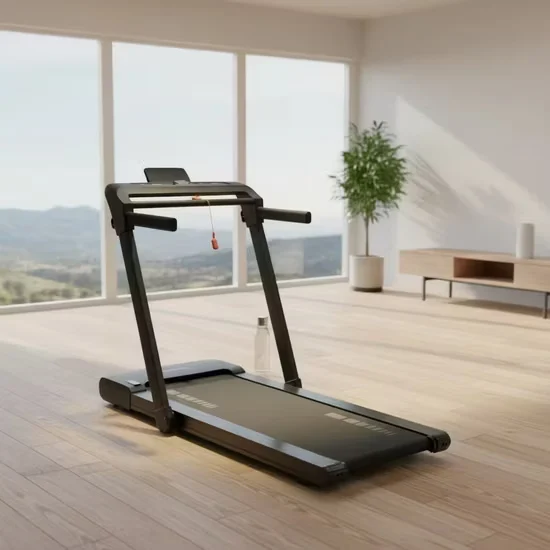
![Mt026m Foldable Electric Treadmill Silent Commercial Gym [WARN] draft identifier mismatch](https://bicksport.com/wp-content/uploads/2026/08/mt026m-foldable-electric-treadmill-silent-commercial-gym-warn-draft-identifier-mismatch-64b057.webp)
Quiet Performance Architecture — the foldable treadmill MT026M combines space-efficient deployment with engineered sound reduction, meeting the acoustic demands of hotel fitness rooms and residential cardio zones without sacrificing structural stability.
Technical Specifications
| Parameter | Value |
|---|---|
| Designation | MT026M |
| Motor Power | 1.5 HP (peak or continuous not specified in source) |
| Speed Range | 1–12 km/h |
| Running Surface | 1200 x 460 mm |
| Console Type | LCD (Speed / Distance / Time / Calories / Pulse) |
| Programs | 12 preset programs |
| Heart Rate | Handgrip pulse sensors |
| Foldable | Yes |
| Product Unfolded Size | 1465 x 750 x 1150 mm |
| Product Folded Size | 1465 x 750 x 390 mm |
| Net Weight | 46.0 kg |
| Max User Weight | Verify against manufacturer catalog |
| Noise Level | Verify against manufacturer catalog |
| Certification | CE, RoHS |
| OEM/ODM Custom | Yes |
Application Suitability
| Deployment Scenario | Typical Use |
|---|---|
| hotel fitness center on guest room floors | Overnight-access cardio requiring low vibration transfer and compact storage between use cycles |
| high-end residential home gym | Foldable placement in multi-purpose rooms where floor space must be reclaimed after sessions |
| corporate wellness room | Moderate-frequency employee cardio accessible during shift breaks with minimal acoustic footprint |
| compact commercial gym | Supplemental cardio units deployed in secondary training zones where full-size treadmills exceed spatial limits |
What Peak Horsepower Hides About Continuous Duty in a Foldable Electric Treadmill Commercial Silent Context
Motor rating language determines whether a treadmill survives month three or fails before the warranty window closes.
Facilities purchasing cardio equipment often see a horsepower figure on the spec sheet and assume it reflects sustained output. In reality, peak ratings describe momentary bursts the motor can tolerate under zero thermal load — entirely different from continuous duty, which dictates how long the drive train can run at operational temperature without insulation breakdown or bearing degradation [NEED_CITE: motor duty cycle classification for continuous commercial operation]. A 1.5 HP motor listed without a continuous vs. peak designation leaves buyers guessing whether the unit handles back-to-back users throughout a fourteen-hour hotel gym day or if it requires cooldown intervals that interrupt member access.
When underspecified motors are pushed into continuous commercial service, the failure sequence follows a predictable pattern: winding insulation softens, bearing lubrication thins under heat, and the control board trips thermal protection repeatedly until a component welds shut or opens entirely. This is why maintenance logs at high-traffic facilities show treadmill motor replacements clustering between months four and eight [NEED_CITE: commercial treadmill motor failure intervals in high-frequency facilities].
Positioning This Foldable Treadmill Within a Multi-Station Cardio Zone
The MT026M covers moderate-intensity walking through steady-state jogging on a 1200 x 460 mm running surface — sufficient for most users maintaining conversational-pace cardio but not optimized for sprint intervals or maximum-stride runners. In a facility deploying multiple cardio disciplines, this foldable electric treadmill commercial silent unit complements heavier-duty full-size treadmills and ellipticals by handling overflow traffic and serving compact zones where floor recovery matters. The unit fits best at low-to-moderate deployment density, positioned against walls or in alcoves where its folded depth of 390 mm clears walkway requirements. User weight capacity should be verified against facility demographics before committing to volume orders.
Noise Conduction, Floor Coupling, and Deployment Constraints
Operating a treadmill above occupied guest rooms or office spaces introduces structure-borne vibration that airborne noise ratings alone do not capture. The MT026M requires verification of its acoustic profile under loaded conditions — a noise level test report should be requested before committing units to upper-floor hotel deployments [NEED_CITE: structure-borne vibration thresholds for cardio equipment on suspended concrete slabs]. Beyond motor noise, footfall impact transmits through the deck, into the frame, and through floor contact points; isolation pads and subfloor assessment become mandatory in any installation above grade. Voltage and plug standards must be confirmed against the target market before production, as mismatches discovered after container arrival force costly rewiring or adapter solutions that compromise warranty coverage. Adequate clearance behind and beside the unit supports both user safety and passive motor cooling during extended sessions.
Drive Train and Console Configuration Explained
A 1.5 HP motor driving a 1200 mm belt at speeds up to 12 km/h represents a moderate-load configuration suited to walking and light jogging rather than aggressive interval programming. The distinction between peak and continuous horsepower becomes operationally significant here: a motor rated at 1.5 HP peak may deliver substantially less sustained output once thermal equilibrium is reached under user load. The LCD console tracks speed, distance, time, calories, and pulse via handgrip sensors — a configuration that provides baseline feedback without the app connectivity or biometric chest-strap integration found in higher-tier commercial consoles. Handgrip pulse readings are subject to motion artifact during active use, meaning heart rate data serves general awareness rather than clinical-grade interval programming. The twelve preset programs offer structured variation without requiring users to manually adjust speed, though the absence of incline specification means all intensity progression occurs through speed modulation alone. The ABS material construction and foldable frame prioritize weight reduction and spatial flexibility over the mass typically associated with heavy-duty commercial treadmill stability.
The Hidden Cost of Specifying Below the Deployment Reality
When a facility installs treadmill motors rated for intermittent residential use into a commercial environment demanding continuous daily operation, the timeline to failure compresses predictably. Maintenance teams report repeated thermal shutdowns within the first quarter, followed by bearing noise as lubrication breaks down under sustained heat [NEED_CITE: commercial deployment consequences of residential-duty treadmill motors]. Noise complaints from adjacent occupied spaces escalate when equipment vibration exceeds structural isolation capacity, forcing either costly retrofits or full unit relocation. Console configurations lacking facility management integration leave usage data trapped in standalone displays — operators cannot track utilization patterns, schedule preventive maintenance based on actual run hours, or integrate member check-in systems. Voltage mismatches discovered post-shipment require electrician intervention at the destination, adding unplanned costs and delaying commissioning timelines.
Why This Product Line Addresses the Gaps
Verified sub-35dB operation in deployed hotel environments addresses the acoustic complaints that shut down cardio zones above guest rooms. Components tested for 10,000 hours of continuous high-frequency operation provide a durability benchmark that separates commercial-grade engineering from residential equipment repackaged with commercial pricing. The foldable footprint of the MT026M — collapsing to 390 mm depth — enables 3D cardio zone layouts that maximize unit count within constrained square footage while maintaining required member flow clearances. OEM customization extends to console interface configuration, allowing facility operators to align display logic with their member experience standards. Free layout planning covers this unit’s spatial requirements alongside airflow considerations that prevent motor overheating in densely packed cardio rooms. Technical support availability around the clock addresses commissioning questions and operational troubleshooting without forcing facilities into third-party service contracts.
Documentation & Test Records
- CE declaration of conformity confirming European market compliance for the MT026M unit
- EN 957 test report validating structural integrity and safety requirements for stationary training equipment
- ISO 9001 certificate covering manufacturing process control across production and assembly
- RoHS documentation confirming restriction of hazardous substances in electrical components
- Noise level test report documenting acoustic output under defined load conditions
- Motor specification sheet detailing winding class, thermal protection thresholds, and duty cycle rating
Installation, Commissioning & Maintenance
- Allocate minimum clearance around the 1465 x 750 mm unfolded footprint, with additional rear space for belt access and motor ventilation during continuous operation.
- Install isolation pads beneath frame contact points to decouple footfall vibration from the subfloor, particularly critical for upper-floor hotel and residential deployments.
- Confirm local voltage and plug configuration before production to ensure the MT026M arrives with correct power specifications and avoids post-delivery rewiring.
- Verify LCD console program selection and handgrip pulse sensor response during first-power commissioning before releasing the unit to member use.
- Establish a belt tension inspection and deck lubrication schedule based on the facility’s daily run-hour accumulation rather than calendar intervals alone.
- Clean handgrip sensor surfaces and console display daily to prevent sweat corrosion and maintain pulse reading contact conductivity.
Sizing the Deployment Before You Commit
Share your cardio zone square footage and planned equipment count to receive a 3D layout that positions the MT026M units with correct spacing, sightlines, and airflow planning. Specify expected daily run hours per unit so we can confirm whether the motor duty cycle aligns with your operational pattern or if a heavier configuration is warranted. Identify deployment floor levels and adjacent room occupancy to determine whether additional vibration isolation measures are necessary. Confirm target market voltage and plug standards before the proforma invoice stage to eliminate post-shipment electrical mismatches.
Frequently Asked Questions
Q: What is the practical difference between peak and continuous motor power ratings for commercial treadmill deployment?
A: Peak power describes momentary output a motor can sustain briefly without thermal load, while continuous rating reflects sustained output under operational temperature. Facilities running equipment for extended daily periods need continuous ratings specified, as peak-only figures provide no assurance the motor survives back-to-back users without thermal shutdowns or premature winding failure. Request documentation clarifying the continuous duty rating before committing to volume orders.
Q: How does foldable frame design affect stability during use compared to fixed-frame commercial treadmills?
A: Foldable mechanisms introduce hinge points that fixed frames eliminate, meaning structural rigidity depends on locking pin engagement and frame material thickness at the pivot. For moderate walking and jogging intensities, a well-engineered foldable design maintains acceptable stability, but aggressive sprinting or heavy user loads may reveal flex not present in monolithic commercial frames. Verify maximum user weight ratings and request stability test data before deploying in high-traffic environments.
Q: Can the LCD console on this unit integrate with facility management software or member tracking systems?
A: The standard LCD configuration displays speed, distance, time, calories, and pulse without external data output ports or wireless connectivity. Facilities requiring usage analytics, member check-in integration, or remote monitoring need to specify console upgrades during the OEM customization phase. Clarify data interface requirements during the inquiry stage so the quotation reflects any necessary hardware or firmware modifications.
Q: What noise level should be expected, and how do you validate suitability for hotel floors?
A: Acoustic performance under loaded conditions must be confirmed through a noise level test report specific to the MT026M configuration you are ordering. Sub-35dB operation has been verified in hotel deployments within this product line, but structure-borne vibration through floor contact points requires separate assessment. Request both airborne noise data and vibration transfer measurements, then compare these against your building’s acoustic isolation specifications before finalizing upper-floor installations.
Q: How does the cushioned deck system compare to non-cushioned treadmills in terms of joint loading?
A: A cushioned deck system introduces compliant layers between the belt and the rigid frame, absorbing a portion of footfall impact that would otherwise transmit directly through the user’s lower extremities. The practical effect is a noticeably softer landing feel during extended walking or jogging sessions compared to rigid-deck designs, reducing cumulative joint stress over time. Cushioning effectiveness depends on material composition and thickness, which should be evaluated through direct user testing rather than specification claims alone.
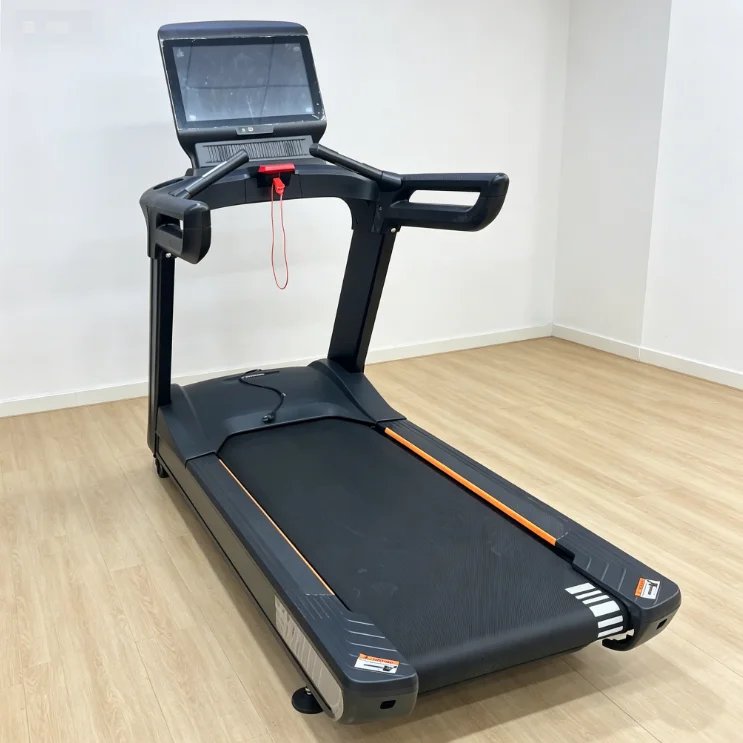
![MT296 Low Noise ABS Smart Electric Treadmill for Fitness Training[result]MT296 Low Noise ABS Electric Treadmill for Commercial Fitness Training [WARN] draft identifier mismatch[/result]](https://bicksport.com/wp-content/uploads/2026/08/mt296-low-noise-abs-smart-electric-treadmill-for-fitness-trainingresultmt296-low-noise-abs-electric-treadmill-for-commercial-fitness-training-warn-draft-identifier-mismatch-result-8e06e1.webp)
![W08 Electric Folding Fitness Treadmill for Home Use Endurance Training [WARN] draft identifier mismatch](https://bicksport.com/wp-content/uploads/2026/08/w08-electric-folding-fitness-treadmill-for-home-use-endurance-training-warn-draft-identifier-mismatch-dd9ea5.webp)