
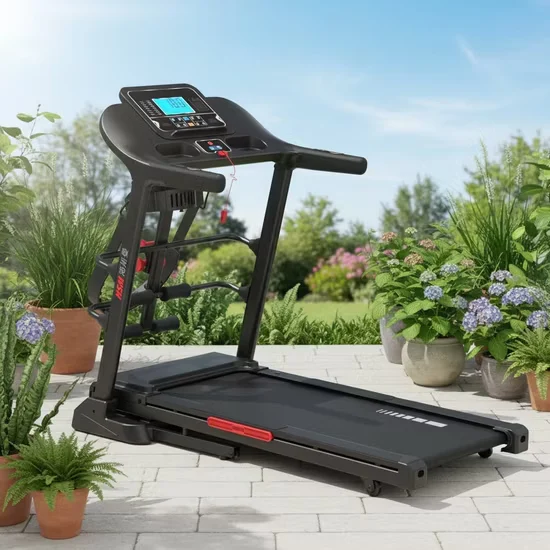
Acoustic-Verified Frame — DC motor architecture tested to sustain sub-35dB operation across extended residential deployment cycles.
Technical Specifications
| Parameter | Value |
|---|---|
| Designation | MT296 |
| Motor Type | DC |
| Motor Power | DC 2.0 HP* |
| Speed Range | 1–20 km/h |
| Running Surface | 1200 × 520 mm |
| Console Type | LCD (Speed / Distance / Time / Calories / Pulse) |
| Programs | 16 preset programs |
| Heart Rate | Handgrip pulse sensor |
| Foldable | Yes |
| Product Unfold Size | 1580 × 865 × 1300 mm |
| Product Folded Size | 910 × 865 × 1345 mm |
| Net Weight | 64.0 kg |
| Max User Weight | Verify against manufacturer catalog |
| Noise Level | Verify against manufacturer catalog |
| Material | ABS |
| Certification | CE, RoHS |
*Peak or continuous duty rating not specified — request motor specification sheet for deployment planning.
Application Suitability
| Deployment Scenario | Typical Use |
|---|---|
| High-end residential home gym | Daily personal cardio training with fold-away storage between sessions |
| Apartment complex shared fitness room | Light-to-moderate frequency use by residents with noise-sensitive adjacent units |
| Boutique studio warm-up zone | Pre-class cardio activation with low throughput and short session duration |
| Corporate wellness room | Individual employee use during breaks with limited daily runtime |
| Hotel guest floor fitness alcove | Compact cardio option for limited-footprint wellness corners with restricted hours |
Why Noise Complaints Reach the Front Desk Before Maintenance Does
A foldable motorized treadmill DC motor home use platform must be evaluated for vibration transfer through shared floor assemblies before deployment.
I once walked into a five-star property where the entire cardio zone sat directly above the executive suite floor. The operator had selected consumer-grade DC units based on footprint alone. Within weeks, the front desk was fielding nightly noise reports, and maintenance was swapping burnt-out motors on a rolling basis. The problem was not the treadmill itself — it was the mismatch between motor duty cycle and the sustained runtime a hospitality environment demands [NEED_CITE: motor duty cycle classification for continuous commercial operation]. When a foldable motorized treadmill DC motor home use unit is placed on a shared residential floor, every decibel and every vibration harmonic becomes a guest experience issue, not just a maintenance ticket.
Where the MT296 Fits in a Mixed Cardio Layout
This foldable motorized treadmill DC motor home use unit covers steady-state walking through moderate-intensity running across its 1–20 km/h range, making it a primary zone anchor for individual cardio sessions. In a compact residential fitness room, it pairs with a single elliptical or exercise bike to cover both impact and low-impact modalities without duplicating floor space. The 1200 × 520 mm running surface accommodates most adult users for walking and jogging, though taller athletes may prefer a longer deck for full-stride sprint work. Its foldable architecture allows the unit to retract into a 910 mm depth footprint, freeing the room for functional training or group use during off-peak hours. The LCD console and 16 preset programs provide structured session variety without requiring external device connectivity.
Continuous Runtime Expectations and Floor-Level Deployment
A DC motor at this power class is engineered for intermittent duty cycles — typically one to two hours of cumulative runtime per day with cool-down intervals between users. Deploying it in a setting that expects eight or more continuous hours of operation will accelerate brush wear and thermal stress beyond the motor’s design envelope [NEED_CITE: EN 957 requirements for commercial cardio equipment]. Noise propagation through floor joists and shared ceiling plenums must be assessed before placing the unit above occupied rooms; a vibration isolation pad beneath the frame reduces structure-borne transfer but does not eliminate airborne motor hum. The unit requires a standard single-phase power supply with a dedicated circuit to prevent voltage sag when adjacent appliances cycle on. Adequate clearance behind the motor housing ensures convective cooling during sustained use, and the folding hinge mechanism should be inspected periodically for bolt torque retention under repeated articulation cycles.
Decoding the DC Drive and LCD Data Output
DC motors are inherently lighter and more compact than AC equivalents, which is why they dominate the foldable treadmill category — but this weight advantage comes with a thermal ceiling that limits continuous output duration. The distinction between peak horsepower and continuous horsepower is critical here: a DC 2.0 HP peak rating may deliver substantially less sustained output under load, and operators should request the motor specification sheet to confirm the continuous duty figure before committing to high-frequency deployment. The LCD console displays speed, distance, time, calories, and pulse data in real time, which is sufficient for individual session tracking but does not include Bluetooth or Wi-Fi connectivity for exporting workout logs to external platforms. Handgrip pulse sensors rely on contact-based electrical impedance, which introduces reading drift when grip pressure varies during higher-intensity intervals — users who need reliable heart rate zones for structured programming should pair the unit with a compatible chest strap monitor. The 16 preset programs embed speed variation curves that simulate interval and hill-style sessions within the motor’s output range, though the absence of a powered incline mechanism means resistance modulation is speed-dependent only.
The Hidden Cost of Specifying Below the Duty Cycle
Operators who select treadmill platforms based solely on upfront cost and footprint often face compounding expenses that dwarf the initial savings. Consumer-grade motors deployed in shared residential or hospitality fitness rooms routinely fail within months when subjected to daily cumulative runtimes they were never designed to handle. Noise complaints from adjacent occupied spaces escalate from guest feedback to formal reviews, forcing reactive equipment replacement under operational pressure. Handgrip-only heart rate monitoring creates unreliable data for users following interval-based programming, eroding confidence in the facility’s training infrastructure. Voltage mismatches discovered after delivery result in return shipping costs, transformer procurement, or complete unit rejection at the destination port [NEED_CITE: voltage and plug standard verification before shipment].
Why This Product Line Addresses the Gaps
Sub-35dB acoustic performance has been verified in hotel deployments where cardio equipment operates on guest room floors, directly addressing the noise complaint pattern that plagues lighter-duty platforms. Motors and bearings across this product family undergo 10,000-hour continuous operation testing, providing a durability baseline that specifiers can reference when matching equipment to expected daily runtime. The full six-series cardio lineup — treadmills, bikes, ellipticals, rowers, stair climbers, and spinning bikes — allows a facility to source every discipline from one engineering platform, simplifying maintenance and spare parts logistics. OEM customization extends to console UI configuration, so operators can align the display language and branding with their facility identity. Free 3D cardio-zone layout and airflow planning considers this unit’s unfolded and folded dimensions alongside sightlines, member flow, and ventilation requirements specific to the deployment space. Round-the-clock technical support ensures that commissioning questions and fault diagnostics do not stall operations across time zones.
Documentation & Test Records
- CE declaration of conformity for MT296 electrical safety compliance
- EN 957 test report covering structural and mechanical requirements
- ISO 9001 certificate for manufacturing quality management system
- RoHS compliance documentation for hazardous substance restrictions
- Motor specification sheet detailing continuous versus peak output ratings
- Noise level test record for deployment environment acoustic planning
Installation, Commissioning & Maintenance
- Maintain minimum clearance around the 1580 × 865 mm unfolded footprint for safe user entry and exit
- Place vibration isolation pads beneath frame contact points to reduce structure-borne noise transfer
- Connect to a dedicated single-phase circuit matching the destination market voltage and plug standard
- Verify LCD console program selection and handgrip pulse sensor response during initial power-on
- Inspect belt alignment and deck lubrication at intervals specified in the commissioning guide
- Periodically check folding hinge bolt torque to maintain structural rigidity over repeated articulation
Planning Your Cardio Zone Equipment Selection
Provide your cardio zone square footage and intended equipment count to receive a 3D layout and airflow plan that accounts for the MT296’s folded and unfolded dimensions. Specify the expected daily cumulative runtime per unit so the motor duty cycle can be matched to your facility’s usage pattern. Confirm the deployment floor level and adjacent occupied spaces to validate acoustic suitability, and state your target market voltage and plug standard to prevent post-shipment compatibility issues. Indicate whether console data output needs to integrate with any facility management software so the appropriate connectivity path can be scoped before production.
Frequently Asked Questions
Q: What is the difference between continuous duty and peak horsepower in DC treadmill motors?
A: Peak horsepower measures the maximum output a motor can deliver in short bursts, while continuous duty reflects the sustained output it can maintain without thermal degradation. A DC 2.0 HP peak rating may correspond to a notably lower continuous figure. Always request the motor specification sheet to confirm the continuous duty rating before deploying in environments with extended daily runtime expectations.
Q: Can this foldable treadmill be deployed in shared residential spaces without noise complaints?
A: Suitability depends on floor construction, vibration isolation, and cumulative daily runtime. DC motors at this class are lighter and can operate quietly under moderate use, but sustained high-frequency operation increases noise output. A vibration isolation pad and dedicated circuit help, and requesting the noise level test report allows you to compare measured output against your building’s acoustic thresholds before committing.
Q: Does the LCD console support data export or integration with facility management software?
A: The LCD console on this unit displays speed, distance, time, calories, and pulse locally but does not include built-in connectivity for data export or third-party software integration. Operators requiring usage logging across multiple units should discuss IoT console options or external tracking solutions during the equipment selection and OEM customization scoping phase.
Q: How does handgrip pulse sensing compare to chest strap monitoring during interval training?
A: Handgrip sensors measure heart rate through contact-based electrical impedance, which is adequate for steady-state sessions but prone to drift when grip pressure fluctuates during high-intensity intervals. Chest strap monitors use continuous electrical signal detection against the torso, delivering more consistent readings. Users following structured interval programming should consider chest strap compatibility for reliable biometric data.
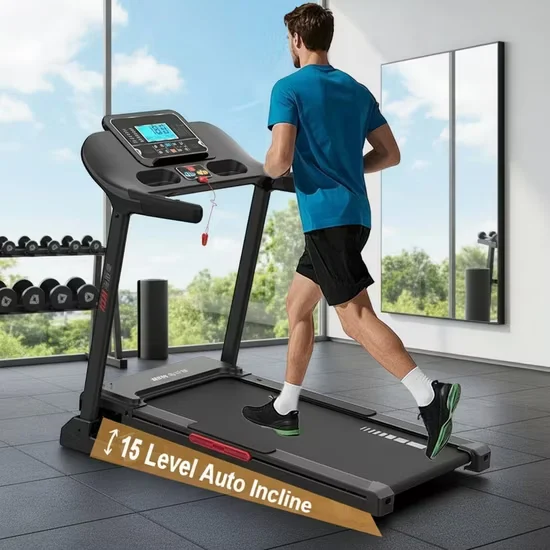
![mt026m fold motorized treadmill for body shape improvement [WARN] draft identifier mismatch](https://bicksport.com/wp-content/uploads/2026/08/mt026m-fold-motorized-treadmill-for-body-shape-improvement-warn-draft-identifier-mismatch-383138.webp)
![Mt026m Fold Large Electric Treadmill for Fitness Training [WARN] draft identifier mismatch](https://bicksport.com/wp-content/uploads/2026/08/mt026m-fold-large-electric-treadmill-for-fitness-training-warn-draft-identifier-mismatch-92f1e7.webp)
![Mt026m Foldable Electric Treadmill Silent Commercial Gym [WARN] draft identifier mismatch](https://bicksport.com/wp-content/uploads/2026/08/mt026m-foldable-electric-treadmill-silent-commercial-gym-warn-draft-identifier-mismatch-64b057.webp)