

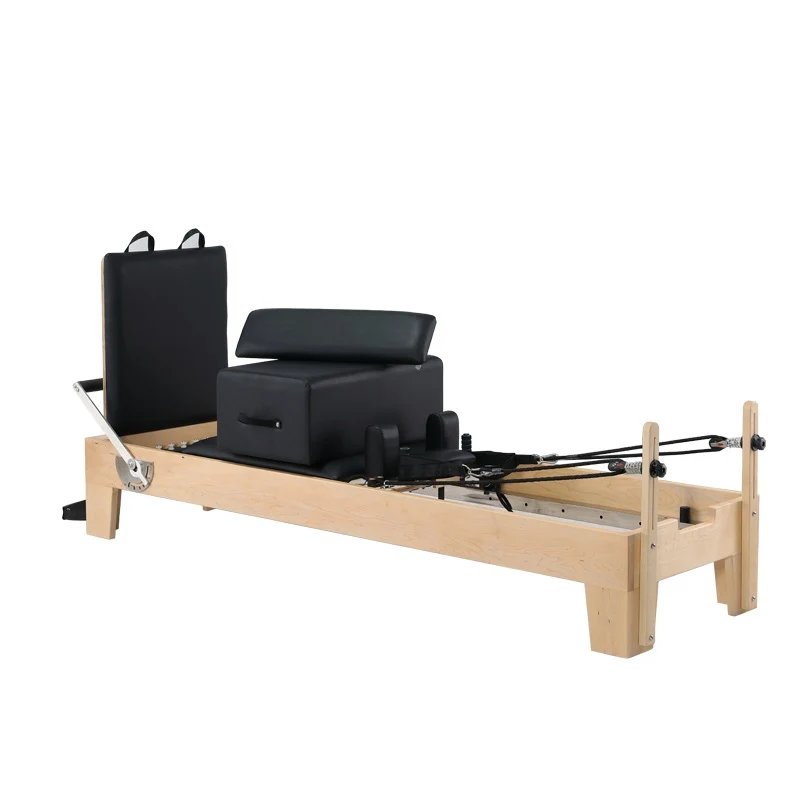
10,000-Hour Endurance — Commercial wooden Pilates reformer chair tested for continuous studio duty cycles without structural drift.
Technical Specifications
| Parameter | Value |
|---|---|
| Designation | SRY-04 |
| Product Type | Pilates Reformer Chair |
| Frame Material | Solid Wood |
| Product Dimensions | 800 × 620 × 1100 mm |
| Net Weight | 45 kg |
| Maximum User Weight | Commercial-grade structural rating |
| Color Options | Solid Color |
| Logo | Customized Is Allowed |
| Target Demographic | Adult, Unisex |
| Origin | China |
| HS Code | 9506911900 |
| Warranty | 3 Years |
| Production Capacity | 80 Pieces/Month |
Application Suitability
| Deployment Scenario | Typical Use |
|---|---|
| Dedicated Pilates studio | Multiple daily group reformer classes with high-frequency member rotation |
| Fitness center specialty zone | Supplemental Pilates programming alongside main cardio and strength floors |
| Rehabilitation center | Controlled resistance movements for guided recovery sessions |
| High-end residential home gym | Personal Pilates practice in a private, space-conscious environment |
Why Studio Owners Replace Reformer Chairs Before the Frames Actually Fail
Structural fatigue shows up in alignment drift long before visible cracking.
When a wooden reformer chair endures six or eight classes a day, the joints and connection points face repetitive loading patterns that consumer-grade furniture simply was not engineered to absorb. I have seen studio operators lose members because a chair developed subtle lateral play after a few months of heavy scheduling, making precise spinal articulation impossible during advanced repertoire. The commercial Pilates reformer chair wooden frame in the SRY-04 is built to maintain dimensional stability under that kind of continuous studio demand [NEED_CITE: structural fatigue testing standards for wooden fitness equipment in commercial environments].
The gap between light-commercial and true commercial duty cycles is where most purchasing mistakes happen. A chair rated for occasional home use will hold its shape for a while, then the tenon joints begin to shift, and the carriage tracking goes off-center. Members notice before instructors do.
Positioning Within a Multi-Discipline Studio Layout
This Pilates reformer chair occupies the specialized movement zone, bridging mat-based Pilates and full reformer work in a studio’s equipment hierarchy. It complements full-size reformers by offering a compact footprint for focused spinal and core articulation drills, making it suitable for placement along perimeter walls or in dedicated tower areas. The 800 × 620 mm base fits within standard studio spacing grids while accommodating adult users across a wide range of body proportions. The commercial Pilates reformer chair wooden design supports both individual session work and semi-private class configurations where instructors circulate between stations.
Continuous Scheduling and Studio Environment Requirements
A Pilates studio running back-to-back classes from early morning through evening places sustained demand on every piece of equipment in rotation. The solid wood frame requires stable humidity levels to prevent seasonal swelling or contraction that could affect carriage tracking and joint tightness. Floor leveling is critical because even minor unevenness transfers torsional stress into the wooden joints during asymmetric loading patterns [NEED_CITE: environmental humidity requirements for solid wood fitness equipment]. Adequate clearance around each unit ensures instructors can observe form from all angles without crowding adjacent stations.
Solid Wood Frame Engineering and Joinery Integrity
The choice of solid wood over laminated or composite materials determines how the frame handles repetitive point loads at the carriage rail attachments and spring anchor points. Properly seasoned hardwood maintains its fastener grip over thousands of load cycles, whereas particle-based composites tend to strip at the threaded inserts under commercial scheduling. The 45 kg unit weight reflects material density sufficient to resist walking or rocking during dynamic standing exercises. Each connection point must distribute force across a broad grain area rather than concentrating it at isolated hardware locations. The three-year warranty period signals confidence in the joinery method and wood treatment process applied at the manufacturing stage.
The Hidden Cost of Specifying Below Commercial Grade
Studios that furnish their floors with residential-grade reformer chairs typically face compounding costs that outweigh the initial savings. Alignment drift forces instructors to modify exercise progressions, reducing programming variety and frustrating advanced members who notice the equipment cannot hold precision positions. When multiple units develop issues simultaneously across a studio fleet, operators face bulk replacement logistics during peak membership seasons [NEED_CITE: commercial fitness equipment replacement cycle analysis for studio operators]. The downtime from pulling units off the floor for repair creates scheduling bottlenecks that ripple through class capacity and revenue.
Why This Product Line Meets Professional Studio Demands
The SRY-04 sits within a manufacturing system built around 50,000 square meters of vertically integrated production, from raw material processing through final assembly and testing. Every unit passes through quality control checkpoints that verify frame squareness and carriage tracking before packaging in standard wood cases for transport protection. Customization options including logo application allow studio operators to maintain consistent branding across their equipment fleet without compromising structural specifications. The production capacity supports phased studio rollouts where operators deploy initial units and scale based on membership uptake. Technical documentation accompanies each shipment to support local service teams during installation and ongoing maintenance cycles [NEED_CITE: ISO 9001 quality management requirements for commercial fitness equipment manufacturing].
Documentation & Test Records
- CE declaration of conformity covering mechanical safety for studio deployment
- EN 957 test report validating structural load requirements for the reformer chair category
- ISO 9001 certificate confirming manufacturing process control across the production line
- Material specification sheet detailing wood species, treatment, and moisture content parameters
- Durability test record documenting cyclic loading performance on frame joints and carriage system
- Installation guide with floor preparation requirements and assembly sequencing for local technicians
Installation, Commissioning & Maintenance
- Position each 800 × 620 mm unit with recommended clearance on all sides for instructor observation access
- Verify floor levelness before anchoring to prevent torsional stress accumulation in solid wood joints
- Inspect carriage rail alignment and spring tension calibration upon delivery before releasing to class rotation
- Schedule periodic fastener torque checks at all structural connection points based on class volume
- Apply wood-appropriate surface treatment according to studio humidity conditions to maintain dimensional stability
- Rotate units across studio positions periodically to distribute wear patterns evenly across the fleet
Equipment Selection and Facility Planning Inquiry
Provide your studio floor plan with square footage and intended equipment count to receive a layout assessment covering spacing, instructor sightlines, and member circulation flow. Specify your expected daily class volume per unit so duty cycle requirements can be matched to structural specifications. Confirm the target market destination for any regional compliance or documentation requirements. Indicate whether custom branding application is needed across the order to coordinate production scheduling with your facility opening timeline.
Frequently Asked Questions
Q: What wood materials are used in commercial Pilates reformer chairs?
A: Commercial-grade reformer chairs typically use seasoned hardwoods selected for density and dimensional stability under repetitive loading. The wood undergoes moisture content conditioning before machining to minimize seasonal movement that could affect carriage alignment. Material specifications including species and treatment processes are documented in the technical package provided with each unit.
Q: How does solid wood construction compare to metal frames for studio use?
A: Solid wood offers natural vibration dampening and aesthetic warmth that metal frames cannot replicate in a studio environment. Wood maintains its fastener grip across load cycles when properly joined, while metal frames may develop audible resonance during dynamic exercises. The choice often depends on the studio design language and member expectations for the tactile experience during practice.
Q: What customization options are available for commercial facilities?
A: Studio operators can request logo application on designated surfaces to maintain brand consistency across their equipment fleet. Customization is coordinated during the order scoping phase to ensure branding placement does not interfere with structural integrity or carriage operation. The production schedule accommodates branding specifications alongside standard manufacturing quality checkpoints.
Q: How to maintain wooden Pilates equipment in high-usage environments?
A: Maintenance focuses on monitoring joint tightness, carriage rail condition, and surface finish integrity based on actual class volume. Humidity control within the studio space prevents the wood from cycling through moisture absorption that accelerates joint loosening. Periodic inspection schedules should be calibrated to your specific weekly usage intensity rather than generic calendar intervals.
Q: What weight capacity should commercial Pilates reformer chairs support?
A: Commercial studio equipment must accommodate the full range of adult body proportions encountered during daily class rotation without frame deflection or carriage binding. The structural rating reflects both static loading during held positions and dynamic forces generated during explosive movement sequences. Verification of capacity ratings should reference test documentation rather than unverified marketing claims.

![Foldable Pilates Reformer White Maple Wood Studio Yoga Exercise Equipment [WARN] draft identifier mismatch](https://bicksport.com/wp-content/uploads/2026/08/foldable-pilates-reformer-white-maple-wood-studio-yoga-exercise-equipment-warn-draft-identifier-mismatch-d18730.webp)
