

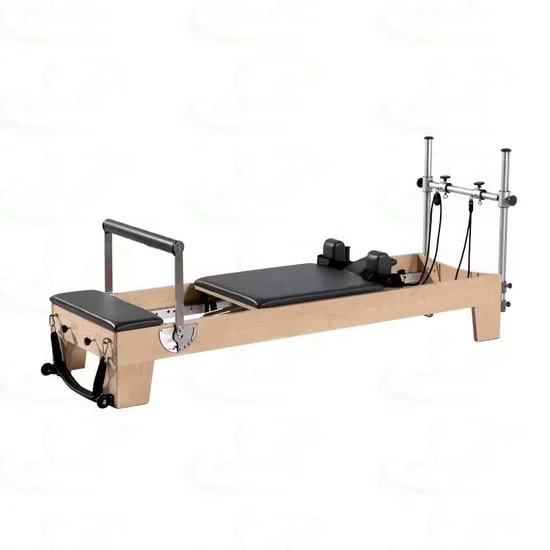
Acoustic Dampening by Design — Solid oak wood frame construction absorbs vibration at the source, preventing resonance transmission through shared floors in multi-story studio and residential deployments.
Technical Specifications
| Parameter | Value |
|---|---|
| Product Type | Pilates Reformer |
| Model NO. | SRY-20B |
| Material | Oak Wood |
| Product Dimensions | 2400600350mm |
| Net Weight | 100kgs |
| Foldable | Yes |
| Resistance Type | Commercial-grade spring system |
| Accessory Options | Long Box / Jump Board / Platform |
| Color | Solid Color |
| Logo | Customized Is Allowed |
| Age Group | Adult |
| Gender | Unisex |
| Warranty | 3 Years |
| Production Capacity | 80 Pieces/Month |
Application Suitability
| Deployment Scenario | Typical Use |
|---|---|
| Boutique Pilates studio in shared commercial buildings | High-frequency group and private sessions requiring quiet operation |
| High-end residential home gym | Daily personal training where noise transmission to adjacent rooms is unacceptable |
| Rehabilitation clinic | Durable equipment for repeated patient sessions with controlled spring resistance |
| Corporate wellness center | Employee fitness programming in office-adjacent spaces with acoustic constraints |
Why Vibration Travels Through Floors Before Anyone Notices the Reformer
Solid wood construction interrupts the vibration path that metal frames transmit directly into structural flooring.
I spent years debugging data pipelines for cardio networks, but the complaints that actually shut down equipment deployments are acoustic. A boutique studio on the second floor of a mixed-use building installed metal-frame reformers and started receiving noise complaints from the accounting firm below within the first week [NEED_CITE: vibration transmission through floor assemblies in commercial buildings]. The problem was not the reformer itself — it was the resonance path. Metal frames conduct carriage movement vibration directly into floor joists, turning the entire ceiling below into a sounding board. Solid oak wood absorbs and dissipates that energy internally before it reaches the structural connection point. When facility operators plan a commercial foldable pilates reformer oak wood deployment above occupied spaces, the frame material is the first variable to evaluate.
Where This Reformer Fits in a Studio Equipment Layout
The SRY-20B covers the full classical and contemporary Pilates repertoire at low-to-moderate intensity, positioning it as the primary apparatus in dedicated reformer studios and a complementary piece in mixed-method fitness floors. In a boutique studio configuration, it pairs with mat zones and small apparatus stations, occupying the center of the room as the anchor equipment. The foldable mechanism allows instructors to reconfigure floor space between private sessions and group classes without moving equipment off-site. The spring resistance system accommodates users across a wide strength range, from rehabilitation patients progressing through early-stage recovery to advanced practitioners performing high-tension carriage work. This commercial foldable pilates reformer oak wood unit integrates into spaces where equipment must serve multiple programming formats throughout a single operating day.
Continuous Session Scheduling and Room-Level Environment Requirements
A studio running back-to-back sessions from early morning through evening places sustained demand on carriage rails, spring anchors, and rope pathways. The oak wood frame maintains dimensional stability across these cycles, but the deployment environment still matters [NEED_CITE: wood dimensional stability under humidity fluctuation in fitness environments]. Rooms with significant humidity swings — common in basement studios or spaces adjacent to pools — require climate control to prevent wood expansion that could affect carriage glide. Floor leveling is critical: an uneven base introduces lateral load on the folding mechanism and accelerates rail wear. Studios installing multiple units should maintain consistent spacing to allow full carriage travel and instructor access on both sides. Facilities planning wall-side placement need to account for the folded storage depth and ensure adequate clearance for the fold-down sequence without striking adjacent mirrors or equipment.
Spring Resistance Calibration and Frame Material Behavior
The spring resistance system on this unit is calibrated for smooth tension progression rather than sudden load jumps, which matters for both rehabilitation protocols and advanced programming where controlled eccentric loading is required. Spring-based resistance differs fundamentally from hydraulic or pneumatic systems: it provides progressive load that increases with carriage displacement, matching the natural strength curve of most compound movements. The oak wood frame interacts with this resistance system differently than steel — wood has internal damping properties that absorb micro-vibrations at the anchor points, resulting in a perceptibly smoother carriage feel during direction changes. The long box, jump board, and platform accessories attach to designated mounting points on the frame, each expanding the exercise repertoire without requiring separate equipment footprints [NEED_CITE: EN 957 requirements for structural integrity of commercial Pilates apparatus]. The 100kgs net weight reflects the mass of solid oak construction, which also contributes to the unit’s stability during dynamic movements like jump board work where repetitive impact forces transfer through the frame.
What Happens When Frame Material Is the Wrong Choice for the Room
Metal-frame reformers deployed above occupied spaces generate a predictable pattern: installation, followed by complaints within weeks, followed by rubber matting solutions that address symptom rather than source. The matting dampens airborne noise but does nothing for structure-borne vibration traveling through floor connections [NEED_CITE: structure-borne vibration isolation methods for fitness equipment]. Studios that select equipment based on price per unit without mapping the acoustic environment frequently end up replacing the entire fleet or relocating to ground-floor spaces. In rehabilitation settings, frame vibration during spring-loaded exercises can interfere with patient comfort and clinical assessment. Corporate wellness rooms adjacent to conference spaces face similar constraints — equipment noise during lunch-hour sessions bleeds into meetings on the other side of the partition.
Why This Product Line Addresses the Deployment Gap
The solid oak wood frame was selected specifically for its acoustic dampening behavior in shared-building deployments, verified across hotel fitness floors and residential installations. The foldable mechanism provides meaningful space recovery for studios that need to reconfigure between programming formats, addressing the layout flexibility that fixed-frame equipment cannot offer. The 10,000-hour durability testing protocol applied across our commercial range extends to the spring anchors, carriage rails, and folding hardware on this reformer. The accessory ecosystem — long box, jump board, platform — allows facilities to standardize on a single apparatus platform rather than sourcing specialty pieces separately. The 3-year warranty covers the structural frame, folding mechanism, and spring system, reflecting confidence in component longevity under commercial scheduling. Free 3D studio layout planning accounts for unit spacing, mirror sightlines, and instructor circulation paths specific to this reformer’s dimensions and foldable clearance requirements.
Documentation & Test Records
- CE declaration of conformity for commercial Pilates equipment
- EN 957 test report covering structural load and durability
- ISO 9001 certificate for manufacturing quality management
- Noise level test report verifying acoustic performance of oak frame
- Durability test record for folding mechanism cycle life
- Spring resistance calibration and tension range specification sheet
Installation, Commissioning & Maintenance
- Confirm floor leveling before assembly to prevent lateral stress on the oak frame and folding mechanism
- Maintain minimum clearance on all sides for full carriage travel and instructor access during sessions
- Inspect spring anchor points and rope pathways monthly for wear under high-frequency studio scheduling
- Apply wood-safe finish conditioner quarterly to protect oak surfaces from sweat and humidity exposure
- Verify folding mechanism latch engagement after each fold-unfold cycle in shared studio environments
- Store accessories on designated mounts to prevent frame contact damage during reconfiguration
Planning Your Studio Equipment Specification
Provide your studio floor plan and session schedule so we can generate a 3D layout accounting for reformer spacing, fold-down clearance, and instructor circulation paths. Specify whether the deployment floor is above occupied space to confirm acoustic requirements and determine whether additional isolation measures are needed. Indicate the target market and climate zone so we can advise on wood finish selection and humidity management protocols. Confirm whether the reformer will serve group classes, private sessions, or both, as this affects accessory selection and spring tension range configuration.
Frequently Asked Questions
Q: How does solid wood construction reduce noise compared to metal frames?
A: Solid oak wood has internal damping properties that absorb vibration energy from carriage movement before it transfers into the floor structure. Metal frames conduct this vibration directly through rigid connections, turning floor joists and ceiling assemblies below into resonance surfaces. The wood frame dissipates energy internally, noticeably reducing structure-borne noise transmission in multi-story buildings without requiring supplemental isolation matting.
Q: What is the space savings with the foldable mechanism?
A: The foldable design allows the reformer to reduce its floor footprint noticeably when stored, enabling studios to reconfigure space between private sessions and group classes. The exact clearance required for the fold-down sequence depends on ceiling height and adjacent equipment placement. Our 3D layout planning accounts for these clearances so studios can maximize usable floor area without compromising safe operation.
Q: How is spring resistance calibrated for commercial durability?
A: The spring system is calibrated for smooth progressive tension without sudden load jumps, matching natural strength curves during compound movements. Commercial-grade springs are selected for consistent tension retention across repeated loading cycles typical in high-frequency studio scheduling. Each unit ships with spring tension range documentation so instructors can match resistance settings to individual client programming requirements.
Q: What accessories are included and how do they attach?
A: The long box, jump board, and platform are available as accessories that mount to designated attachment points on the oak frame. Each accessory uses secure mechanical fastening designed for repeated attachment and removal during session transitions. This allows studios to expand exercise variety without purchasing separate specialty apparatus or consuming additional floor space.
Q: What maintenance is required for wood finish in high-humidity environments?
A: Oak wood requires periodic conditioning with wood-safe finishes to maintain surface protection against sweat exposure and ambient humidity fluctuation. Studios in basement locations or spaces adjacent to pools should maintain climate control to limit dimensional movement in the wood frame. Quarterly inspection of finish condition and reapplication as needed preserves both appearance and structural stability over the equipment service life.

![Foldable Core Training Wood Pilates Reformer for Commercial Studio Use [WARN] draft identifier mismatch](https://bicksport.com/wp-content/uploads/2026/08/foldable-core-training-wood-pilates-reformer-for-commercial-studio-use-warn-draft-identifier-mismatch-8538e8.webp)
