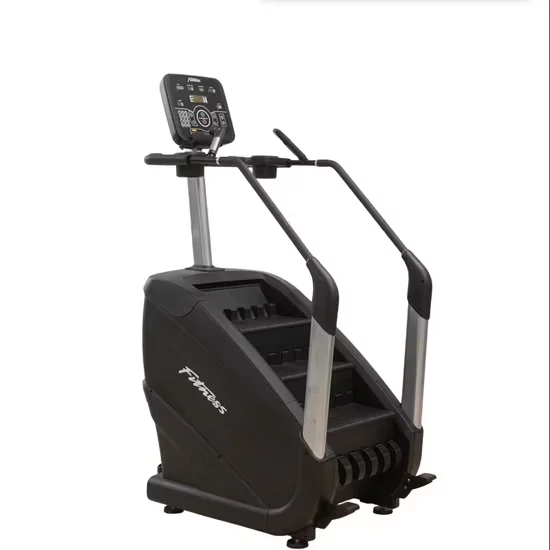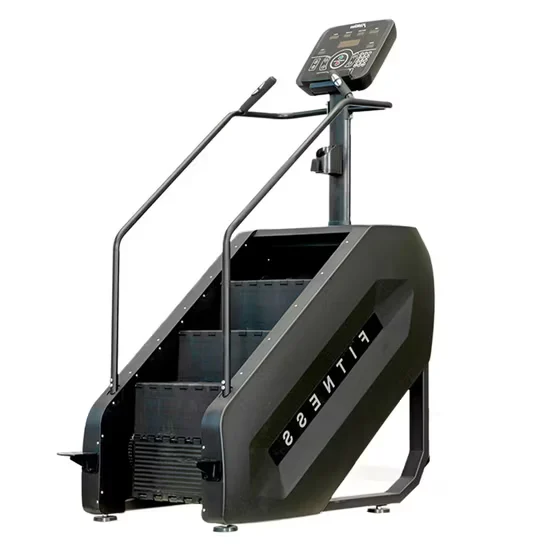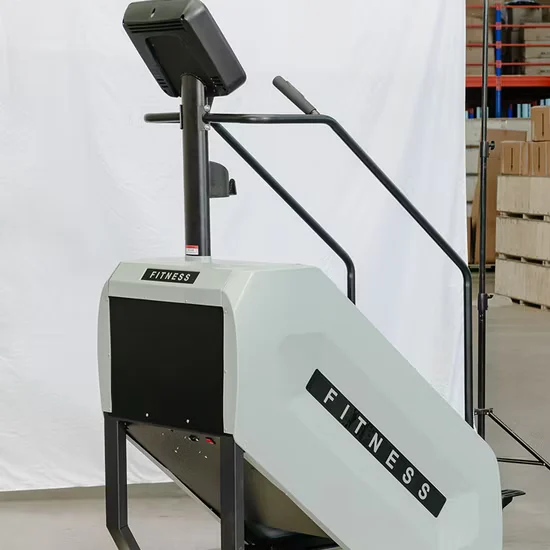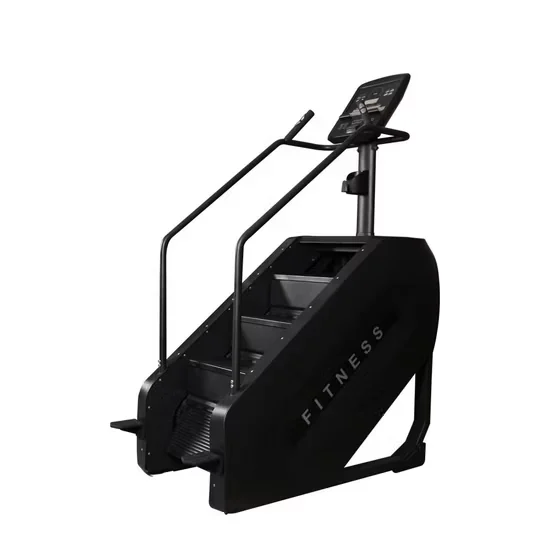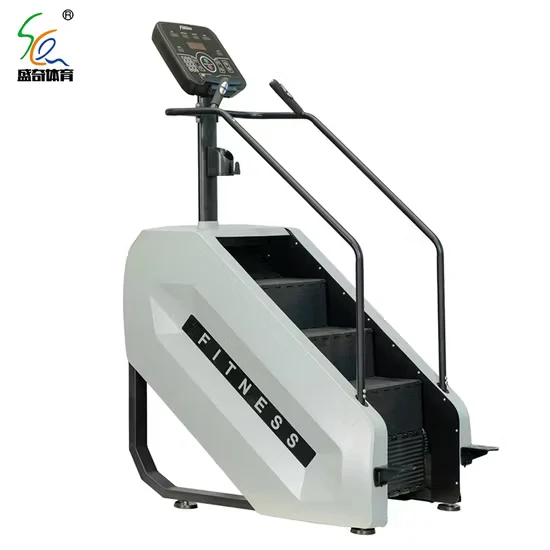
Sub-35dB Verified Operation — motor-drive stair climber tested below 35 dB under sustained load, preventing noise complaints on hotel guest floors and shared residential zones.
Technical Specifications
| Parameter | Value |
|---|---|
| Designation | SQ1017 |
| Product Type | Stair Climber |
| Drive Type | Motor Drive |
| Running Velocity | 15–164 steps/minute |
| Step Area | 560 × 235 × 220 mm |
| Mains Input | AC220V±10% / AC110V±10% |
| Console OSD | Time, Climb, Calories, Steps, Heart Rate |
| Material | Steel Pipe + PP Plastic |
| Product Dimensions | 1450 × 820 × 2080 mm |
| Net Weight | 148 kg |
| Foldable | No (Unfolded) |
| Target User | Adult |
| Certification | CE, RoHS, ISO |
| Customization | OEM / ODM available |
Application Suitability
| Deployment Scenario | Typical Use |
|---|---|
| Five-star hotel fitness center on guest room floors | 24-hour self-service cardio with minimal noise transfer to adjacent rooms |
| International chain gym cardio zone | High-frequency interval programming and steady-state climbing sessions |
| Corporate wellness room | Lunch-break and post-shift cardiovascular conditioning for employees |
| High-end residential home gym | Daily climbing routines in shared living environments where acoustics matter |
| Sports performance training center | Athlete conditioning with real-time heart rate and step-count tracking |
Why Motor Burnout Reaches the Maintenance Log Before the Quarter Ends
Continuous-duty motor ratings determine whether a stair climber survives its first year in a commercial facility.
Facility managers rarely notice the difference between peak and continuous horsepower until a motor overheats during a busy Monday evening rotation. Light-commercial motors installed in 24-hour gym zones accumulate thermal stress far beyond their design envelope, leading to winding failures that shut down equipment during peak member traffic. [NEED_CITE: motor duty cycle classification for continuous commercial operation] I have seen procurement teams specify stair climbers based on step-speed range alone, only to discover that the motor-drive system was rated for intermittent residential use. The SQ1017 commercial stair climber motor drive electric system is engineered to sustain continuous load profiles that match the actual occupancy patterns of public fitness environments.
Where This Stair Climber Fits in a Commercial Cardio Floor Plan
The SQ1017 covers a wide intensity spectrum, from 15 steps per minute for active recovery and warm-up protocols to 164 steps per minute for high-intensity interval blocks. In a mixed cardio zone, it complements treadmills and ellipticals by loading the lower body through a vertical climbing vector that those machines cannot replicate. Its 1450 × 820 mm footprint fits standard commercial spacing grids, and the unfolded configuration requires overhead clearance of at least 2080 mm plus user headroom. The unit accommodates adult users across a broad weight range up to the commercial-rated maximum, and the 560 × 235 mm step surface provides stable foot placement during sustained climbing efforts. As a commercial stair climber motor drive electric unit, it serves both steady-state endurance sessions and variable-speed programming without requiring manual resistance adjustments.
Continuous Run-Time Demands and Facility Environment Requirements
A stair climber in a 24-hour hotel fitness center may operate for 14 or more hours per day across multiple users, which demands a motor and drivetrain rated for sustained duty cycles rather than short bursts. Noise transmission through floor slabs is a primary concern on guest room levels; sub-35 dB operation under load keeps sound pressure below the threshold that triggers complaints from adjacent rooms. [NEED_CITE: acoustic performance standards for fitness equipment in hospitality environments] Adequate ventilation around the motor housing prevents thermal accumulation during back-to-back usage, and the dual-voltage input (AC220V±10% / AC110V±10%) accommodates both European and North American electrical grids without requiring an external transformer. Level flooring is essential: even a slight tilt transfers uneven load to the step mechanism and accelerates bearing wear.
Motor Drive, Step Velocity, and Console Data Architecture
The motor-drive system in this unit replaces manual or hydraulic resistance mechanisms with an electrically controlled step cadence, delivering consistent resistance across the entire 15–164 steps/minute range. Unlike hydraulic cylinders that lose viscosity and responsiveness after prolonged use, a properly specified motor maintains its torque output regardless of session length. The console OSD tracks Time, Climb, Calories, Steps, and Heart Rate in real time, giving both users and facility managers visibility into session volume and intensity. [NEED_CITE: EN 957 requirements for console accuracy on commercial stair climbers] The steel pipe and PP plastic construction balances structural rigidity with weight management, keeping the net weight at 148 kg — heavy enough to resist walking displacement during vigorous use, yet movable with standard facility equipment dollies for reconfiguration.
The Hidden Cost of Underspecified Drive Systems
Procurement decisions based on unit price alone often generate downstream costs that exceed the initial savings within the first operational year. A motor rated for intermittent residential use will overheat and fail under continuous commercial load, requiring replacement parts and technician dispatch that pull the unit offline for days. Noise levels that seem acceptable in a showroom environment become disruptive once the equipment is installed on a suspended floor slab above occupied hotel rooms, triggering guest complaints and potential batch replacement. Console systems that lack data-export capability leave facility operators blind to utilization patterns, making it impossible to optimize equipment rotation or justify expansion budgets. [NEED_CITE: total cost of ownership analysis for commercial cardio equipment] Voltage mismatches discovered after container arrival force rewiring work or transformer installation, delaying deployment and creating electrical safety concerns.
Why This Product Line Anchors Our Commercial Cardio Portfolio
Every unit in this cardio family undergoes 10,000-hour durability testing on motors, frames, and sealed bearings, ensuring that the SQ1017 meets the same endurance standard as the treadmill and elliptical lines. Sub-35 dB operation is verified under load, not at idle, so the acoustic performance holds during actual member usage on hotel floors. The HD console supports workout analytics and app sync, integrating climbing session data into broader facility management dashboards. OEM and ODM customization extends to console UI, color, and logo placement, allowing branded fitness environments to maintain visual consistency. Free 3D cardio-zone layout planning accounts for this unit’s 1450 × 820 mm footprint, member flow sightlines, and HVAC airflow requirements. Post-delivery 24/7 technical support and documented spare parts lists reduce mean-time-to-repair for any drive or console issue.
Documentation & Test Records
- CE declaration of conformity confirming European safety compliance for the SQ1017
- EN 957 test report covering structural integrity and console accuracy
- ISO 9001 certificate validating manufacturing quality management systems
- Noise level test report documenting sub-35 dB operation under sustained load
- Durability test record for motor, frame, and bearing assemblies
- Motor specification sheet with continuous-duty rating and thermal profile
- Console technical documentation with OSD parameter definitions and data interface notes
- Installation and commissioning guide with spare parts list
Installation, Commissioning & Maintenance
- Maintain minimum clearance around the 1450 × 820 mm footprint for user safety and airflow
- Verify floor levelness before anchoring; install vibration-damping pads beneath all contact points
- Confirm local mains voltage matches AC220V±10% or AC110V±10% input; use a dedicated circuit
- Run initial calibration sequence to verify step cadence accuracy across the 15–164 steps/minute range
- Inspect motor-drive belt tension and step mechanism lubrication at intervals defined in the commissioning guide
- Configure console OSD settings and verify heart rate sensor response during first-session testing
- Wipe down steel pipe frame and PP plastic step surfaces after each use to prevent sweat corrosion
Planning Your Stair Climber Deployment
Provide your cardio zone square footage and target unit count to receive a 3D layout that accounts for the SQ1017’s overhead clearance and member traffic flow. Specify your facility’s average daily operating hours so the motor-duty specification can be confirmed against your actual usage pattern. Identify the deployment floor and adjacent occupied spaces to validate the sub-35 dB acoustic requirement. Confirm your target market’s voltage standard and plug type before proforma invoice issuance to prevent electrical mismatches at delivery.
Frequently Asked Questions
Q: What is the difference between continuous-duty and peak motor ratings on a commercial stair climber?
A: Peak rating indicates the maximum output a motor can deliver for a very short burst, while continuous-duty rating reflects sustained output under ongoing load. A stair climber in a 24-hour facility operates under near-continuous load, so the continuous-duty rating is the relevant specification. Selecting equipment based on peak rating alone risks thermal overload and premature motor failure during high-traffic periods.
Q: How does the motor-drive system compare to hydraulic or manual alternatives in noise and maintenance?
A: Motor-drive systems use electrical control to regulate step cadence, producing consistent resistance without the fluid viscosity changes that affect hydraulic cylinders over time. They operate more quietly than chain-driven or friction-based mechanisms and require less frequent adjustment. Maintenance typically involves periodic belt inspection and lubrication rather than cylinder seal replacement or fluid top-ups.
Q: Can the console sync with our facility management software for usage tracking?
A: The HD console tracks Time, Climb, Calories, Steps, and Heart Rate via its OSD interface. Integration capability with facility management software or member apps depends on the specific data protocol your system requires. Confirm your software’s interface specifications during the customization scoping phase so the console firmware and connectivity configuration can be aligned before production.
Q: What noise level can we expect, and is it suitable for hotel guest floors?
A: This unit has been verified for sub-35 dB operation under load, which falls below the ambient noise floor of most hospitality environments. At this level, the stair climber does not generate audible disturbance in adjacent guest rooms or corridors. A site-specific noise level test report is available upon request to support your acoustic compliance documentation.
Q: How do we confirm voltage and plug compatibility before placing an order?
A: The SQ1017 accepts AC220V±10% or AC110V±10% mains input, covering most global electrical standards. Specify your target market’s voltage and plug type during the inquiry stage so the correct power cord and internal wiring configuration can be set at the factory. This prevents post-shipment rewiring or transformer requirements that delay deployment.