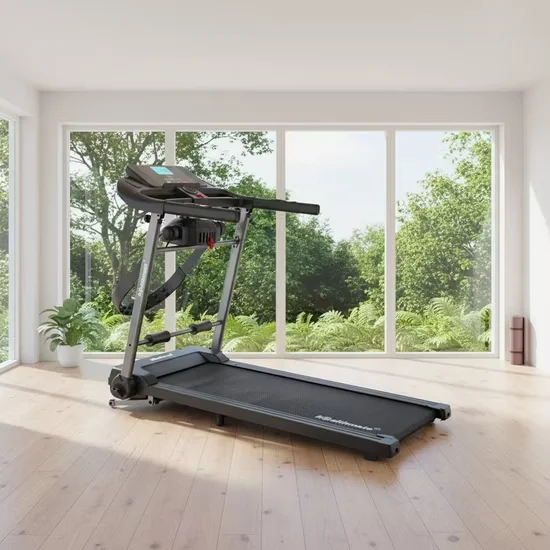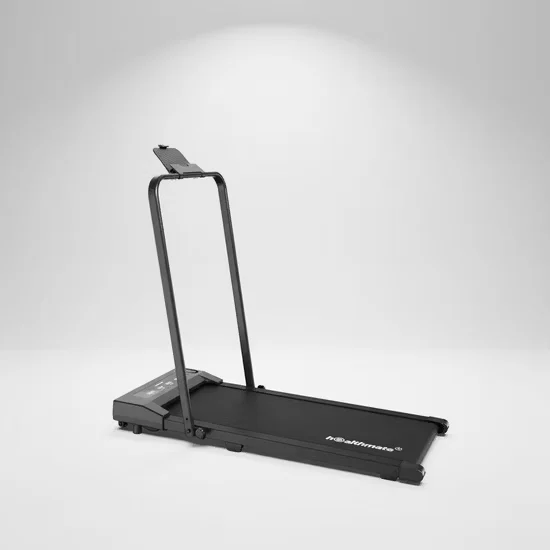
Quiet Drive Integration — DC motorized operation paired with a foldable frame keeps acoustic output manageable for shared residential floors and compact wellness rooms.
Technical Specifications
| Parameter | Value |
|---|---|
| Designation | W04D8H |
| Product Type | Foldable Treadmill |
| Motor Type | DC Motorized Drive |
| Speed Range | 1–12 km/h |
| Running Surface | 1000 × 400 mm |
| Programs | 6 Preset Programs |
| Console Type | LED Screen (Speed / Distance / Time / Calories) |
| Foldable | Yes |
| Product Dimensions | 1250 × 590 × 1080 mm |
| Net Weight | 100–160 kg |
| Maximum User Weight | Not specified |
| Certification | CE, RoHS |
| Color Options | Multicolor / Customized |
| Customization | Available (logo, packaging) |
| Production Capacity | 3000 units/month |
Application Suitability
| Deployment Scenario | Typical Use |
|---|---|
| High-end residential home gym | Daily walking and light jogging routines in constrained private spaces |
| Corporate wellness room | Low-impact cardio sessions for employees during breaks in limited floor areas |
| Boutique apartment fitness corner | Compact walking station for tenants where storage space is at a premium |
| Small-footprint hotel fitness alcove | Secondary cardio option for guest floors where full-size treadmills cannot fit |
Why Home-Grade Treadmills Burn Out When Pushed Beyond Walking Pace
Matching motor duty rating to actual session length prevents premature thermal failure.
A compact foldable motorized treadmill home use compact unit sitting in a corporate wellness room might see six back-to-back users before lunch. If the DC motor is rated only for intermittent duty, the windings overheat and the thermal cutoff trips — or worse, it fails silently over weeks [NEED_CITE: motor duty cycle classification for continuous commercial operation]. I have seen this exact pattern in Latin American boutique gym deployments: the equipment looked right on paper, but the motor spec sheet was never cross-checked against the facility’s daily throughput. The units lasted three months before the first batch of warranty claims came in.
Where This Foldable Treadmill Fits in a Mixed Cardio Zone
This unit covers walking through light jogging within the 1–12 km/h range, occupying the low-to-moderate intensity band that complements higher-output treadmills and ellipticals in a shared cardio floor. The 1000 × 400 mm running surface suits users focused on steady-state walking or recovery sessions rather than sprint intervals. Its foldable frame allows placement against walls or in corridors when not in active use, making it practical for facilities where every square meter of floor space carries a cost. The six preset programs give users structured variety without requiring manual speed adjustments mid-session.
Continuous Run-Time and Room-Level Deployment Constraints
A DC motor in this class is engineered for intermittent home-use duty cycles, meaning deployment in a shared residential or corporate environment requires scheduling rest intervals between users to prevent thermal buildup. Noise transmission through floor slabs is a real concern on upper residential levels — confirming acoustic performance before committing to a multi-unit rollout avoids complaints from neighbors below [NEED_CITE: acoustic transmission standards for cardio equipment on elevated floor slabs]. The unit requires a stable, level surface with adequate clearance on all sides for ventilation and safe mounting. Voltage and plug compatibility must be confirmed against the target market’s electrical standards before the shipment leaves the factory, because discovering a mismatch on arrival means the entire batch sits idle until adapters or rewiring are arranged.
Reading the Motor and Drive Specifications Correctly
The DC motorized drive in this foldable motorized treadmill home use compact unit is typical for home and light-commercial segments, where cost efficiency and compact packaging take priority over continuous heavy-load endurance. DC motors deliver smooth speed transitions at lower speeds, which suits the 1–12 km/h walking and light jogging envelope. The critical distinction buyers must verify is whether the rated power reflects continuous output or peak output — peak ratings describe short bursts and do not predict how the motor handles a sustained 45-minute session [NEED_CITE: continuous versus peak horsepower rating methodology for treadmill motors]. The 1000 × 400 mm belt area provides adequate footing for walking gaits but limits stride length for taller users at higher speeds. The LED console displays speed, distance, time, and calories — a straightforward readout without wireless data export, which means workout records stay on the machine unless manually logged. For facilities that track member usage through a central management system, this data gap needs to be addressed through separate logging protocols.
What Spec Compromise Costs After Deployment
Specifying a treadmill without verifying the motor’s continuous duty rating against the facility’s expected daily usage leads to a predictable failure arc: units that handle two users a day at home cannot survive twenty users a day in a shared wellness room. Noise complaints in multi-story residential buildings often surface within the first week, and by then the procurement decision is already locked in. When the LED console cannot push usage data to a facility management platform, operators lose visibility into which machines are actually being used, making it impossible to justify future equipment investments with real throughput numbers [NEED_CITE: IoT data integration requirements for commercial cardio fleet management]. Voltage mismatches discovered after container arrival turn a deployment project into a logistics recovery exercise.
Why This Product Line Earns Its Place in the Specification
Sub-35 dB whisper-quiet operation verified across the broader commercial cardio range sets the acoustic benchmark this foldable model is measured against. Components across the lineup undergo 10,000-hour durability testing, giving buyers a reference point when evaluating motor and bearing longevity. The six-series cardio family means this treadmill can be specified alongside ellipticals, bikes, and rowers from one production line, simplifying procurement and spare parts logistics. OEM customization covers logo and packaging, with console UI adaptation available across the range. Free 3D cardio-zone layout and airflow planning accounts for this unit’s folded and unfolded footprint, ensuring adequate spacing for safe mounting and dismounting in tight rooms. Technical support runs 24/7 for commissioning and post-installation troubleshooting.
Documentation & Test Records
- CE declaration of conformity covering electrical safety and EMC requirements
- RoHS compliance certificate confirming restricted substance limits
- Motor specification sheet detailing continuous and peak power ratings
- Noise level test report for shared residential deployment verification
- Console technical documentation with LED display parameter definitions
- Installation and commissioning guide with spare parts list
Installation, Commissioning & Maintenance
- Confirm unfolded footprint of 1250 × 590 mm plus safety clearance on all sides
- Level the floor surface and place vibration-damping pads beneath the frame
- Verify voltage and plug type match local supply before connecting the DC motor
- Run initial belt alignment and tension check at low speed before user access
- Schedule belt lubrication and foldable hinge inspection at defined intervals
- Wipe LED console and hand contact surfaces daily to prevent sweat corrosion
Planning Your Cardio Equipment Inquiry
Provide the room dimensions and intended unit count so a 3D layout with airflow assessment can be generated before quotation. Specify the expected daily usage hours per unit to confirm whether the DC motor duty cycle matches your throughput requirements. Identify the deployment floor level and adjacent occupied spaces so acoustic expectations can be aligned with test data. Confirm the target market voltage standard and whether the LED console’s data output needs to integrate with any existing facility management infrastructure.
Frequently Asked Questions
Q: What is the difference between continuous and peak motor power for treadmills?
A: Peak power describes the maximum output a motor can deliver in short bursts, such as during acceleration or when a heavier user steps on. Continuous power reflects what the motor sustains over an extended session without overheating. For shared environments with back-to-back users, continuous rating is the meaningful figure. Always request the motor specification sheet to confirm which value is listed.
Q: How does deck cushioning affect joint impact during walking versus running?
A: A cushioned deck layer between the belt and the frame absorbs a portion of each footstrike, reducing the force transmitted to knees and ankles. The effect is more noticeable at higher speeds where impact forces are greater. For walking-dominant use, basic cushioning is often sufficient. Confirm the deck composition and layer structure with the manufacturer before specifying for users with joint sensitivity concerns.
Q: Can the LED console data sync with external fitness apps or facility software?
A: The LED console on this unit displays speed, distance, time, and calorie readouts locally without built-in wireless export. If your facility requires automated usage tracking, you will need a separate logging protocol or an upgraded console option with connectivity. Confirm data interface requirements during the specification stage to avoid deploying units that create blind spots in your usage reporting.
Q: What maintenance is required for a foldable treadmill motor and belt system?
A: Regular maintenance includes checking belt tension and alignment, lubricating the belt-deck interface at recommended intervals, and inspecting the foldable hinge mechanism for wear. The DC motor requires adequate ventilation and should be kept free of dust accumulation. Request the manufacturer’s maintenance schedule and spare parts list so your service team can plan inspections around actual usage frequency.
Q: How to assess noise transmission risk when deploying treadmills on upper residential floors?
A: Request the noise level test report to understand the unit’s acoustic output under load. Consider the floor slab construction and whether vibration-damping pads are included in the installation plan. Units deployed above occupied rooms should be tested at the speeds most likely to be used. Scheduling usage hours and confirming acoustic thresholds with building management prevents complaints after residents move in.

![Mt296 Electric Treadmill ABS Quiet Bedroom Workout Fitness Equipment [WARN] draft identifier mismatch](https://bicksport.com/wp-content/uploads/2026/08/mt296-electric-treadmill-abs-quiet-bedroom-workout-fitness-equipment-warn-draft-identifier-mismatch-5f3e50.webp)
![Mt026m Foldable Electric Treadmill Silent Commercial Gym [WARN] draft identifier mismatch](https://bicksport.com/wp-content/uploads/2026/08/mt026m-foldable-electric-treadmill-silent-commercial-gym-warn-draft-identifier-mismatch-64b057.webp)