Zero Electrical Noise Risk — A fully manual resistance design eliminates motors and control boards, ensuring zero electrical noise and maintenance across continuous high-frequency deployment.
Technical Specifications
| Parameter | Value |
|---|---|
| Designation | OS-H5078 |
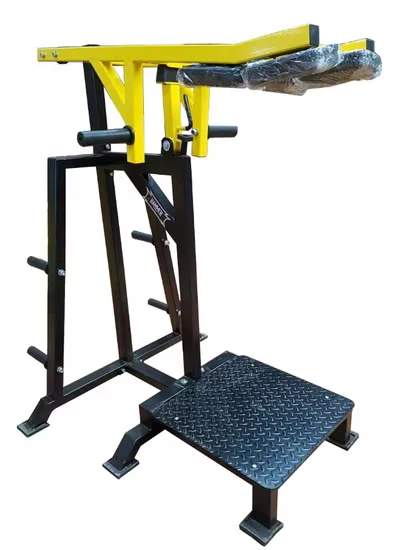
| Product Type | Stand Calf Raise |
| Power Source | Manual |
| Exercise Part | Calf |
| Material | Steel |
| Specification | 1390×1260×1700mm |
| Net Weight | 116kg |
| Main Frame Color | Available per customer requirements |
| Cushion Color | Available per customer requirements |
| Foldable | Unfolded |
| Certification | ISO9001, CE |
| OEM/ODM | Acceptable |
| Age Group | Adult |
| Gender | Unisex |
| HS Code | 950691190 |
Application Suitability
| Deployment Scenario | Typical Use |
|---|---|
| Chain gym strength zone | Dedicated calf isolation station in free-weight and plate-loaded areas |
| Corporate wellness room | Compact lower-body strength training for employee fitness programs |
| Community fitness center | Multi-user calf training in high-traffic shared facility environments |
| Sports performance training center | Lower-limb power development for athletes requiring precise load control |
| Professional gym and club | Stand-alone calf raise unit integrated into full-body resistance circuits |
Why Manual Resistance Eliminates the Motor Failures That Shut Down Strength Zones
No motor means no burnout, no electrical fault, and no unplanned downtime in continuous commercial operation.
Every facility manager who runs plate-loaded strength floors has dealt with a machine pulled from service mid-week because a motor overheated or a control board shorted. In high-traffic gym environments where equipment runs from early morning to late night, electrical components carry the highest failure rate across any strength station. The commercial stand calf raise machine OS-H5078 sidesteps this entirely. By relying on a manual resistance architecture, it removes every electronic failure point from the equation [NEED_CITE: mechanical failure rates in plate-loaded versus motorized commercial strength equipment]. The result is a machine that stays operational through the heaviest usage cycles without requiring electrical maintenance intervention.
Where Stand Calf Raise Fits in a Commercial Strength Layout
The commercial stand calf raise machine OS-H5078 occupies a specific role within a professional strength zone: isolated calf development under full-body standing load. It complements leg press machines, hack squats, and seated calf raise units by targeting the gastrocnemius and soleus through a different range of motion and body position. In a typical gym floor plan, it pairs naturally with free-weight racks and plate-loaded leg machines, forming a cohesive lower-body training cluster. The standing configuration accommodates users across a wide range of heights and body weights, and the 1390×1260mm footprint allows placement against walls or between larger machines without consuming excessive floor area. It supports progressive loading through manual plate addition, giving users direct control over resistance intensity without relying on pin-selected weight stacks.
Continuous Operation Without Electrical Infrastructure
Because the OS-H5078 draws no power, it requires no dedicated circuit, no voltage matching, and no surge protection. This makes deployment straightforward on any floor level, including guest room floors in hotels or upper-level mezzanines in multi-story gym facilities where electrical load distribution is already constrained [NEED_CITE: electrical load planning for commercial fitness equipment across multiple floors]. The absence of a motor also means zero operational noise from the machine itself — any sound during use comes solely from plate contact and user movement, both of which are managed by proper floor matting and technique. Ventilation and thermal management are irrelevant to this unit, simplifying HVAC planning for enclosed strength rooms. The unfolded, fully assembled steel frame ships ready for immediate placement, requiring only ground leveling verification and anti-vibration pad installation before member use.
Manual Drive Architecture and Steel Frame Stability
The manual power source eliminates the entire electrical chain — no motor, no drive belt, no control PCB, no wiring harness. Resistance is applied directly through plate loading, which provides a linear and predictable load curve that does not degrade over time the way electronic resistance systems can. The full steel frame at 116kg net weight anchors the platform firmly during loaded standing calf raises, minimizing frame resonance and lateral sway that lighter constructions produce under heavy axial loads. This mass-to-load ratio is critical: when a user loads substantial weight onto the shoulder pads, the frame must resist deflection to maintain a stable movement path [NEED_CITE: frame rigidity requirements for axial-loaded standing strength equipment]. The unfolded configuration means the frame arrives as a single welded assembly, avoiding the bolt-joint loosening that field-assembled units experience after repeated load cycles. Steel material selection also ensures compatibility with standard gym environment cleaning agents without surface degradation.
The Hidden Cost of Specifying Motorized Machines Where Manual Suffices
Facility operators sometimes default to motorized resistance stations out of habit, assuming electronic adjustment equates to higher quality. In strength isolation exercises like calf raises, this assumption creates unnecessary complexity. Motors in plate-loaded exercise paths add failure points without improving the resistance delivery — the calf raise movement does not require variable-speed adjustment or programmable resistance curves. What operators end up paying for is additional maintenance: motor replacements, board diagnostics, and electrical troubleshooting that pulls technicians away from genuinely complex cardio units [NEED_CITE: maintenance hour allocation across motorized versus manual strength equipment]. Worse, a motorized calf raise machine that goes offline leaves a gap in the strength circuit that frustrates members who expect consistent equipment availability. Choosing manual architecture where it suits the exercise pattern keeps the maintenance budget focused on machines that genuinely need electrical servicing.
Why This Product Line Addresses Real Deployment Challenges
The sub-35dB whisper-quiet environment verified across hotel cardio deployments extends naturally to the strength floor when manual machines like the OS-H5078 remove motor noise entirely. Every unit in this cardio and strength family undergoes 10,000-hour durability testing on load-bearing components, ensuring the steel frame and welded joints withstand continuous high-frequency use. OEM customization covers frame color and cushion color matching, allowing facility operators to align the unit visually with existing equipment branding. The free 3D cardio and strength zone layout service accounts for this machine’s 1390×1260mm footprint when planning sightlines, member flow, and safe spacing between adjacent stations. Full ISO9001 and CE certification documentation supports procurement compliance across international markets. Technical support operates on a 24/7 response basis, and spare parts availability is maintained through integrated manufacturing across assembly, frame welding, CNC machining, and logistics divisions.
Documentation & Test Records
- CE declaration of conformity covering OS-H5078 structural and safety compliance
- EN 957 test report validating strength equipment load and stability requirements
- ISO 9001 certificate for quality management across manufacturing processes
- Noise level test report confirming zero motor-generated acoustic output
- Durability test record documenting frame and weld performance under cyclic loading
- Installation and commissioning guide with spare parts list for field teams
Installation, Commissioning & Maintenance
- Verify floor leveling across the 1390×1260mm footprint before securing the 116kg steel frame in position
- Place anti-vibration pads beneath all contact points to manage plate-drop impact transmission to subfloors
- Inspect all welded joints and shoulder pad mounting bolts after the first month of heavy use
- Apply standard gym cleaner to steel surfaces and cushion upholstery, avoiding solvent-based products
- Maintain clear safety spacing of at least one meter on all sides for safe plate loading and unloading
- Conduct quarterly structural inspection of the manual loading mechanism and guide rod alignment
How to Specify This Unit for Your Facility
Share your strength zone floor area and current equipment list to receive a 3D layout incorporating the OS-H5078 alongside existing machines with proper spacing and member flow analysis. Specify your target market so voltage documentation requirements can be clarified — though this manual unit requires no electrical connection, accompanying cardio equipment in the same zone will. Confirm deployment floor level and adjacent occupied spaces to verify that plate-drop noise management through floor matting meets your acoustic requirements. Indicate whether OEM frame and cushion color matching is needed to align with your facility’s existing visual standard, and state your expected daily member throughput to confirm load cycle durability alignment.
Frequently Asked Questions
Q: How does manual resistance equipment differ from plate-loaded machines in maintenance requirements?
A: Manual resistance units like the OS-H5078 share the plate-loading principle but feature a guided movement path specific to calf raises. Maintenance focuses on mechanical components: guide rod lubrication, bolt torque verification, and weld inspection. There are no motors, wiring harnesses, or control boards to diagnose or replace, which reduces preventive maintenance time and eliminates electrical spare parts inventory for this station entirely.
Q: How is frame load capacity validated for standing calf raise machines?
A: Frame validation involves static load testing at multiples of expected maximum user weight plus applied resistance, cyclic fatigue testing across thousands of repetitions, and weld joint inspection under stress. The 116kg steel frame of the OS-H5078 provides substantial mass to resist deflection during loaded standing exercises. Operators should confirm the maximum user weight rating and maximum plate load with the manufacturer before specifying for heavy-use athletic populations.
Q: What are the OEM customization options and minimum order requirements for frame and cushion color?
A: The OS-H5078 accepts OEM customization for main frame color and cushion color to match facility branding and visual standards. Minimum order quantities and production lead times vary based on color specification complexity and order volume. Operators should submit RAL or Pantone color references during the quotation stage to receive accurate MOQ and timeline confirmations before proforma invoice issuance.
Q: How should floor loading and vibration management be planned for heavy plate-loaded strength equipment?
A: Standing calf raise machines concentrate substantial axial load through a relatively small footprint. Facilities on upper floors should verify structural load capacity with a building engineer. Anti-vibration rubber mats beneath the unit manage impact transmission from plate contact and user movement. Placing the machine away from shared walls with quiet zones and using dedicated flooring in the strength area reduces vibration transfer to adjacent spaces.
![ISO-Lateral Chest Back Hammer Strength Professional Gym Equipment [WARN] draft identifier mismatch](https://bicksport.com/wp-content/uploads/2026/08/iso-lateral-chest-back-hammer-strength-professional-gym-equipment-warn-draft-identifier-mismatch-211df6.webp)

![2019 Hammer Strength ISO-Lateral Wide Chest 19 Commercial Gym Equipment [WARN] draft identifier mismatch](https://bicksport.com/wp-content/uploads/2026/08/2019-hammer-strength-iso-lateral-wide-chest-19-commercial-gym-equipment-warn-draft-identifier-mismatch-c85a21.webp)