
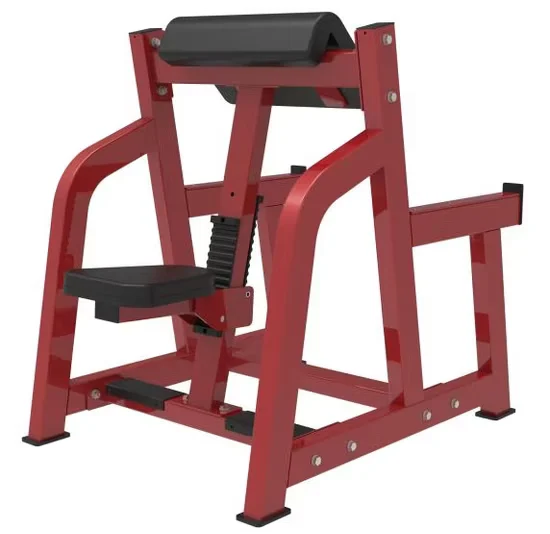
Continuous Duty Verified — Load-bearing components on the H5046 undergo 10,000-hour high-frequency cycle testing before leaving the Shandong production line.
Technical Specifications
| Parameter | Value |
|---|---|
| Designation | H5046 |
| Product Type | Seated Arm Curl |
| Exercise Part | Arm |
| Main Frame Material | Steel |
| Product Dimensions | 1000 × 800 × 1120 mm |
| Net Weight | 75 kg |
| Age Group | Adult |
| Gender | Unisex |
| Type | Integrated Gym Trainer |
| Main Frame Color | Available per customer requirements |
| Cushion Color | Available per customer requirements |
| OEM/ODM | Acceptable |
| Certification | ISO 9001, CE |
| Production Capacity | 1,000 units per month |
Application Suitability
| Deployment Scenario | Typical Use |
|---|---|
| Professional gym and club | High-frequency isolated arm training in dedicated strength zones |
| Community fitness center | Supervised and unsupervised bicep conditioning for diverse adult users |
| Gymnasium training facility | Structured resistance sessions within athletic conditioning programs |
| Hotel fitness center | Compact single-station placement in limited-floor-space environments |
| Corporate wellness room | Low-supervision bicep isolation for employee fitness programming |
Why Stability Complaints Emerge Six Months After Opening Day
The frame either holds its geometry under load or it does not — there is no middle ground once the warranty call comes in.
Commercial seated arm curl machines experience repetitive off-axis torque every time a user curls through full range. In facilities running twelve to fourteen hours daily, that torque accumulates into fatigue stress on welded joints and bearing housings. The machines that develop lateral wobble by month six are typically the ones where frame thickness and gusset placement were value-engineered to hit a target shipping weight rather than a target service interval. I have inspected gym floors where entire rows of curl stations were swapped out before the second year because the pivot bushings wore oval under continuous rotation [NEED_CITE: load cycle fatigue in commercial strength equipment frames]. The H5046 commercial seated arm curl machine addresses this through a reinforced steel frame engineered for the torque profiles specific to isolated arm work, with sealed bearings rated for the oscillating load pattern of curl repetitions rather than linear cycling.
Isolation Work That Fits Between Compound Stations
The H5046 commercial seated arm curl machine serves one purpose: controlled bicep isolation under constant tension throughout the full flexion-extension arc. In a gym layout, it complements compound pulling stations like lat pulldowns and cable rows, giving members a dedicated isolation point after heavy back work. It suits moderate-density deployment — positioned at the end of a row or against a wall where its compact 1000 × 800 mm footprint does not interrupt traffic flow. The seated position accommodates a broad user height range without requiring seat adjustment between sets, and the fixed movement path removes the learning curve that discourages newer members from using free-weight curl stations.
Duty Cycle and Environment for Continuous Placement
Facilities scheduling sixteen-plus hours of daily access need to evaluate whether each strength station can tolerate the member turnover without developing play in the pivot points or cushion compression. The H5046 is built for gymnasium and professional club environments where equipment runs continuously during peak hours with minimal rest between users. Ventilation requirements are straightforward since there is no motor generating heat — placement near HVAC supply ducts is unnecessary, but adequate clearance around the unit prevents moisture accumulation on steel surfaces. Floor leveling is critical: an uneven base introduces lateral torque into the frame joints during heavy sets, accelerating wear at the pivot axis [NEED_CITE: EN 957 stability requirements for plate-loaded and selectorized strength equipment].
Steel Geometry and Bearing Specification Under Repetitive Curl Loading
The 75 kg net weight of the H5046 reflects steel mass distributed through the main frame and base rather than decorative shrouds. In seated curl machines, frame rigidity directly governs the user’s perception of stability — a frame that deflects under load feels loose even when bearings and pivots are within tolerance. The 1000 × 800 × 1120 mm envelope keeps the center of gravity low and the base width proportional to the maximum moment arm a user can generate. Sealed bearings at the pivot point resist contamination from sweat aerosol and chalk dust, which are the primary abrasive agents in open-plate and selectorized strength environments. The cushion and frame color options allow facility operators to match existing equipment lines without requiring a full-floor aesthetic overhaul.
What Value-Engineered Frames Cost After Year One
Gyms that procure curl stations based on per-unit price alone often discover the real cost during the first maintenance sweep. Frames that flex under load develop elongated bolt holes within months, requiring complete fastener replacement rather than simple retightening. Cushions that compress beyond recovery threshold create user complaints about seat comfort, and replacement cushion sets carry lead times that take stations offline for weeks. Pivot bushings that are not sealed against sweat ingress corrode from the inside, producing the grinding noise that sends members to the front desk [NEED_CITE: corrosion failure modes in gym equipment pivot assemblies]. These are not cosmetic issues — they are the mechanical failures that turn a strength zone from a member retention tool into a maintenance liability.
Why This Production Line Exists in Shandong
Every H5046 that leaves the assembly line has its frame welded and its pivot bearings seated within the same 50,000-square-meter facility that produces the cardio range. That vertical integration means the same 10,000-hour durability testing protocol applied to treadmill motors and elliptical drive shafts is applied to the sealed bearings in this curl station. OEM customization extends beyond color — the cushion profile, frame finish, and branding placement are scoped per facility requirement, and the MOQ flexibility means a single deployment order can include mixed colorways across a full strength zone. The 3D layout planning service covers this unit’s footprint and clearance requirements alongside cardio stations, ensuring airflow paths and sightlines are resolved before equipment ships. Technical support operates around the clock, with spare parts documentation shipped alongside the installation guide.
Documentation & Test Records
- CE declaration of conformity covering the H5046 mechanical and structural safety requirements
- EN 957 test report validating load capacity and stability under cyclic arm curl loading
- ISO 9001 certificate from the Shandong manufacturing facility
- Noise level test record confirming sub-threshold acoustic output during loaded repetitions
- Durability test record documenting pivot bearing performance across extended cycle counts
- Spare parts list covering cushions, pivot bushings, and fastener hardware
Installation, Commissioning & Maintenance
- Allow minimum 600 mm clearance on all sides of the H5046 for user entry and maintenance access
- Level the base frame on concrete flooring using adjustable feet before securing anchor bolts
- Inspect pivot bearing seal integrity and retighten all frame fasteners after the first 500 use cycles
- Wipe cushion surfaces and steel contact points daily with pH-neutral cleaner to prevent sweat corrosion
- Re-torque pivot axis fasteners on a quarterly schedule aligned with facility preventive maintenance calendar
- Verify cushion compression depth during each maintenance visit and flag units exceeding recovery threshold
Specifying This Unit for Your Strength Zone
Facility operators planning a strength equipment rollout should provide the zone’s square footage and adjacent equipment list so that a 3D layout can position the H5046 within traffic flow and ventilation requirements. Specifying the expected daily usage hours allows the engineering team to confirm bearing and pivot suitability for the target duty cycle. Where the curl station will deploy on upper floors or adjacent to occupied rooms, acoustic isolation requirements should be confirmed before installation. Buyers in export markets should declare local voltage and plug standards if any electronically monitored variants are being scoped alongside the mechanical units.
Frequently Asked Questions
Q: What materials form the main structure and contact surfaces?
A: The H5046 frame is fabricated from structural steel welded into a fixed geometry that resists the lateral torque generated during loaded arm curls. Cushions are mounted on steel backing plates with replaceable fasteners. Both frame color and cushion color are available per customer specification, allowing the unit to integrate with existing equipment lines without requiring full-floor replacement.
Q: How does OEM customization work for branding and finish?
A: Frame color, cushion color, and logo placement are scoped during the inquiry stage based on the buyer’s facility design requirements. The manufacturing facility supports flexible MOQ for customized runs, meaning a single order can include multiple colorways for different zones. Console and specification adjustments are available where the base model’s engineering parameters permit modification without compromising structural integrity.
Q: What stability performance should a facility expect during heavy use?
A: The 75 kg steel frame provides a fixed base that resists the off-axis torque characteristic of seated curl movements. Stability under load depends on correct floor leveling during installation and periodic fastener retightening on a quarterly cycle. Facilities should verify that the deployment surface is concrete or equivalent rigid substrate to prevent frame deflection during maximum-load repetitions.
Q: What maintenance intervals apply to the pivot and cushion components?
A: Pivot bearings are sealed against sweat and chalk contamination, reducing but not eliminating the need for periodic inspection. Facilities should schedule fastener retightening every 500 cycles initially, then quarterly once wear patterns stabilize. Cushion compression should be measured during each maintenance visit, and units showing permanent deformation beyond recovery threshold should be flagged for cushion replacement to maintain user comfort and posture alignment.
![Commercial Flat Bench Waist Machine for Gym and Club Use [WARN] draft identifier mismatch](https://bicksport.com/wp-content/uploads/2026/08/commercial-flat-bench-waist-machine-for-gym-and-club-use-warn-draft-identifier-mismatch-84a58a.webp)

![Hammer Strength ISO-Lateral Incline Press Gym Fitness Equipment [WARN] draft identifier mismatch](https://bicksport.com/wp-content/uploads/2026/08/hammer-strength-iso-lateral-incline-press-gym-fitness-equipment-warn-draft-identifier-mismatch-f0a380.webp)