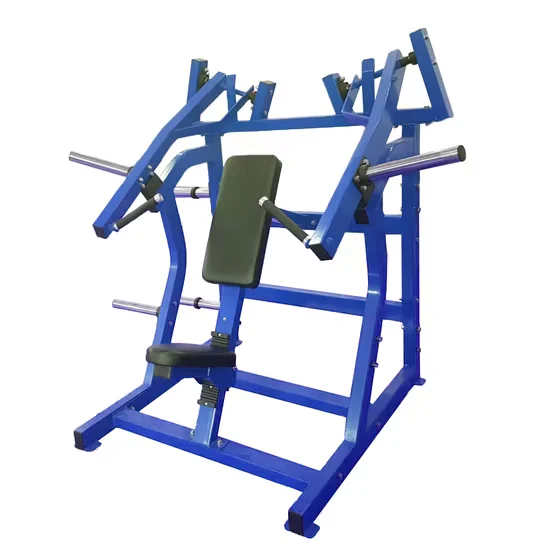
![Hammer Strength ISO-Lateral Incline Press Gym Fitness Equipment [WARN] draft identifier mismatch](https://bicksport.com/wp-content/uploads/2026/08/hammer-strength-iso-lateral-incline-press-gym-fitness-equipment-warn-draft-identifier-mismatch-f0a380.webp)
10,000-Hour Endurance Verified — Steel frame and sealed pivot bearings tested through continuous high-frequency cycling to survive 24/7 facility deployment without premature wear.
Technical Specifications
| Parameter | Value |
|---|---|
| Designation | H5008 |
| Product Type | ISO-Lateral Incline Press |
| Exercise Focus | Chest (Upper and Mid) |
| Frame Material | Commercial-Grade Steel |
| Movement System | ISO-Lateral Independent Arms |
| Max User Weight | 180 kg |
| Product Dimensions | 1500 × 1350 × 1650 mm |
| Net Weight | 137 kg |
| Color | Optional |
| Certification | ISO 9001, CE |
| OEM | Available |
Application Suitability
| Deployment Scenario | Typical Use |
|---|---|
| Chain gym strength floor | High-volume chest training with independent arm loading for diverse membership |
| Hotel fitness center on guest room floors | Compact footprint with quiet pivot operation in space-constrained facilities |
| Corporate wellness room | Mid-day usage patterns with minimal supervision and low maintenance demand |
| High-end residential home gym | Serious lifters requiring commercial durability without residential noise concerns |
| Sports performance training center | Athletes needing independent arm tracking for strength symmetry assessment |
Why Independent Arms Change What Maintenance Has to Replace First
ISO-lateral movement absorbs load imbalances that fixed-bar designs transfer directly into pivot bearings.
When both arms are mechanically linked, a user favoring one side sends asymmetric forces through a single pivot axis. In high-traffic gym environments, that uneven loading accelerates bearing wear and eventually produces lateral play that members feel before technicians notice [NEED_CITE: ISO-lateral bearing load distribution under asymmetric commercial use]. The commercial ISO-lateral incline press chest strength equipment H5008 decouples each arm so load paths remain aligned with their own pivot geometry, distributing stress across sealed bearings rather than concentrating it at one failure point.
Where This Press Fits in a Commercial Strength Floor
The H5008 covers incline pressing angles that flat benches and shoulder machines leave open, targeting the clavicular head of the pectoralis through a converging arc. On a busy strength floor, it pairs with a flat ISO-lateral press and a decline or cable crossover to give members a complete chest training sequence without redundant movement patterns. Its 1500 × 1350 mm footprint allows deployment in standard equipment rows with adequate clearance for loading and spotting. The 180 kg user weight capacity accommodates the full range of commercial gym demographics, and the independent arm system means the machine handles both novice lifters correcting imbalances and advanced users working heavy unilateral loads.
Deployment Conditions That Determine Bearing and Frame Life
Facilities running sixteen or more hours daily place different demands on pivot hardware than those operating eight-hour windows. Sealed bearings in the H5008 are specified for continuous high-frequency cycles, but deployment environment still dictates service intervals [NEED_CITE: sealed bearing service life under varying humidity and load conditions]. Ground-floor installations on concrete slabs with vibration-damping pads isolate the frame from structural resonance, while upper-floor placements require verified floor load ratings for the 137 kg unit weight plus live user load. Ambient temperature and humidity in tropical or coastal deployments accelerate corrosion on any exposed pivot surface, making sealed bearing specification essential. Standard commercial power circuits are sufficient since the H5008 operates without motorized components.
What Steel Gauge and Pivot Geometry Mean for Load Transfer
The commercial-grade steel frame provides the rigidity needed to keep pivot axes parallel under heavy loading — a frame that flexes under load introduces angular deviation that accelerates wear on one side of each bearing. ISO-lateral independent arms require precise alignment between the pivot point and the user’s shoulder joint axis, and the H5008 positions this relationship to track natural pressing mechanics through the incline arc. The 137 kg frame mass reflects steel section sizing adequate for continuous commercial loading rather than light-duty tube profiles [NEED_CITE: frame deflection thresholds for commercial strength equipment under repeated peak loads]. Convergence at the top of the movement follows a fixed arc determined by the pivot geometry, meaning resistance feel remains consistent across repetitions without the variation introduced by cable or band systems.
The Cost of Underspecifying Pivot Hardware in Shared Facilities
Light-commercial pivot bearings rated for home or boutique studio duty cycles develop lateral play within months when subjected to continuous gym traffic, producing the clunk that sends members looking for alternatives. Once play develops in an ISO-lateral system, the misalignment transfers to the seat mounting and frame welds, escalating a bearing replacement into a structural refurbishment. Facilities that selected equipment based on purchase price alone often find themselves cycling through premature rebuilds [NEED_CITE: total cost of ownership for commercial versus light-commercial pivot systems]. Voltage and plug standard mismatches do not apply to selectorized strength equipment, but facilities importing equipment still encounter fastener thread standard conflicts that complicate field maintenance.
Why This Product Line Holds Up Where Others Require Early Replacement
The sealed pivot bearings are tested through 10,000 hours of continuous cycling before specification approval, which translates to years of operation in facilities running sixteen-hour daily schedules. The full product range spans six cardio and strength categories, so a facility can source its entire floor from one engineering standard rather than mixing duty-cycle ratings across vendors. OEM customization extends to frame color and branding, allowing the H5008 to integrate with facility design standards without aftermarket refinishing. The free 3D layout service addresses equipment spacing and member flow specific to each room, ensuring the 1500 × 1350 mm footprint is positioned with correct loading clearance and sightline consideration [NEED_CITE: equipment spacing standards for commercial strength training zones]. Technical support remains available around the clock for calibration questions and parts identification.
Documentation & Test Records
- CE declaration of conformity covering commercial strength equipment safety requirements
- EN 957 test report documenting static and dynamic load performance
- ISO 9001 certificate for manufacturing quality management system
- Durability test record for sealed pivot bearing assemblies under cyclic loading
- Frame structural analysis report covering weld integrity and deflection thresholds
- Installation and commissioning guide with floor mounting specifications
Installation, Commissioning & Maintenance
- Maintain minimum 600 mm clearance on each side of the 1500 × 1350 mm footprint for loading access
- Level the unit on vibration-damping pads to prevent frame torsion under asymmetric loading
- Inspect pivot bearing seals quarterly in high-humidity environments and replace if moisture ingress is detected
- Verify seat adjustment mechanism engagement before first use and recheck at 90-day intervals
- Clean guide rods and pivot surfaces weekly with non-corrosive solvent to prevent abrasive particle buildup
- Wipe frame and upholstery daily with pH-neutral cleaner to prevent sweat corrosion on steel surfaces
Request a Layout and Duty-Cycle Match
Provide your strength floor area and planned equipment count to receive a 3D layout addressing spacing, member flow, and sightline planning for the H5008 deployment. Specify daily operating hours and expected peak usage density so bearing and frame specifications are confirmed against your facility duty cycle. Indicate deployment floor level and adjacent occupied spaces to verify whether additional vibration isolation is required. State any OEM requirements for frame color or branding integration early in the process so production scheduling remains on track.
Frequently Asked Questions
Q: What is ISO-lateral movement and why does it matter for chest training?
A: ISO-lateral means each arm operates independently on its own pivot axis rather than being linked by a fixed bar. This allows each side to track the user’s natural pressing arc without forcing symmetrical movement, which accommodates strength imbalances between sides and reduces stress on the shoulder joint during incline pressing. In commercial environments, it also isolates bearing wear to the loaded side.
Q: How does commercial-grade steel frame construction differ from light-commercial equipment?
A: Commercial frames use heavier steel sections and reinforced weld patterns rated for continuous high-frequency loading across thousands of cycles daily. Light-commercial frames are engineered for lower cycle counts and lighter user loads, which leads to frame flex and pivot misalignment when deployed in busy gym environments. The difference shows in bearing life and structural service intervals.
Q: What OEM customization options are available for facility branding?
A: OEM options include frame color selection to match facility design standards and branding elements integrated into the frame or upholstery. Custom specifications are scoped during the ordering process to ensure production tooling accommodates the requirements. Minimum order quantities are flexible depending on the customization scope and production schedule alignment.
Q: How to plan strength zone layout for optimal member flow and space utilization?
A: Equipment placement should account for the full loading envelope including plate storage, user movement during loading and unloading, and spotting access. The 3D layout service addresses these factors along with sightline planning so members can see available equipment without walking the entire floor. Spacing standards vary by equipment category and expected peak-hour density.