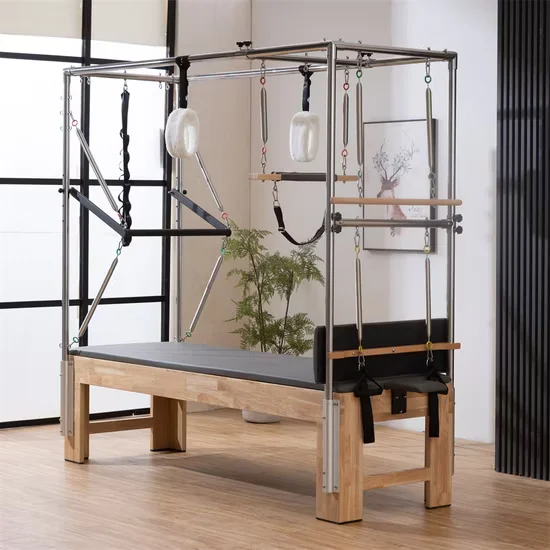
Compact Storage Engineering — SRY-21 folding aluminum Pilates reformer commercial units collapse to one-third footprint while maintaining full 2550mm carriage travel for studio flexibility.
Technical Specifications
| Parameter | Value |
|---|---|
| Model NO. | SRY-21 |
| Product Type | Pilates Reformer |
| Frame Material | Aluminum |
| Folding Mechanism | Enabled |
| Product Dimensions | 2550×680×350mm |
| Net Weight | 65kg |
| Accessories | Long Box / Jump Board / Platform |
| Color Options | Solid Color (customizable) |
| Logo Customization | Available |
| Target User | Adult, Unisex |
| Warranty | 3 Years |
| Production Capacity | 80 Pieces/Month |
| HS Code | 9506911900 |
| Certification | CE, ISO 9001 |
Application Suitability
| Deployment Scenario | Typical Use |
|---|---|
| Boutique Pilates studios | Group reformer classes with flexible floor planning between sessions |
| Five-star hotel wellness floors | Equipment folded after peak hours to reclaim guest-facing space |
| Rehabilitation and physiotherapy clinics | Controlled resistance progression for post-injury clients |
| Corporate wellness facilities | Mid-day movement breaks without dedicated permanent zones |
| High-end residential home gyms | Compact storage when room serves multiple household functions |
Why Carriage Noise Reaches Neighboring Rooms Before Maintenance Notices
Aluminum frame resonance dampening prevents structural vibration transmission through building floors.
Traditional steel-frame reformers generate carriage rattle that travels through floor slabs into occupied rooms below, particularly during spring-loaded jump board work. Hotel wellness floors and residential tower gyms absorb these complaints before equipment teams identify the source. The aluminum construction in this folding aluminum Pilates reformer commercial grade unit dissipates vibration energy rather than channeling it into the structure [NEED_CITE: acoustic transmission through floor assemblies in multi-story commercial buildings]. Boutique studios sharing walls with retail tenants face similar pressure when early-morning classes run reformer circuits against partition boundaries.
Movement Repertoire Coverage in Mixed-Use Spaces
The SRY-21 supports full classical reformer sequences plus jump board cardio intervals and platform-based standing work. In a boutique studio layout, these units pair with mat zones and small apparatus stations rather than competing with tower or cadillac installations. The modular accessory system means one folding aluminum Pilates reformer commercial deployment covers reformer, jump board and long box disciplines without tripling the equipment count. Suitable for users across standard adult height and weight ranges, the 65kg aluminum frame anchors stable carriage travel during dynamic standing exercises while remaining portable enough for layout reconfiguration between class formats.
Daily Deployment Cycles and Floor-Level Constraints
Hotel wellness floors running 16-hour access windows need equipment that folds reliably across hundreds of articulation cycles. The SRY-21 folding mechanism must maintain rail alignment and locking pin engagement through continuous daily deployment. Noise transmission becomes critical when cardio zones sit directly above guest room floors — aluminum frame construction limits resonance pathways that steel frames amplify through structural connections [NEED_CITE: commercial fitness equipment noise standards for hospitality deployments]. Ground-floor studios and basement installations have more flexibility on acoustic transmission but still require level flooring to prevent carriage drift and uneven spring tension across the rail length.
Aluminum Frame and Folding Mechanism Specifications
Aluminum alloy construction reduces frame mass compared to welded steel while maintaining rigidity under dynamic loads — the 65kg net weight reflects material savings that also lower shipping and repositioning costs. The folding mechanism collapses the 2550mm deployed length for storage without compromising carriage travel during use. Spring-based resistance systems on reformer platforms deliver linear force curves predictable across joint rehabilitation ranges, unlike elastic band resistance that degrades nonlinearly over time. The accessory mounting points for long box, jump board and platform must maintain structural alignment through repeated attachment cycles [NEED_CITE: commercial Pilates equipment load testing standards for accessory mounts]. Solid color finishes support facility branding consistency across multi-unit deployments while resisting sweat and cleaning chemical degradation common in high-touch studio environments.
What Steel Frame Reformers Cost When Neighbors File Complaints
Steel-frame reformers transmit carriage vibration through floor assemblies into rooms below, generating noise complaints that trigger emergency equipment swaps. Studios and hotels replacing entire reformer fleets absorb procurement, shipping and installation costs alongside revenue loss during the changeover period. Aluminum construction avoids this cascade by dampening vibration at the source rather than attempting isolation after transmission begins [NEED_CITE: cost analysis of equipment replacement due to acoustic complaints in commercial facilities]. Facilities that skip frame material verification during initial procurement end up paying twice when neighbor pressure forces mid-lease equipment changes.
Why This Product Line Holds Position in Commercial Deployments
The aluminum frame reduces structural vibration transmission verified in hotel floor installations where guest room proximity demands acoustic discipline. The folding mechanism enables storage reconfiguration for studios running multiple class formats in shared spaces. OEM customization covers logo placement and color matching for multi-site brand consistency without requiring separate production runs. The complete accessory ecosystem — long box, jump board, platform — ships from one production line ensuring mounting point compatibility across units. Free 3D layout planning addresses reformer spacing, sightlines and instructor movement paths for group class configurations. Technical support covers mechanism troubleshooting and accessory compatibility questions across deployment time zones [NEED_CITE: commercial equipment technical support response standards for international deployments].
Documentation & Test Records
- CE declaration of conformity covering mechanical safety requirements for commercial fitness equipment
- EN 957 test report validating structural integrity under repeated dynamic loading cycles
- ISO 9001 certificate covering manufacturing process control from raw material to finished unit
- Noise level test report documenting acoustic output during carriage travel and jump board impact
- Durability test record tracking folding mechanism articulation cycles and locking pin engagement
- Installation and commissioning guide with accessory mounting procedures and floor leveling requirements
Installation, Commissioning & Maintenance
- Deployed footprint requires 2550×680mm clearance plus instructor circulation space on three sides
- Floor leveling verification prevents carriage drift and uneven spring tension across rail length
- Folding mechanism inspection every quarter confirms locking pin engagement and hinge alignment
- Accessory mounting points checked for wear after each jump board attachment cycle
- Rail lubrication schedule based on deployment frequency maintains carriage smoothness
- Daily surface cleaning protocols protect solid color finish from sweat and chemical degradation
Equipment Specification Consultation
Provide studio square footage and unit count requirements to receive 3D layout planning covering reformer spacing, instructor sightlines and emergency egress paths. Specify deployment floor level and adjacent occupied spaces to confirm acoustic transmission requirements match aluminum frame performance. Indicate target market for accessory compatibility verification and documentation language requirements. Confirm branding customization scope including logo placement positions and color matching references for multi-site rollouts.
Frequently Asked Questions
Q: How does aluminum frame construction affect noise and vibration compared to steel reformers?
A: Aluminum dissipates vibration energy rather than channeling it through structural connections into floor assemblies. Steel frames act as rigid pathways transmitting carriage rattle and jump board impact to rooms below, generating noise complaints in multi-story buildings. The material difference becomes operationally significant when equipment deploys on hotel guest floors or above occupied retail spaces where acoustic transmission triggers neighbor complaints.
Q: What is the folding mechanism’s durability rating for daily studio use?
A: The folding articulation must maintain rail alignment and locking pin engagement through repeated daily cycles in commercial studio environments. Facilities running morning-through-evening class schedules deploy and collapse units multiple times daily. Mechanism wear manifests as carriage drift or pin disengagement rather than sudden failure, allowing preventive maintenance scheduling before operational disruption occurs during active class sessions.
Q: Are the long box, jump board and platform accessories interchangeable across reformer models?
A: Accessory compatibility depends on mounting point geometry and load-bearing specifications engineered for specific frame designs. The SRY-21 mounting system accepts its designated long box, jump board and platform configurations. Facilities planning multi-model deployments should verify attachment compatibility during procurement rather than assuming cross-model interchangeability after equipment arrives on site.
Q: Can the reformer be customized with facility branding and color matching?
A: Solid color finishes accept OEM customization covering logo placement and color specification to match facility branding requirements. Multi-site studio chains deploy consistent visual identity across locations through coordinated color and logo positioning. Customization scope gets confirmed during quotation phase with production samples validating color accuracy and logo durability before full production runs commence.
Q: What floor space is required for deployed vs. folded storage configuration?
A: Deployed configuration occupies 2550×680mm plus instructor circulation space on three sides for safe class management. Folded storage reduces the footprint substantially, allowing studios to reclaim floor area between class sessions or convert spaces for different programming formats. Exact folded dimensions and stacking capability depend on facility storage protocols and whether units store vertically or horizontally against walls.