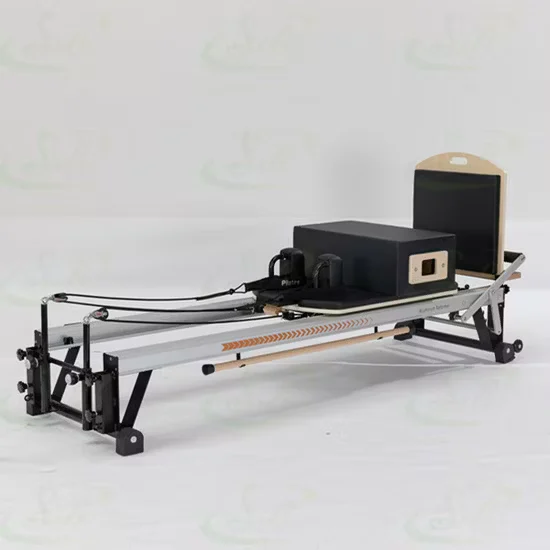
Aluminum Alloy Glide — The SRY-12A foldable Pilates reformer uses a precision aluminum bed to eliminate carriage rail resonance in shared residential deployments.
Technical Specifications
| Parameter | Value |
|---|---|
| Product Type | Foldable Pilates Reformer |
| Designation | SRY-12A |
| Frame Material | Aluminum Alloy |
| Product Dimensions | 2570 × 730 × 270 mm |
| Net Weight | 90 kg |
| Foldable | Yes |
| Included Accessories | Long Box, Jump Board, Platform |
| Color | White (customization available) |
| Logo | Customized is allowed |
| Warranty | 3 Years |
| Target User | Adult, Unisex |
Application Suitability
| Deployment Scenario | Typical Use |
|---|---|
| High-end residential home gym | Daily low-impact reformer sessions in apartment or shared-wall environments where noise transmission is a constraint |
| Boutique Pilates studio | Multi-class room configurations requiring foldable storage between sessions to maximize floor versatility |
| Private studio | One-on-one or small-group instruction with full accessory ecosystem for varied movement repertoire |
| Corporate wellness room | Employee recovery and flexibility programming in compact fitness spaces adjacent to office zones |
Why Neighbor Complaints Start at the Carriage Rail
A foldable aluminum alloy bed frame eliminates the steel-on-steel resonance that triggers noise disputes in shared residential floors.
I have watched reformers with standard steel carriages get pulled from apartment fitness rooms after weeks of low-frequency rail vibration traveling through floor joists into units below. The complaint rarely mentions the equipment by name — residents report a rhythmic humming at odd hours, and building management traces it back to the carriage glide. The SRY-12A addresses this at the structural level: aluminum alloy dampens vibration transfer far more effectively than welded steel, and the foldable reformer Pilates machine aluminum alloy home use design means the unit stores flat against a wall when the room serves other purposes [NEED_CITE: acoustic transmission characteristics of aluminum versus steel in fitness equipment frames].
Where This Reformer Fits in a Mixed-Discipline Studio Layout
The SRY-12A covers the full spectrum of classical and contemporary Pilates movement patterns, from footwork sequences through advanced pulling strap work, supported by the included Long Box, Jump Board, and Platform. In a studio that also deploys mat zones and barrel stations, this foldable Pilates reformer aluminum alloy home use unit occupies the primary apparatus position and stores vertically to clear floor space for group mat classes. The 2570 mm length accommodates users across a broad height range without requiring carriage extension adjustments, and the 90 kg net weight keeps the frame stable during dynamic Jump Board sequences while remaining movable by a single instructor for room reconfiguration.
Continuous Session Scheduling and Room Environment Requirements
Back-to-back private sessions place repeated load cycles on the carriage rail and spring anchors, and the aluminum alloy bed must maintain glide consistency across temperature fluctuations in rooms without dedicated climate control. Studios deploying this unit in converted residential spaces should confirm that floor leveling is within tolerance — even minor unevenness introduces lateral carriage drift that accelerates wheel wear over months of use. The foldable mechanism introduces a hinge point that requires periodic inspection in high-frequency commercial deployments, particularly where multiple instructors fold and unfold the unit daily [NEED_CITE: foldable hinge durability standards for commercial Pilates equipment]. Adequate clearance around the stored position prevents accidental deployment and protects adjacent walls from frame contact marks.
Reading the Frame, Rail, and Accessory Attachment Specifications
The aluminum alloy bed is the defining specification here, and its significance extends beyond weight savings. Aluminum’s internal damping coefficient differs fundamentally from carbon steel, meaning carriage wheel vibration dissipates within the frame material rather than propagating through the bed to the floor. The 2570 mm overall length provides a carriage travel distance suitable for full-range leg press and long spine movements without compromise. The included Long Box extends the reformer into seated and supine arm work, while the Jump Board converts the foot bar end into a plyometric surface — both attachments must lock into the frame without introducing secondary vibration points. The 90 kg net weight reflects a frame mass that resists walking or shifting during aggressive spring-loaded sequences without requiring floor anchoring. The three-year warranty covers the structural frame, though buyers should confirm specific coverage terms for the foldable hinge mechanism and carriage wheel assemblies under commercial use conditions [NEED_CITE: commercial warranty scope for foldable fitness equipment hinge mechanisms].
What Spec Compromise Costs After Six Months of Studio Use
Reformers built with lighter-gauge steel or composite bed materials may present attractively at purchase but reveal their limitations through progressive carriage rattle, spring anchor loosening, and hinge play that compromises movement precision. Instructors notice the degradation first — cues that relied on smooth carriage transitions begin requiring compensation, and advanced clients feel the instability during single-leg work. Studios that purchased multiple units on price often face a staggered replacement cycle as individual machines develop distinct failure modes, creating an inconsistent experience across the apparatus lineup. The hidden cost is not the replacement itself but the member attrition that follows when clients lose confidence in equipment reliability [NEED_CITE: member retention correlation with equipment consistency in boutique fitness studios].
Why This Product Line Earns Its Studio Placement
Senrui’s manufacturing approach applies the same acoustic discipline developed across 15 years of commercial cardio engineering to the Pilates category. The SRY-12A benefits from facility-level deployment thinking: the 3D layout planning service addresses how this foldable reformer coexists with other apparatus in tight boutique footprints, mapping instructor sightlines and member flow around the stored and deployed positions. OEM customization extends beyond logo placement to color matching for studio brand environments, and the accessory ecosystem ships as an integrated set rather than requiring aftermarket sourcing. For operators expanding from a single reformer to a full apparatus room, the consistent aluminum alloy construction across the lineup means carriage feel remains uniform as additional units join the floor. Documentation includes installation guides specific to the foldable mechanism’s calibration requirements.
Documentation & Test Records
- CE declaration of conformity applicable to Pilates reformer structural and mechanical safety
- EN 957 test report covering frame load capacity and accessory attachment integrity
- ISO 95001 quality management certification covering manufacturing and assembly processes
- Noise level assessment documenting carriage glide acoustics under loaded conditions
- Foldable hinge mechanism cycle test record for repeated deployment verification
- Accessory load testing documentation for Long Box, Jump Board, and Platform anchors
Installation, Commissioning & Maintenance
- Confirm floor leveling within tolerance across the 2570 × 730 mm footprint before positioning to prevent lateral carriage drift
- Maintain minimum clearance on all sides for safe foldable deployment and instructor circulation during sessions
- Inspect foldable hinge mechanism monthly under commercial use for play or fastener loosening requiring torque adjustment
- Lubricate carriage rail contact surfaces per schedule using manufacturer-specified compound to preserve aluminum glide consistency
- Verify Long Box, Jump Board, and Platform attachment points before each class to confirm secure locking under dynamic load
- Clean aluminum frame surfaces with pH-neutral solution to prevent sweat residue corrosion in high-humidity studio environments
Sizing Your Reformer Deployment
Share your studio floor dimensions and planned apparatus count to receive a 3D layout mapping the SRY-12A’s stored and deployed footprints against instructor circulation paths and member entry flow. Specify your average daily session volume so hinge mechanism duty expectations align with your scheduling model. Confirm whether deployment occurs in a purpose-built studio or a converted residential or commercial space, as floor construction directly affects vibration transmission and leveling requirements. Indicate any brand color matching needs early in the specification process to align customization lead time with your opening or renovation schedule.
Frequently Asked Questions
Q: How does aluminum alloy frame construction reduce noise compared to steel reformers?
A: Aluminum’s internal damping properties absorb carriage wheel vibration rather than transmitting it through the frame to the floor structure. In shared-wall and multi-story residential deployments, this material difference eliminates the low-frequency hum that steel frames propagate into adjacent units during repetitive carriage movements, particularly noticeable during slow controlled exercises where rail contact sound dominates the acoustic profile.
Q: What is the folded footprint and does it fit standard residential storage spaces?
A: The SRY-12A folds along its frame hinge to reduce its 2570 mm length significantly for vertical or flat storage against a wall. Confirm your specific ceiling height and wall clearance before deployment, as the folded unit’s 90 kg weight requires a stable leaning surface or wall-mounted retention bracket. Boutique studios typically allocate a dedicated storage zone to streamline room reconfiguration between group and private sessions.
Q: Are the Long Box, Jump Board, and Platform included as standard or optional accessories?
A: All three accessories ship as standard inclusions with the SRY-12A, eliminating the need for aftermarket sourcing and ensuring attachment point compatibility with the aluminum alloy frame. The Long Box enables seated and supine arm sequences, the Jump Board converts the foot bar zone for plyometric work, and the Platform extends the carriage surface for standing balance exercises across the full movement repertoire.
Q: What is the warranty coverage for the foldable hinge mechanism and carriage rail system?
A: The SRY-12A carries a three-year warranty covering the structural frame and primary mechanical components. Buyers deploying in commercial studio environments should confirm specific hinge mechanism and carriage wheel coverage terms under high-frequency use conditions, as warranty scope may differentiate between private home use and scheduled back-to-back professional instruction sessions.
Q: Can the reformer be customized with studio branding and color matching?
A: Logo customization is available, and color options can be scoped to align with studio brand environments or residential interior specifications. Confirm customization requirements during the inquiry stage, as modified color and branding orders involve specific production lead times that must align with your deployment timeline and studio opening schedule.

![Commercial Wood Maple Pilates Pulley Tower Combination Unit [WARN] draft identifier mismatch](https://bicksport.com/wp-content/uploads/2026/08/commercial-wood-maple-pilates-pulley-tower-combination-unit-warn-draft-identifier-mismatch-b5731f.webp)