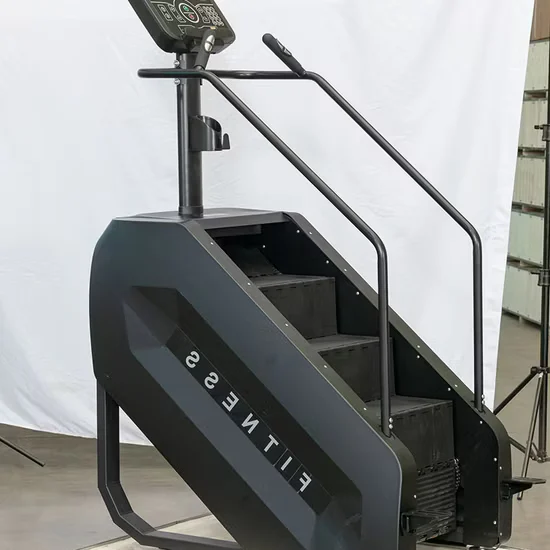
![Ergonomic Electric Stair Climber Machine for Workouts [WARN] draft identifier mismatch](https://bicksport.com/wp-content/uploads/2026/08/ergonomic-electric-stair-climber-machine-for-workouts-warn-draft-identifier-mismatch-eec5a4.webp)
Silent Vertical Training — sub-35dB magnetic resistance keeps stair climbing below conversation level on hotel guest floors.
Technical Specifications
| Parameter | Value |
|---|---|
| Product Type | Stair Climber |
| Drive System | Electric Motor |
| Speed Range | 15–164 RPM |
| Heart Rate Monitoring | Grip Sensors |
| Console OSD | Steps, Time, Calories, Speed, Heart Rate |
| Connectivity | IoT-enabled |
| Max User Weight | 180 kg |
| Frame Material | Aluminium Alloy Pipe + PP Plastic |
| Product Dimensions | 2160 × 830 × 1432 mm |
| Net Weight | 195 kg |
| Power Requirement | AC 220V±10% or AC 110V±10% |
| Certification | CE, RoHS, ISO 9001 |
| Warranty | One Year |
Application Suitability
| Deployment Scenario | Typical Use |
|---|---|
| Hotel fitness center on guest room floors | 24-hour access with minimal acoustic disruption to adjacent occupied rooms |
| Chain gym cardio zone | High-frequency rotation between treadmill, elliptical, and climbing stations |
| Corporate wellness room | Compact vertical cardio option alongside desks and meeting spaces |
| High-end residential home gym | Shared building facilities where neighbor noise tolerance is low |
| Sports performance training center | Leg endurance and cardiovascular conditioning for athletic programming |
Why Motor Burnout Precedes the First Guest Complaint
Continuous-duty engineering separates equipment that lasts from equipment that gets returned.
When a hotel installs cardio machines rated for light-commercial duty cycles, the motor overheating does not announce itself with a warning light — it fails silently at 3 AM on the third month, right when a jet-lagged guest is mid-session [NEED_CITE: motor duty cycle classification for continuous commercial operation]. The front desk receives the call, not maintenance. A commercial stair climber electric stepper machine must sustain thermal stability through back-to-back use, and that requires motor windings, sealed bearings, and drive electronics specified for hours of uninterrupted load rather than intermittent home use.
Vertical Cardio Station in a Multi-Discipline Layout
This stair climber covers the high-intensity lower-body segment of the cardio spectrum, complementing steady-state treadmills and full-body ellipticals in a mixed-equipment zone. Its vertical footprint positions well against walls or as a bookend to horizontal machines, creating clear sightlines for floor staff. The step rate range accommodates both recovery-paced stepping and anaerobic interval work. Users from moderate to advanced fitness levels can self-regulate intensity through speed control. The commercial stair climber electric stepper machine collects step count, elapsed time, caloric expenditure, speed, and heart rate through the console, giving trainers and facility managers a data point for each session without additional wearable hardware.
Occupied-Floor Deployment and Continuous Run-Time
A hotel placing this unit above sleeping guests must account for structure-borne vibration as much as airborne noise. The 195 kg net weight and aluminium alloy frame provide mass dampening, but isolation pads and a level substrate remain necessary to prevent low-frequency transfer through floor slabs [NEED_CITE: EN 957 requirements for commercial cardio equipment]. Dual-voltage input (AC 220V or AC 110V) eliminates the post-shipment discovery of plug and breaker incompatibility. The electric motor must sustain a thermal equilibrium under continuous operation — ventilation clearance around the motor housing should follow the installation guide to avoid heat accumulation in enclosed fitness rooms. Console data output allows integration with facility management software for usage tracking across a deployed fleet.
Electric Drive, Speed Range, and Signal Accuracy
The electric motor drives the step mechanism across a 15–164 RPM range, covering slow rehabilitation stepping through high-cadence athletic intervals. Unlike manual or friction-based climbers, the electric drive maintains consistent step velocity regardless of user weight shift, which keeps heart rate data meaningful for interval programming. Grip-based heart rate sensors provide a baseline reading suitable for zone monitoring, though chest-strap telemetry remains more stable during the upper-body movement inherent in climbing. The console surfaces steps, time, calories, speed, and heart rate simultaneously, avoiding the menu-diving that interrupts a session. IoT connectivity enables workout data export to third-party platforms where API documentation is available [NEED_CITE: IoT console data interoperability standards for commercial fitness equipment].
The Hidden Cost of Spec-Down Substitution
A stair climber specified without continuous-duty validation will accumulate thermal fatigue in its motor windings, and the failure pattern is rarely immediate — it manifests as a gradual loss of step consistency that members attribute to their own fatigue before they blame the machine. Noise creep in under-specified drive systems generates a rising complaint curve that correlates directly with occupancy rates [NEED_CITE: acoustic complaint patterns in hotel fitness installations]. Data isolation from consoles lacking export capability leaves facility operators blind to which machines are overused and which are dead zones in the layout. Voltage mismatch discovered at the port of entry converts a scheduled deployment into a storage cost.
Why This Product Line Holds Up in the Field
Every unit undergoes acoustic verification against the sub-35dB threshold before leaving the Shandong facility, and this stair climber is no exception. The 10,000-hour durability protocol tests the motor, bearings, and step linkage under continuous load to validate the duty-cycle rating printed on the spec sheet. The console UI is customizable under OEM terms, so a hotel chain can brand the interface or a gym network can simplify the menu for walk-in members. The 2160 × 830 mm footprint and required clearance around the unit are factored into the free 3D cardio-zone layout we provide, which also maps airflow paths so heat from the motor housing does not pool in an enclosed room. Full six-series cardio coverage means a facility can source treadmills, ellipticals, rowers, bikes, and this climber from a single engineering platform with unified documentation.
Documentation & Test Records
- CE declaration of conformity covering this stair climber model
- EN 957 test report validating mechanical and electrical safety
- ISO 9001 certificate for the manufacturing quality system
- Noise level test report confirming sub-35dB acoustic output
- Durability test record documenting 10,000-hour motor and bearing validation
- Console technical documentation with data interface specifications
Installation, Commissioning & Maintenance
- Maintain minimum clearance per the 2160 × 830 × 1432 mm footprint plus user entry space on all sides.
- Install vibration isolation pads under all four contact points to decouple structure-borne noise from floor slabs.
- Connect to a dedicated circuit matching the specified AC 220V or AC 110V input to prevent voltage sag during peak step loads.
- Run the initial calibration cycle per the commissioning guide to verify step velocity across the full 15–164 RPM range.
- Schedule periodic inspection of the step linkage and sealed bearings per the maintenance interval in the installation guide.
- Configure console IoT settings and confirm data handshake with facility management software before member launch.
Specifying for Your Facility
Provide the cardio zone square footage and planned equipment count to receive a 3D layout that positions this climber for sightline and airflow compliance. State the expected daily operating hours so we can confirm the motor duty-cycle rating matches your usage profile. Identify the deployment floor and adjacent room types to validate the acoustic requirement. Confirm your target market voltage standard and whether console data integration with your existing management platform is required.
Frequently Asked Questions
Q: How does an electric drive compare to a manual stair climber for maintenance and noise?
A: Electric drive systems maintain consistent step velocity under varying user loads, reducing mechanical wear on linkages compared to friction-dependent manual mechanisms. The motor and sealed bearings operate below the sub-35dB threshold verified in hotel deployments. Manual climbers require more frequent adjustment of friction surfaces and generate variable noise as those surfaces degrade. Maintenance intervals for the electric drive focus on bearing inspection and electronic calibration rather than mechanical replacement.
Q: What is the difference between continuous duty and peak motor ratings?
A: Peak rating describes the maximum output a motor can sustain briefly before thermal protection activates. Continuous duty rating reflects the output the motor can sustain indefinitely under load without overheating. Commercial stair climber electric stepper machine applications require continuous duty validation because members use the equipment back-to-back, and a peak-rated motor will accumulate thermal fatigue and eventually fail. Always request the continuous duty specification when evaluating equipment for high-traffic facilities.
Q: Can the console sync workout data with facility management systems?
A: The IoT-enabled console supports data export for session metrics including steps, time, calories, speed, and heart rate. Integration requires API documentation from both the console platform and the receiving facility management software. We provide console technical documentation detailing available data protocols so your IT team can assess compatibility before deployment. Custom console UI configurations are available under OEM terms for branded network environments.
Q: How does the 195 kg net weight affect deployment?
A: The mass provides inherent stability during vigorous climbing, reducing lateral sway that lighter frames exhibit under dynamic loading. The aluminium alloy construction concentrates weight in the structural frame for vibration dampening while keeping the unit manageable for installation positioning. Floor-loading calculations should account for this weight plus the 180 kg maximum user load when deploying on upper floors. Isolation pads are recommended to manage any residual low-frequency transfer to the building structure.
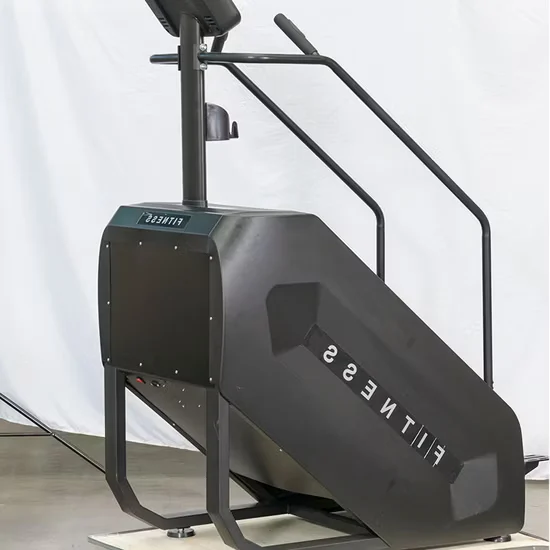

![Commercial Stair Climber Machine for Home Gym Fitness [WARN] draft identifier mismatch](https://bicksport.com/wp-content/uploads/2026/08/commercial-stair-climber-machine-for-home-gym-fitness-warn-draft-identifier-mismatch-7b0cb3.webp)