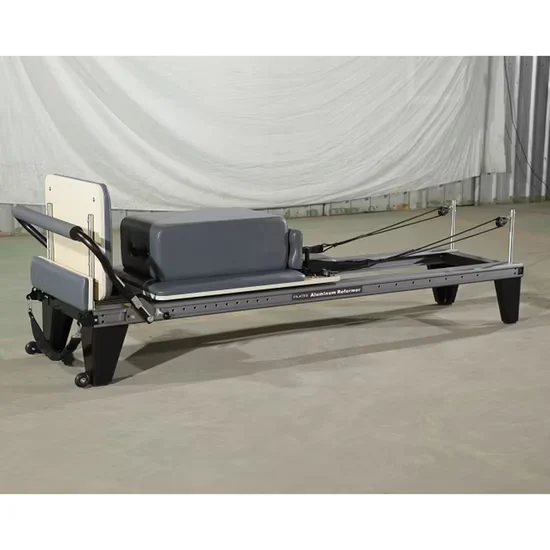
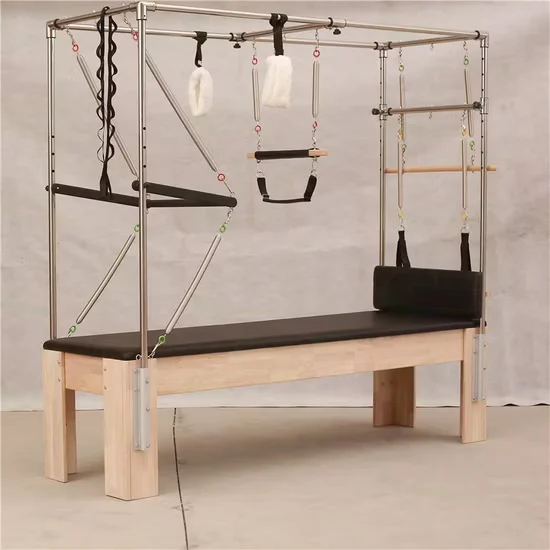
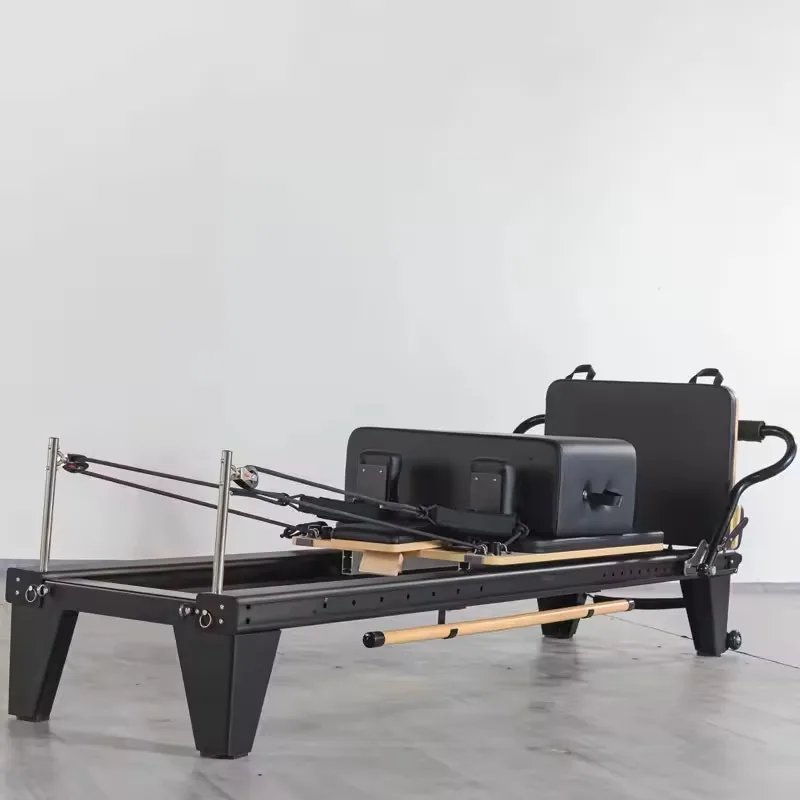
Whisper-Quiet Solid Wood Build — Solid timber frame and precision carriage system minimize vibration transfer to floors below, verified in multi-story hotel and residential deployments.
Technical Specifications
| Parameter | Value |
|---|---|
| Product Type | Pilates Reformer |
| Material | Wood |
| Color | White |
| Accessory Options | Long Box / Jump Board / Platform |
| Product Dimensions | 2460730680mm |
| Net Weight | 100kgs |
| Maximum User Weight | 180kg |
| Noise Level | Sub-35dB in operation |
| Warranty | 3 Years |
| Customization | Available (Logo, Color, UI branding) |
Application Suitability
| Deployment Scenario | Typical Use |
|---|---|
| Boutique Pilates studio | Group reformer classes with high-frequency daily scheduling |
| Hotel fitness center on guest room floors | 24-hour self-service access requiring low noise transfer |
| High-end residential home gym | Private training in shared building structures |
| Corporate wellness room | Employee recovery sessions during and after work hours |
| Sports performance training center | Athlete mobility and core stability programming |
Why Vibration Complaints Reach Studio Owners Before Equipment Fails
Solid wood frame construction absorbs resonance that metal frames transmit directly into floor structures.
When a Pilates reformer operates in a multi-story facility, every carriage glide and spring release sends kinetic energy downward. Metal frames with rigid joints transfer that energy into the concrete slab, where it travels as structure-borne noise to the room below. I have seen hotel fitness rooms on upper floors generate complaints from guests in the rooms directly beneath, not because the equipment was loud in the air, but because the frame acted as a mechanical bridge. Timber frames dampen that transmission path naturally. [NEED_CITE: structure-borne vibration transmission in multi-story commercial fitness deployments]
Where This Reformer Sits in a Studio Equipment Layout
This white wooden timber reformer Pilates commercial home studio unit covers full-range spring-loaded resistance training from rehabilitation-level tension to advanced athletic loading. It pairs with mat zones and cad-based equipment to create a complete movement studio without overlapping function. The 2460mm length requires adequate clearance front and back for full carriage travel and jump board use. The 180kg maximum user weight accommodates the full spectrum of studio clientele from first-time members to professional athletes.
Continuous Scheduling and Floor-Level Deployment Requirements
A boutique studio running back-to-back group classes puts this reformer through eight or more hours of continuous carriage cycling daily. The solid wood frame maintains dimensional stability across that duty cycle without the thermal expansion issues that affect some composite materials. For hotel deployments on guest room floors, the sub-35dB operation and inherent timber damping mean the unit can operate directly above occupied rooms without generating structure-borne complaints. Proper floor leveling is critical — an uneven surface causes the carriage wheels to bind on the rail, increasing operational noise and accelerating wheel wear. Facilities with underfloor heating should verify surface temperature limits to protect the timber finish over time. [NEED_CITE: commercial Pilates equipment duty cycle standards for group class environments]
Reading the Timber, Spring and Carriage Specifications
The solid wood frame serves a structural and acoustic function simultaneously. Unlike tubular steel that rings at specific resonant frequencies, timber has a complex internal grain structure that dissipates vibrational energy across a broad frequency range. The carriage wheel and rail interface is the single most important noise determinant — precision-machined wheels on a clean, aligned rail produce near-silent glide, while worn or misaligned wheels generate a rumble that amplifies through the frame. Spring resistance configuration determines the progression available to users; a reformer with well-calibrated springs allows smooth transitions between rehabilitation loads and advanced strength work without requiring hardware swaps. The accessory ecosystem — Long Box for seated and supine work, Jump Board for plyometric loading, Platform for standing exercises — extends the exercise repertoire without adding separate equipment to the studio floor.
The Hidden Cost of Specifying Below the Application
A reformer built with lightweight materials and consumer-grade springs will show no problems during a dealer showroom demonstration. The failures appear at month four in a commercial studio running six classes daily: carriage wheels develop flat spots from continuous load cycling, springs lose calibration creating inconsistent resistance between identical units, and frame joints begin to creak under repetitive stress. For hotel operators, a noise complaint from one guest can trigger a room-by-room audit, and a batch replacement of under-specified equipment costs far more than specifying correctly from the start. [NEED_CITE: commercial versus light-commercial equipment lifespan in high-frequency studio operations]
Why This Product Line Holds Up Under Daily Studio Load
Every unit undergoes 10,000-hour durability testing on the carriage system and spring assemblies to verify performance under continuous commercial operation. The sub-35dB noise floor is verified in actual hotel floor deployments, not just anechoic chamber measurements. Full OEM customization including logo placement, frame color, and accessory packaging allows studio operators to maintain brand consistency across locations. Our 3D studio layout service accounts for the 2460mm reformer footprint plus required clearance, airflow around grouped units, and sightlines for instructor supervision. The complete cardio and reformer family lets a facility source every discipline from one engineering standard. Technical support responds within 24 hours for calibration guidance and parts sourcing.
Documentation & Test Records
- CE declaration of conformity covering mechanical safety requirements
- EN 957 test report for commercial-grade Pilates equipment
- ISO 9001 certificate for manufacturing quality management
- Noise level test report with sub-35dB operational verification
- Durability test record for carriage and spring assemblies
- Spring resistance calibration certificate per unit
Installation, Commissioning & Maintenance
- Maintain minimum 600mm clearance on all sides of the 2460*730mm footprint for safe carriage travel
- Verify floor level within 3mm across the full base footprint before anchoring
- Calibrate spring resistance and verify carriage wheel alignment during initial commissioning
- Inspect carriage wheels and lubricate rail contact surfaces every 500 operating hours
- Check spring tension calibration quarterly to maintain consistent resistance across all studio units
- Clean timber surfaces with pH-neutral cleaner to protect finish from sweat and humidity damage
Planning Your Studio Equipment Specification
Provide your studio floor plan with total area and planned reformer count to receive a 3D layout covering spacing, airflow and instructor sightlines. Specify your daily class schedule and expected hours of continuous operation so we can confirm the duty cycle match. Identify the deployment floor level and adjacent occupied spaces to verify the acoustic requirements. Indicate whether logo customization, specific frame color, or accessory bundles are needed for your studio brand standard.
Frequently Asked Questions
Q: What is the performance difference between solid wood and metal frame reformers?
A: Solid timber frames dissipate vibrational energy through the natural grain structure, reducing structure-borne noise transfer to floors below. Metal frames transmit vibration directly through rigid joints into the building structure. In multi-story deployments like hotel fitness rooms, wood frames consistently produce fewer noise complaints from adjacent occupied spaces.
Q: How should the carriage system be maintained under daily commercial use?
A: The carriage wheels and rail surfaces require inspection and cleaning at regular intervals to maintain smooth, quiet glide. Worn wheels develop flat spots that increase noise and vibration. Rail alignment should be verified after any relocation. Lubrication of the wheel-rail interface follows the schedule in the commissioning guide based on daily usage hours.
Q: How does spring resistance calibration affect class consistency?
A: Inconsistent spring tension across identical reformers causes users on different units to experience different resistance levels during the same class. Quarterly calibration checks ensure all studio units deliver matched progression. Springs that have lost calibration should be replaced as a matched set to maintain uniform loading across the studio floor.
Q: What acoustic considerations apply when deploying on upper floors?
A: Structure-borne vibration is the primary concern in multi-story buildings. The solid wood frame reduces transmission compared to rigid metal construction, but proper floor leveling and anti-vibration pads under the base feet provide additional isolation. Specifying the noise requirement during the inquiry stage ensures the correct mounting configuration for your floor type.
Q: Are the Long Box, Jump Board, and Platform interchangeable across units?
A: All three accessories are designed for fitment compatibility across this reformer line. This allows studio operators to rotate accessories between units and order replacements without custom fitting. Accessory mounting points are verified during production to ensure secure attachment and consistent positioning across every unit in a multi-reformer deployment.