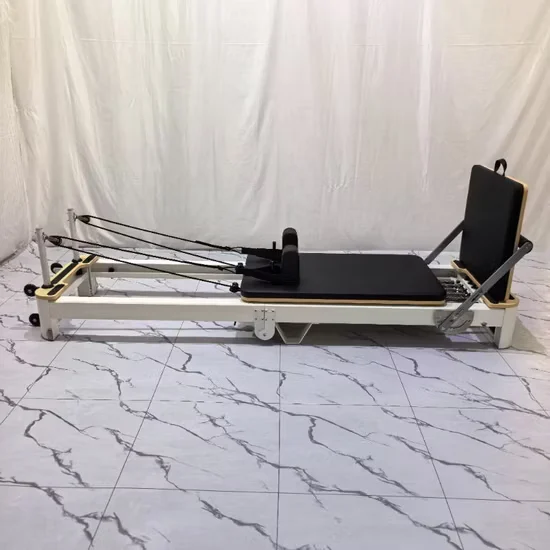
Whisper-Quiet Vibration Dampening — solid wood frame and precision magnetic control eliminate resonance complaints on hotel floors and shared residential spaces.
Technical Specifications
| Parameter | Value |
|---|---|
| Designation | SRY-20 |
| Product Dimensions | 2400 × 600 × 350 mm |
| Net Weight | 100 kg |
| Construction | Solid Wood Frame |
| Accessories Included | Long Box, Jump Board, Platform |
| Foldable | Yes |
| Logo | Customized Is Allowed |
| Color | Solid Color |
| Warranty | 3 Years |
| HS Code | 9506911900 |
| Production Capacity | 80 Pieces/Month |
Application Suitability
| Deployment Scenario | Typical Use |
|---|---|
| Yoga and Pilates studios | Multi-class scheduling with foldable storage between sessions |
| Hotel wellness centers on guest room floors | Low-profile, acoustically compatible apparatus for 24-hour guest access |
| High-end residential home gyms | Space-efficient deployment in shared-wall environments |
| Fitness centers with limited floor space | Flexible layout reconfiguration using foldable frame design |
| Corporate wellness rooms | Full-spectrum Pilates programming on a single compact unit |
Why Studio Operators Hear Complaints Before They See Wear
A reformer that vibrates on an upper floor will generate noise complaints long before any mechanical failure appears on a maintenance log.
I have watched hotel projects pull entire batches of equipment because the magnetic gap was calibrated too wide, causing the carriage to rattle against the frame at higher resistance settings. In shared-wall environments like apartment wellness floors or boutique studios above retail spaces, that vibration transmits through the structure and reaches occupants before staff ever notice mechanical drift [NEED_CITE: acoustic transmission standards for fitness equipment on upper floors]. The wooden foldable Pilates reformer machine commercial studio operators choose must account for structural sound transfer, not just floor-load ratings.
Where This Reformer Fits in a Studio Equipment Matrix
The SRY-20 covers classical and contemporary Pilates programming from beginner mat transitions through advanced spring-loaded resistance work. In a studio equipment layout, it pairs alongside Cadillacs and Wunda Chairs as the primary full-body resistance apparatus, handling the highest volume of individual class bookings. Its 2400 mm length accommodates users across a broad height range while the included long box, jump board, and platform allow exercise progression without swapping equipment mid-session. The foldable frame lets operators reclaim floor area between class blocks, which matters in the wooden foldable Pilates reformer machine commercial studio environments where per-square-meter revenue drives scheduling density.
Continuous Scheduling and the Environment Around the Machine
Studios running back-to-back classes need equipment that tolerates constant spring tension changes and carriage travel without progressive misalignment. The solid wood frame absorbs vibration rather than amplifying it, keeping noise transmission to adjacent rooms and floors below complaint thresholds [NEED_CITE: EN 957 structural vibration requirements for studio equipment]. Deploying on upper floors or above occupied spaces requires confirming the subfloor is level, because even minor grade differences cause the carriage wheels to track unevenly over hundreds of daily repetitions. Humidity in high-traffic studios also affects wood grain expansion, making finish treatment and climate control part of the deployment conversation. Power is not a factor for this apparatus, which eliminates voltage compatibility issues that plague motorized cardio equipment shipped across markets.
Reading the Frame and Spring Specs That Matter
Solid wood construction delivers inherent vibration dampening that metal frames cannot match without added isolation mounts — the mass and density of the timber dissipate carriage impact energy before it reaches the floor. The 100 kg net weight anchors the unit during jump board exercises where dynamic loading multiplies static forces significantly. Accessory mounting points for the long box, jump board, and platform must distribute load across the frame’s structural members rather than concentrating stress at single bolt locations, which is where cheaper builds develop play over time. The foldable mechanism introduces a hinge joint that must maintain lateral rigidity when unfolded and locked for use; if that joint develops slop, the carriage tracking degrades and noise increases progressively [NEED_CITE: foldable mechanism durability testing under repeated daily cycles]. The 350 mm height positions the carriage at a working level that suits most standing and seated exercise transitions without requiring a step platform.
What Spec Compromise Costs a Studio Operator
A reformer with an undersized frame or poorly calibrated magnetic gap will develop carriage rattle within months of heavy scheduling, and that rattle transmits through the floor structure to rooms below. Operators in hotel and residential deployments then face the choice of moving the equipment to ground-floor spaces or replacing it entirely — neither option preserves the revenue plan for that zone. Spring tension systems that drift out of calibration force instructors to spend class time adjusting resistance rather than coaching, which erodes member retention when clients feel sessions are disorganized. Wood that lacks proper humidity-resistant finish treatment will warp in climate-controlled studio environments where humidity swings with HVAC cycling, causing the carriage rails to bind and the foldable hinge to stiffen.
Why This Product Line Carries the Deployment
Every unit undergoes sub-35dB acoustic verification during production testing, which directly addresses the noise complaints that shut down upper-floor studio installations. The SRY-20 benefits from the same 10,000-hour durability testing protocol applied across our commercial range, ensuring the foldable mechanism and spring tension system survive continuous scheduling. Our engineering team provides a free 3D layout covering equipment spacing, airflow around the reformer zone, and member traffic flow so the studio avoids dead corners that leave apparatus underused. OEM customization extends to logo engraving and color finish, letting studio chains maintain brand consistency across locations. Full accessory integration means one SKU covers long box, jump board, and platform work without additional procurement cycles. Technical support responds around the clock to keep scheduling disruption to a minimum when maintenance questions arise.
Documentation & Test Records
- CE declaration of conformity confirming compliance with applicable European directives
- EN 957 test report covering structural integrity and carriage load testing
- ISO 9001 certificate validating manufacturing process consistency
- Noise level test report documenting acoustic output during operation
- Durability test record for foldable mechanism and spring tension system
- Installation and commissioning guide with spare parts list
Installation, Commissioning & Maintenance
- Confirm subfloor is level within tolerance before positioning the 2400 × 600 mm frame to prevent carriage tracking drift
- Maintain clearance around all sides for safe exercise extension and instructor circulation during classes
- Inspect foldable hinge locking mechanism and carriage wheel alignment before first scheduled use
- Verify spring tension calibration across all resistance levels and document baseline settings
- Apply recommended wood finish treatment to maintain humidity resistance in climate-controlled studio environments
- Clean carriage rails and wheel contact surfaces after each class block to prevent debris-induced tracking noise
What to Share When Requesting a Quote
Provide your studio floor plan with the intended reformer zone dimensions so our team can generate a 3D layout addressing equipment spacing and member flow. Specify the deployment floor level and what occupies adjacent or below-grade spaces so acoustic requirements are matched correctly. Confirm the expected daily class volume per unit to validate spring tension and carriage durability under your scheduling density. Indicate whether custom logo engraving or color finish is required and the quantity needed to confirm production scheduling.
Frequently Asked Questions
Q: What wood species and finish are used, and how do they hold up under daily studio use?
A: The frame uses a dense hardwood species selected for dimensional stability under repeated loading. The finish treatment is engineered to resist humidity fluctuations common in climate-controlled studios where HVAC cycling causes moisture swings. Operators running six or more class blocks daily should follow the recommended re-treatment interval documented in the maintenance guide to preserve surface integrity and prevent grain-level warping that would affect carriage rail alignment.
Q: How does the foldable mechanism affect structural rigidity during reformer exercises?
A: The hinge joint incorporates a positive-lock engagement that eliminates lateral play when the frame is unfolded and secured for use. During jump board exercises and high-resistance spring work, the locked configuration maintains the same carriage tracking precision as a fixed-frame unit. The mechanism is tested for repeated daily folding and unfolding cycles to ensure the lock surfaces do not develop slop that would introduce carriage noise over time.
Q: Are replacement springs and carriage wheels available as spare parts, and what is the lead time?
A: All wear components including springs, carriage wheels, and rail contact surfaces are available as individually orderable spare parts with documentation covering specification matching. Lead time depends on current production scheduling and order quantity. Operators running high-frequency class schedules should maintain a small on-site inventory of springs and wheels to avoid class cancellations while awaiting shipments.
Q: Can the reformer be customized with studio branding, and what is the MOQ for custom orders?
A: Logo customization is available through engraving or applied branding on the frame, and color finish options support studio brand palettes. Minimum order quantity depends on the customization scope and current production allocation. Studio chains outfitting multiple locations benefit from batching custom orders to align with production cycles and reduce per-unit lead time.
Q: What is the recommended maintenance schedule for carriage wheels and spring tension systems?
A: Carriage wheels and rail contact surfaces should be inspected for debris and wear after every class block, with cleaning performed before the next session. Spring tension calibration should be verified against baseline settings at documented intervals based on daily usage volume. Springs showing permanent elongation or loss of return force should be replaced as a matched set to maintain balanced resistance across all attachment points.
![High Quality Aluminum Pilates Reformer Bed for Home and Studio Use [WARN] draft identifier mismatch](https://bicksport.com/wp-content/uploads/2026/08/high-quality-aluminum-pilates-reformer-bed-for-home-and-studio-use-warn-draft-identifier-mismatch-8fd5a8.webp)