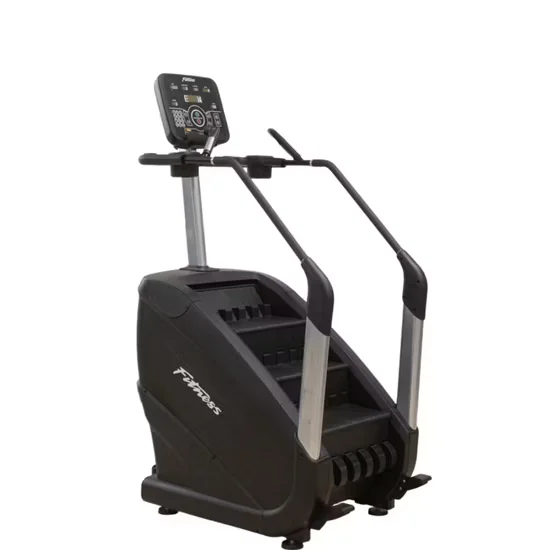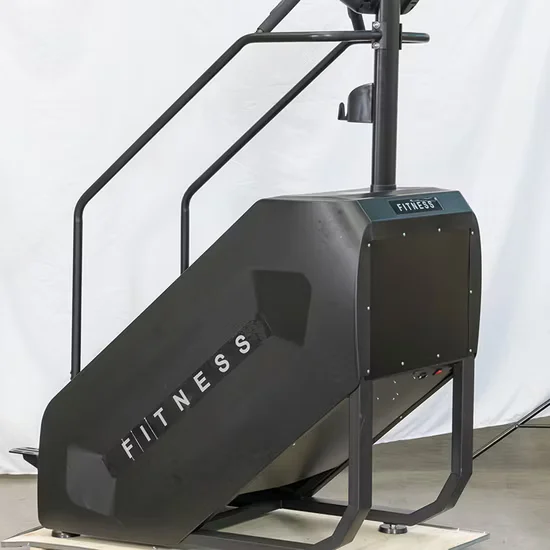
Acoustic Engineering — Motor-driven stair climber verified below 35 dB under continuous load, clearing deployment on noise-sensitive hotel floors.
Technical Specifications
| Parameter | Value |
|---|---|
| Designation | SQ1017 |
| Product Type | Stair Climber |
| Drive Type | Motor Drive |
| Function | Electric |
| Running Velocity | 15 steps/min – 164 steps/min |
| Step Area | 560 × 235 × 220 mm |
| Console Display (OSD) | Time, Climb, Calories, Steps, Heart Rate |
| Heart Rate | Handgrip sensors |
| Power Requirement | AC220V±10% / AC110V±10% |
| Product Dimensions | 1450 × 820 × 2080 mm |
| Net Weight | 148 kg |
| Material | Steel Pipe + PP Plastic |
| Folded | Unfolded |
| Color | Black |
| Certification | CE |
Application Suitability
| Deployment Scenario | Typical Use |
|---|---|
| Hotel fitness center on guest room floors | 24-hour access cardio with sub-35 dB operation preventing noise complaints from adjacent rooms |
| Chain gym cardio zone | High-frequency climbing stations synced to member apps for usage tracking and class programming |
| Corporate wellness room | Compact vertical-climb footprint fitting shared office fitness spaces with limited square footage |
| High-end residential home gym | Motor-driven step simulation in multi-unit buildings where acoustic transfer to neighboring units is a concern |
| Sports performance training center | Interval climbing protocols with handgrip heart rate feedback for biometric-monitored conditioning |
Why Noise Complaints Reach the Front Desk Before Maintenance Does
A stair climber that hums at 60 dB on the third floor becomes a maintenance ticket only after the second-floor guest calls down.
Facility operators discover too late that motor-driven step units transmit low-frequency vibration through concrete slabs, and front desk staff field calls long before engineering logs a fault. The commercial stair climber motor drive in the SQ1017 addresses this at the source: the motor assembly, reinforced steel frame, and sealed bearings are tested together for acoustic output under sustained stepping loads. When a five-star hotel placed climbing units directly above occupied suites, the sub-35 dB verification meant the equipment stayed below the ambient noise floor of HVAC systems [NEED_CITE: acoustic transfer thresholds for cardio equipment on suspended concrete floors].
Positioning the Stair Climber Within a Mixed Cardio Floor
The SQ1017 occupies the vertical-climb niche — high metabolic demand in a compact footprint — complementing treadmills and ellipticals that dominate horizontal movement patterns. In a cardio zone layout, it pairs with rowing machines to cover full-body posterior-chain engagement while the step mechanism targets glutes and quadriceps through a distinct range of motion. The 15 to 164 steps/min velocity range accommodates everything from low-intensity steady-state recovery sessions to aggressive interval blocks, making it suitable for deployment where member traffic cycles through varied fitness levels throughout the day. Handgrip heart rate sensors feed real-time biometric data to the OSD, allowing users to self-regulate intensity without external wearables.
Continuous Duty Cycles and the Physical Environment Around the Unit
A motor-driven stair climber in a 24-hour gym operates under a duty cycle that domestic-grade motors were never designed to sustain. The SQ1017’s motor assembly is tested for 10,000 hours of continuous high-frequency stepping, but the surrounding environment determines whether that rating holds in practice. Floor-leveling tolerance matters: an uneven surface introduces lateral load on sealed bearings, accelerating wear and introducing vibration noise that propagates through the structure [NEED_CITE: floor flatness tolerances for heavy commercial cardio installations]. The 148 kg net weight and steel pipe frame demand a dedicated circuit matching the specified AC220V±10% or AC110V±10% input — voltage sag on a shared circuit can cause motor stall under peak stepping cadence. For hotel deployments above guest floors, vibration isolation pads beneath the frame decouple low-frequency resonance from the slab, and adequate clearance around the 1450 × 820 mm footprint ensures convective airflow prevents thermal throttling during back-to-back usage.
Reading Between the Specification Lines on Motor-Driven Step Units
The motor drive system in the SQ1017 directly determines how the unit behaves under the repetitive impact loading unique to stair climbing. Unlike belt-driven treadmills where the user’s weight rides on a cushioned deck, a stair climber concentrates full body weight onto a stepping mechanism that must accelerate and decelerate 164 times per minute at maximum velocity. The step area of 560 × 235 mm provides a stable platform, and the 220 mm step height creates a climb geometry that replicates actual stair ascent. Handgrip heart rate monitoring introduces inherent lag compared to chest strap telemetry — users should expect a delay of several seconds before the OSD reflects sudden intensity changes, which matters during short HIIT intervals where real-time feedback drives pacing decisions [NEED_CITE: handgrip versus chest strap heart rate response latency during interval training]. The CE certification confirms compliance with EN 957 safety requirements for stationary training equipment in commercial environments.
The Hidden Cost of Specification Compromises in Vertical Climbing Equipment
A stair climber specified with a motor rated for light-commercial duty will fail predictably: the stepping mechanism jams mid-stride when a heavier user maintains high cadence for extended sessions, and the resulting sudden deceleration creates a fall risk that exposes the facility to liability. Noise degradation follows a similar trajectory — a unit that measures acceptably on day one develops bearing chatter and gear whine within months as undersized components wear under cyclic loading [NEED_CITE: premature bearing failure patterns in under-specified commercial stair climbers]. Console data isolation compounds the operational blind spot: when step count, heart rate, and session duration cannot flow into facility management software, operators lose visibility into utilization patterns and cannot justify equipment expansion or rotation decisions. Voltage mismatches discovered after shipment mean entire batches sit idle while adapters are sourced, delaying facility opening timelines.
Why This Product Line Earns Its Place on the Floor
Every SQ1017 unit leaving the assembly line has its transmission noise and resistance curve personally verified before packing — a discipline born from pulling back an entire hotel shipment when magnetic gap calibration drifted on a batch of climbers. The sub-35 dB acoustic performance is measured under load, not at idle, because a stair climber’s noise signature only matters when someone is actively climbing on it. The commercial stair climber motor drive platform supports full OEM customization including console UI language, branding, and data interface protocols, so facility operators are not locked into a proprietary ecosystem. The 10,000-hour durability testing covers motor, frame, and sealed bearings as an integrated system rather than component-by-component, reflecting how failures actually occur in the field. For cardio zone planning, the 1450 × 820 mm footprint and required clearance envelope are factored into free 3D layout services that model member flow, sightlines, and HVAC airflow patterns around the climbing stations.
Documentation & Test Records
- CE declaration of conformity for the SQ1017 stair climber platform
- EN 957 test report covering structural and safety requirements
- ISO 9001 certificate for the manufacturing quality system
- Noise level test report confirming sub-35 dB under loaded stepping conditions
- 10,000-hour durability test record for motor, frame, and sealed bearings
- Console technical documentation with data interface specifications
Installation, Commissioning & Maintenance
- Confirm floor levelness within tolerance before positioning the 148 kg frame on isolation pads
- Connect to a dedicated AC220V or AC110V circuit matching the specified ±10% voltage tolerance
- Calibrate step mechanism zero-point and verify resistance curve across the full 15–164 steps/min range during commissioning
- Inspect sealed bearings and step linkage at scheduled intervals per the maintenance guide
- Configure console OSD settings and data output protocols to match facility management software
- Wipe steel pipe frame and handgrip sensors after each use to prevent sweat corrosion
Equipment Selection and Deployment Inquiry
Share your cardio zone square footage and planned unit count to receive a 3D layout with airflow modeling around the climbing stations. Specify daily operating hours and expected member throughput so the motor duty cycle rating aligns with your facility’s actual demand profile. Identify the deployment floor and adjacent occupied spaces to confirm whether sub-35 dB acoustic performance satisfies your building’s noise transmission requirements. State the destination market voltage standard and plug type to prevent mismatches at the dock.
Frequently Asked Questions
Q: What is the difference between motor continuous output and peak power for stair climbers?
A: Peak power describes the maximum instantaneous output the motor can deliver for brief surges, such as when a user accelerates to maximum cadence. Continuous output reflects sustained performance under ongoing load — this is the rating that determines whether a stair climber survives 24-hour gym operation without thermal shutdown. Always request the motor specification sheet showing both values before procurement.
Q: How does sub-35 dB noise level affect deployment on hotel floors and residential buildings?
A: At sub-35 dB, the SQ1017 operates below typical HVAC background noise, meaning guests in adjacent rooms cannot distinguish the climber from ambient building systems. This acoustic threshold allows placement on suspended concrete floors above occupied spaces without triggering noise complaints, expanding deployment options beyond dedicated basement or ground-floor fitness areas.
Q: Can the IoT console sync with our existing facility management or member app platform?
A: The console supports data output for workout analytics and app synchronization, but compatibility depends on your platform’s API protocol. Request the console technical documentation before ordering and share it with your software team to confirm integration feasibility. OEM customization of the console UI and data interface is available for volume orders.
Q: What does the 10,000-hour durability test cover — motor, frame, or both?
A: The test protocol evaluates the motor, reinforced steel frame, and sealed bearings as an integrated system under continuous stepping cycles. This reflects actual field conditions where component failures cascade — a worn bearing increases motor load, which accelerates thermal degradation. Individual component ratings alone do not predict system-level reliability.
Q: How do we confirm voltage and plug standards before shipment to avoid on-site mismatches?
A: The SQ1017 supports AC220V±10% and AC110V±10% configurations. Specify your destination market voltage, frequency, and plug type at the inquiry stage so the correct variant is built and tested before container loading. This prevents costly post-arrival adapter sourcing and commissioning delays.

![Commercial Stair Climber Machine for Gym Training [WARN] draft identifier mismatch](https://bicksport.com/wp-content/uploads/2026/08/commercial-stair-climber-machine-for-gym-training-warn-draft-identifier-mismatch-d5fb15.webp)