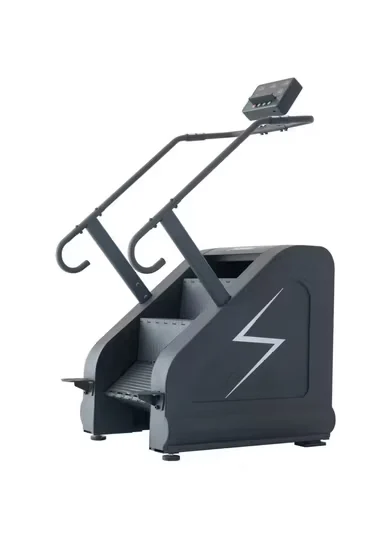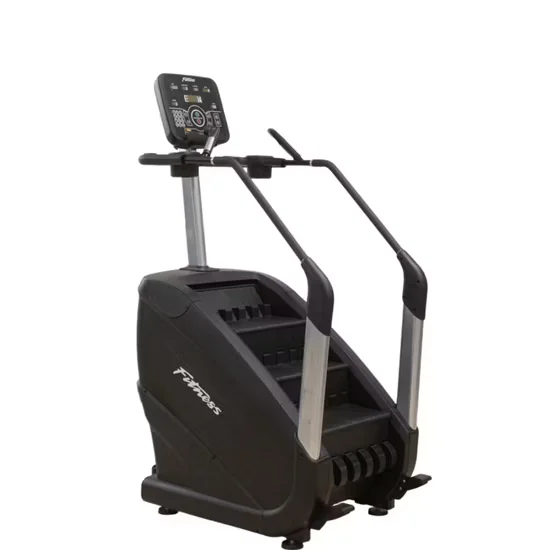
Acoustic Engineering for Vertical Cardio — Sealed mechanical drive path and motor-controlled stepping verified under continuous hotel deployment to keep guest-floor noise complaints at bay.
Technical Specifications
| Parameter | Value |
|---|---|
| Product Type | Stair Climber |
| Drive Type | Motor Drive |
| Running Velocity | 15 steps/Minute – 164 steps/Minute |
| Step Area | 560 × 240 × 200 mm |
| Console Display (OSD) | Time, Climb, Calories, Steps, Heart Rate |
| Power Requirement | AC220V±10% / AC110V±10% |
| Material | Steel Pipe + PP Plastic |
| Product Dimensions | 1400 × 700 × 2000 mm |
| Net Weight | 148 kg |
| Folded | Unfolded |
| Certification | CE, RoHS, ISO |
| Color | Black (Customizable) |
Application Suitability
| Deployment Scenario | Typical Use |
|---|---|
| Hotel fitness center on guest room floors | 24-hour access cardio with noise-sensitive placement above occupied rooms |
| Chain gym cardio zone | High-frequency stepping stations complementing treadmills and ellipticals |
| Corporate wellness room | Compact vertical footprint fitting limited square footage with visible workout metrics |
| High-end residential home gym | Commercial-grade stepper deployed where durability expectations exceed consumer units |
| Sports performance training center | Athlete conditioning with controlled step-rate progression and heart-rate feedback |
Why Continuous-Duty Motor Sizing Matters More Than Peak Labels
A motor rated only for peak output will overheat and shut down during back-to-back peak-hour sessions, while a continuous-duty motor sustains thermal stability across the full operating window.
Facilities that specify home-grade steppers for commercial zones learn this lesson the hard way: motors thermally trip mid-session, maintenance calls spike, and members migrate to equipment that stays online. On upper hotel floors, a motor struggling under load also generates audible vibration that travels through floor slabs [NEED_CITE: motor duty cycle classification for continuous commercial operation]. The commercial stair climber motor drive in this unit is sized for sustained stepping cadences without thermal derating, so the step rate holds steady from warm-up through high-intensity intervals without mechanical hesitation.
Where a Stair Climber Fits in the Cardio Zone Layout
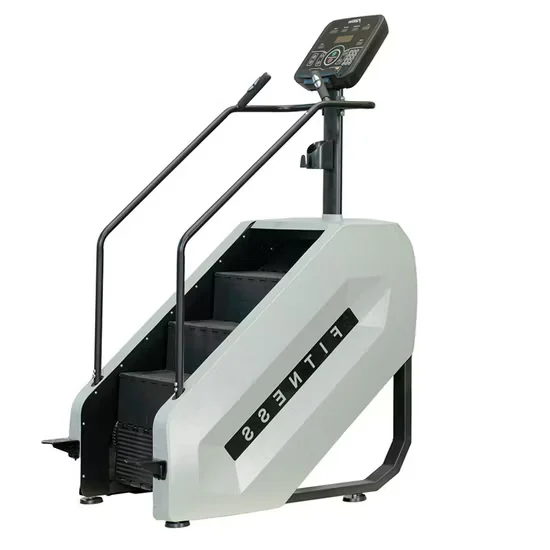
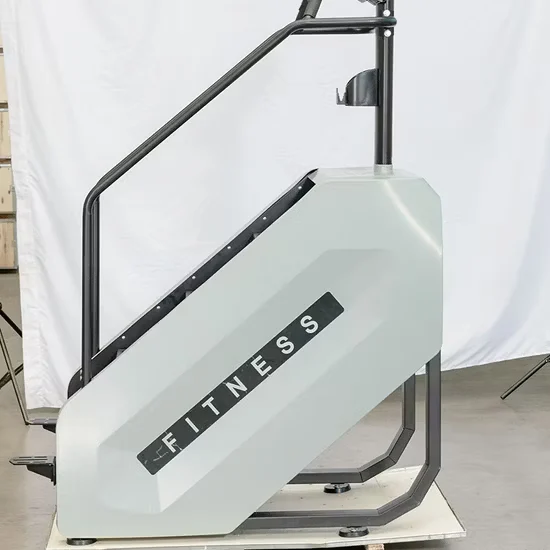
This machine fills the high-calorie, lower-body dominant station that treadmills and ellipticals cannot fully replicate. It covers step rates from 15 to 164 steps per minute, accommodating slow recovery cadences and aggressive interval work on the same unit. In a mixed cardio zone, it pairs well beside rowing machines for full-body rotation programming and near ellipticals for members who need a zero-impact alternative with comparable cardiovascular demand. The 1400 × 700 mm footprint requires overhead clearance for the 2000 mm height, and the commercial stair climber motor drive architecture keeps the unit stationary once placed. It accommodates a wide range of user statures given the continuous step surface.
Deployment Considerations for Continuous Operation and Building Integration
A stair climber running eight or more hours daily demands attention to thermal dissipation around the motor housing and adequate spacing between units for airflow. On hotel guest floors, vibration transmission through the floor slab is a primary concern — isolation pads beneath the steel frame reduce structure-borne noise traveling to rooms below [NEED_CITE: vibration transmission standards for fitness equipment on suspended floors]. The dual-voltage input (AC220V±10% / AC110V±10%) eliminates the need for external transformers, but plug configuration must match the destination market before the unit ships. Console data output should be verified against any facility management software in use so that session metrics do not remain stranded on the display.
Reading the Drive and Control Specifications
The motor-drive architecture here replaces the manual or hydraulic resistance found in consumer steppers with a continuously powered stepping surface. Unlike magnetic resistance systems that depend on user input to generate load, a motor drive maintains a set cadence regardless of whether the user pushes hard or lightly — the motor does the pacing. The console OSD surfaces time, climb, calories, steps, and heart rate, giving real-time feedback without requiring a connected device. Heart rate input arrives through the handlebar sensors, which are adequate for steady-state monitoring but less precise than chest-strap telemetry during rapid interval transitions. The step area of 560 × 240 mm provides sufficient surface for most foot sizes while keeping the overall frame width manageable for dense cardio zone layouts.
The Hidden Cost of Underspecifying Stepping Equipment
Procurement teams who substitute light-duty steppers into commercial environments encounter a predictable failure cascade: motors burn out within months under continuous run-times, step mechanisms develop play that creates noise complaints, and consoles that cannot export data leave operators blind to utilization patterns [NEED_CITE: premature motor failure rates in light-commercial equipment deployed in 24/7 facilities]. Voltage mismatches discovered after container arrival force costly transformer retrofits or return shipments. Each of these failures traces back to a specification that was checked on paper but never validated against the actual deployment environment.
Why This Product Line for Your Facility
Every unit ships after completing durability testing on the motor, frame, and bearings — a protocol developed through fifteen years of cardio equipment engineering and refined after real-world deployment feedback from hotel and gym operators. The sub-35dB operating target guides acoustic validation so that units placed on guest floors do not generate complaints. The console supports OEM customization including UI branding for chains that want a unified member-facing interface across all cardio stations. Free 3D cardio-zone layout planning covers this unit’s overhead clearance, front-entry spacing, and airflow requirements so that the stepping zone performs as intended rather than becoming an underused corner. Technical support runs 24/7 with spare parts logistics from the Shandong manufacturing base.
Documentation & Test Records
- CE declaration of conformity covering mechanical and electrical safety for this stair climber
- EN 957 test report validating structural integrity and stepping mechanism durability
- ISO 9001 certificate for the manufacturing quality management system
- Noise level test report documenting acoustic output under loaded stepping conditions
- Durability test record for motor, bearings, and step mechanism under continuous operation
- Console technical documentation with OSD parameter descriptions and data output details
Installation, Commissioning & Maintenance
- Maintain minimum clearance around the 1400 × 700 mm footprint for safe mounting and dismounting
- Level the steel frame on isolation pads to prevent structure-borne vibration on upper floors
- Confirm AC220V or AC110V circuit capacity and dedicated breaker before first power-on
- Calibrate stepping speed range and verify all OSD parameters during commissioning
- Inspect step mechanism and drive components at scheduled intervals per the maintenance guide
- Wipe handlebar heart-rate sensors and console screen daily to prevent sweat corrosion
Requesting the Right Configuration for Your Project
Provide the cardio zone dimensions, ceiling height, and target unit count to receive a 3D layout with airflow and sightline planning. Specify the expected daily run-time so the motor duty cycle is matched to actual usage patterns. Confirm the deployment floor and adjacent room types to validate acoustic suitability. State the destination market voltage and plug standard to prevent post-arrival electrical mismatches. Indicate whether console data needs to interface with existing facility management platforms.
Frequently Asked Questions
Q: How does a motor-drive stair climber compare to manual vertical climbers for commercial use?
A: A motor-drive system maintains a consistent stepping cadence regardless of user effort, eliminating the uneven pace and mechanical stalling common in manual climbers under heavy use. This consistency supports structured interval programming and reduces maintenance calls related to linkage wear. For facilities running equipment throughout operating hours, motor-driven units sustain performance across successive users without the warm-up variability of self-powered alternatives.
Q: What is the difference between continuous-duty and peak motor ratings in gym environments?
A: Peak ratings describe the maximum output a motor can deliver for short bursts, while continuous-duty ratings reflect sustained thermal stability over hours of operation. Gym environments with back-to-back users demand continuous-duty performance because the motor never fully cools between sessions. Selecting equipment based only on peak ratings risks thermal shutdowns during peak hours, leaving members waiting for machines to reset.
Q: Can the console data be exported or synced with gym management platforms?
A: The console OSD tracks time, climb, calories, steps, and heart rate in real time. Data export capability depends on the console configuration selected at order — OEM customization can include data output formatting compatible with facility management systems. Confirm your platform’s required protocol during the specification phase so the integration is built into the console firmware before production begins.
Q: What noise level should be expected when placing this unit on hotel guest floors?
A: Motor-driven stepping with sealed mechanical components keeps operational noise within acceptable thresholds for noise-sensitive environments. Actual perceived noise depends on floor construction, isolation padding, and adjacent room occupancy patterns. Request the noise level test report for this unit and share it with your acoustical consultant to confirm suitability for the specific floor assembly where deployment is planned.
Q: What voltage and plug standards are available, and how are mismatches avoided?
A: The unit supports AC220V±10% and AC110V±10% input, covering most international markets. Plug configuration must be confirmed before production to match the destination country’s standard. The sales process includes a voltage and plug verification step during proforma invoice review, preventing the costly discovery of mismatched connectors after the shipment has already arrived at the facility.
![Commercial Stair Climber Machine for Effective Fat Burning [WARN] draft identifier mismatch](https://bicksport.com/wp-content/uploads/2026/08/commercial-stair-climber-machine-for-effective-fat-burning-warn-draft-identifier-mismatch-3274be.webp)