
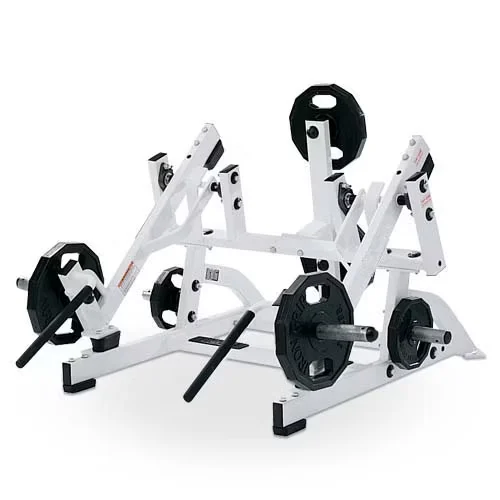
Reinforced Steel Frame Engineering — Structural joints tested for continuous high-frequency cyclic loading in 24/7 commercial gym environments.
Technical Specifications
| Parameter | Value |
|---|---|
| Product Type | Strength Machine (Squat High Pull) |
| Model NO. | 5043 |
| Exercise Part | Arm, Hip, Chest, Leg |
| Frame Material | Steel |
| Product Dimensions | 1650 × 1150 × 1050 mm |
| Net Weight | 99 kg |
| Max User Weight | 180 kg |
| Certification | ISO 9001, CE |
| Appliance | Gymnasium |
| Age Group | Adult |
| Gender | Unisex |
| Transport Package | Plywood |
| Production Capacity | 500 pieces per month |
Application Suitability
| Deployment Scenario | Typical Use |
|---|---|
| Chain gym strength training zone | High-frequency compound movement stations for member self-service |
| Corporate wellness center | Full-body resistance training for diverse employee demographics |
| Hotel fitness room | Space-efficient strength equipment alongside cardio arrays |
| Sports performance training center | Athlete-grade squat and high pull programming under coached supervision |
| Community fitness facility | Durable multi-joint equipment for unsupervised public access |
Why Frame Flex Becomes a Maintenance Headache Before Members Even Notice
Reinforced structural joints resist deformation across repeated squat-to-pull transitions.
Strength machines in high-traffic facilities absorb thousands of loading cycles weekly, and the pivot points where squat and high pull movements intersect face compounding lateral stress. When the frame flexes under load, members sense instability before they can articulate the problem — they simply stop using that station. Facility operators then face a choice between costly frame replacements or watching the equipment gather dust [NEED_CITE: structural fatigue patterns in commercial strength equipment]. The commercial squat high pull machine gym equipment addresses this through reinforced steel construction and sealed bearing systems at every pivot junction.
Positioning Within the Strength Training Zone
This unit covers compound lower-body and upper-body pulling patterns, bridging squat racks and cable stations in a single footprint. In a commercial layout, it complements isolated leg press and lat pulldown machines by offering a free-motion compound alternative that trained members gravitate toward during peak hours. The 1650 × 1150 mm footprint fits within standard strength zone aisle spacing, allowing deployment along perimeter walls or as an island station between plate-loaded and selectorized rows. It accommodates users across a broad height and weight range, with the 180 kg maximum user capacity aligning with commercial facility standards for unsupervised strength areas.
Continuous Operation and Floor-Level Deployment Considerations
At 99 kg net weight, the unit requires a level concrete subfloor with minimal deflection to prevent frame racking during heavy squat loading. Facilities deploying this commercial squat high pull machine gym equipment on elevated floors should verify structural load ratings and consider vibration-dampening rubber mats beneath the base plates [NEED_CITE: floor loading requirements for commercial strength equipment]. Adequate clearance on all four sides — particularly behind the pull path — ensures member safety during explosive high pull repetitions. Ventilation is less critical than with motorized cardio units, but ambient temperature and humidity still affect upholstery longevity and grip surface integrity over extended operating cycles.
How the Multi-Joint Pivot System Transfers Load
The sealed bearing assemblies at each pivot point manage the transition between vertical squat force and the angled pull trajectory, preventing the lateral play that causes squeaking and eventual joint looseness. Steel frame thickness and gusset placement at the base-to-upright junction distribute concentrated loads across a wider structural area rather than concentrating stress at single weld points. Multi-grip handles allow members to adjust hand position for different pull angles, which in turn changes the force vector the frame must absorb. Commercial-grade upholstery on contact surfaces is rated for repeated sanitation cycles without cracking or delamination, a frequent failure point on equipment specified without facility cleaning protocols in mind.
The Hidden Cost of Underspecified Frames in Commercial Settings
Facilities that select strength equipment based on upfront cost rather than cyclic loading ratings often discover frame fatigue within the first year of continuous operation. Pivot points develop play, creating audible clicking that members interpret as structural failure — even when the frame itself remains intact. This perception drives station avoidance, leaving equipment underutilized while adjacent machines see disproportionate wear. In worst cases, frame deformation under repeated off-axis loading forces operators into unplanned capital replacement cycles, disrupting training programming and member retention [NEED_CITE: premature replacement costs from underspecified commercial strength frames].
Why This Product Line Meets Deployment Standards
Every unit in this series undergoes cyclic loading verification at pivot points and weld junctions before shipment, documenting structural performance under simulated high-frequency use. The 10,000-hour durability testing protocol extends beyond frame integrity to include grip surface wear and upholstery adhesion under repeated sanitation. OEM customization covers frame color, upholstery material, and grip configuration to match facility branding without compromising structural specifications. Biketon Sport’s engineering team provides 3D strength zone layouts that account for this unit’s footprint, pull-path clearance, and member flow patterns relative to adjacent equipment — ensuring the station integrates into traffic patterns rather than obstructing them. Full technical documentation accompanies each deployment, and 24/7 support addresses alignment or calibration questions as they arise.
Documentation & Test Records
- CE declaration of conformity for strength training equipment
- EN 957 test report covering structural and safety requirements
- ISO 9001 certificate for manufacturing quality management
- Frame cyclic loading and durability test records
- Upholstery and grip material specification sheets
- Installation and commissioning guide with spare parts list
Installation, Commissioning & Maintenance
- Verify 1650 × 1150 mm footprint with minimum 600 mm clearance on all sides before anchoring
- Level concrete subfloor and place vibration-dampening mats beneath base plates
- Inspect sealed bearing pivot points for smooth articulation during initial commissioning
- Schedule quarterly pivot bearing inspection and re-greasing per maintenance documentation
- Clean grip surfaces and upholstery with approved commercial disinfectants only
- Check frame gusset welds for stress indicators during biannual structural audits
Preparing Your Facility Inquiry
Provide your strength zone floor area and existing equipment list to receive a 3D layout that positions this unit within member traffic patterns and pull-path clearances. Specify anticipated daily usage volume so bearing and pivot specifications can be matched to your facility’s operational tempo. Confirm your deployment floor level and adjacent occupied spaces to determine whether supplemental vibration isolation is required. Note any branding or upholstery color requirements for OEM customization scoping.
Frequently Asked Questions
Q: How does frame construction affect long-term durability in commercial environments?
A: Reinforced steel frames with gusseted junctions distribute concentrated loads across wider structural areas, preventing the localized stress concentrations that cause fatigue cracking. Sealed bearing pivot points eliminate metal-on-metal wear at movement junctions, maintaining smooth articulation through thousands of loading cycles. This construction approach directly determines whether a unit survives continuous high-frequency use or requires premature replacement.
Q: What maintenance is required for pivot points and bearing systems?
A: Sealed bearings require periodic visual inspection for play or roughness during articulation, with re-greasing scheduled according to facility usage volume. High-traffic installations benefit from quarterly checks, while moderate-use environments can extend to semiannual intervals. Prompt replacement of any bearing showing lateral play prevents accelerated wear on adjacent structural components and maintains user confidence in equipment stability.
Q: Can this equipment support high-frequency use in 24/7 gym operations?
A: The unit is engineered for continuous commercial duty cycles, with frame and pivot components tested under simulated high-frequency loading protocols. Facilities operating around the clock should specify bearing service intervals matched to their actual usage volume and ensure floor-level deployment with adequate vibration isolation. Structural performance documentation is provided to support facility maintenance scheduling.
Q: How does the multi-grip design enhance training versatility within limited space?
A: Multiple grip positions allow members to adjust pull angles for different muscle engagement patterns, effectively providing several exercise variations from a single station. This reduces the total number of dedicated machines required in a strength zone, freeing floor area for additional equipment types. The compact footprint combined with multi-movement capability makes it particularly suitable for facilities optimizing equipment density without sacrificing training variety.
![Commercial Plate Loaded Bench Press Gym Equipment [WARN] draft identifier mismatch](https://bicksport.com/wp-content/uploads/2026/08/commercial-plate-loaded-bench-press-gym-equipment-warn-draft-identifier-mismatch-2572b3.webp)
![Plate Loaded Hammer Strength PRO Tackler Machine for Commercial Gym [WARN] draft identifier mismatch](https://bicksport.com/wp-content/uploads/2026/08/plate-loaded-hammer-strength-pro-tackler-machine-for-commercial-gym-warn-draft-identifier-mismatch-36dfe6.webp)
